
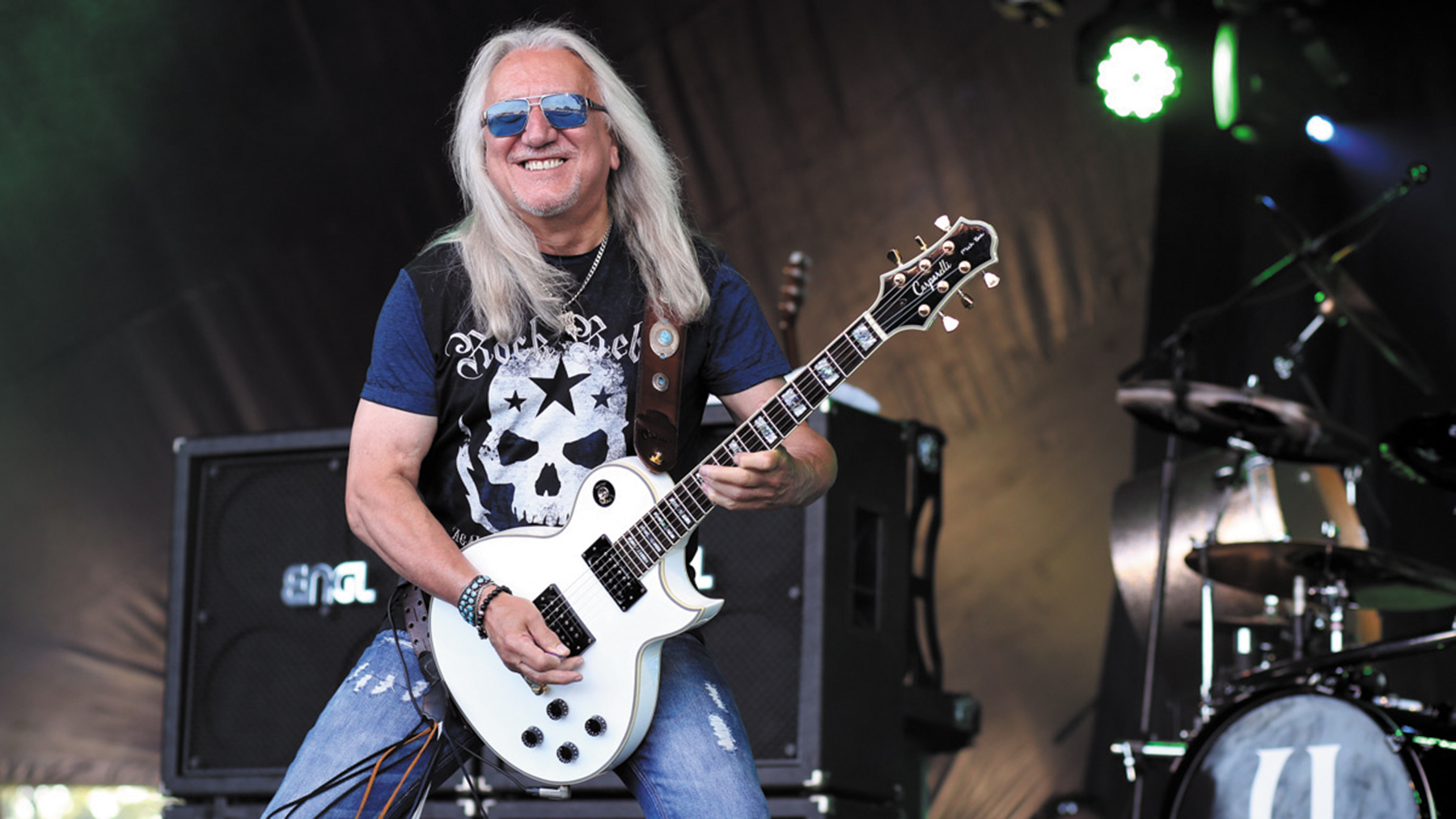
Reckless in his youth but vibrant as he ages, one iconic rocker tells THEO PANAYIDES about his lucky timing and how he has weathered 50 years on the road, being marked this year by 50 concerts across Europe, including Cyprus
The screen comes to life on our Zoom call, and Mick Box whoops with joy. We actually make two consecutive calls (Zoom has a 40-minute limit nowadays), and he whoops with joy both times. “Hello, my friend!” he calls out genially, sitting in a rather bare-looking hotel room in soothing shades of beige.
Maybe it’s a kind of childlike glee at a connection being made, maybe just natural exuberance. Maybe it’s because he’s in Hamburg, on the first day of a German tour – celebrating the 50th anniversary of rock band Uriah Heep – that’ll actually stretch till mid-December and well beyond Germany, including two gigs in Cyprus this coming week: Limassol on Tuesday, Nicosia on Thursday. Or maybe he’s just a happy rock star with much to be grateful for. “When I was born,” he muses, looking quite rock’n roll with his long hair and shades, “I won the lottery.”
That was in June 1947, meaning he celebrated three quarters of a century this year – and he’s been a musician all his adult life (the only other plan, back in his teens, was becoming a footballer), but above all he’s been lucky with the timing. He was in London in the late 60s and 70s, “which was just so vibrant, so creative”. He was part of a rock wave with the likes of Black Sabbath and Led Zeppelin, bell-bottomed rebels going “louder, bigger, better”. He was there for the crazy times, the parties and binges – but he also survived, which not everyone did (more on this later), and survived into an era when old rockers can continue to rock, not just fade away into irrelevance. He was lucky enough to be young when it meant something, and lucky enough to be old when it means next to nothing.
The day after our interview, for instance, the current incarnation of Heep – he’s the last surviving founder member – will travel from Hamburg to Germersheim for a one-off concert with fellow classic-rock veterans Status Quo and Nazareth. Mick is friendly with 73-year-old Francis Rossi of Quo – “We’re always communicating on email” – and 76-year-old Pete Agnew of Nazareth, yet meeting up with his fellow rock-star boomers doesn’t seem like a big deal, which only goes to show how common it is. They performed in Finland with Deep Purple recently, and of course it was great “to see Roger again, and Ian Gillan and Ian Paice, and all the other guys,” recounts Mick in his east London accent. “We’re givin’ each other a big hug. But then – y’know, they’re not waitin’ around for us, we’re not waitin’ around for them”. The bands play separate sets, and often have an eight-hour trip to the next gig the next day. “So it’s kind of ships passing in the night, if you like.”
There’s a professionalism, a mutual respect. There’s also the simple fact that everyone’s older. Not that they’re coasting on past glories, necessarily; Heep never stopped writing music, and in fact have a brand new album “in the can,” as Mick puts it.
Still, the sight – even just the concept – of grizzled musicians in their 70s getting up on stage to play rock music, songs with their roots in the reckless energy of youth, has a weird disconnect; it transcends time. If you ever spent a Saturday night at Scorpios in Nicosia as a teenager you’ll appreciate the nostalgia hit of hearing ‘Lady in Black’ wafting from the stage of the Strovolos Municipal Theatre (if the title seems unfamiliar, look it up; trust me, you’ll recognise it); the music is forever young – yet the people grow old, inevitably. “When we meet up with Alice Cooper there’s big hugs all round,” says Mick – but of course “it tends to be backstage with a cup of tea, rather than in a bar,” he adds with a laugh. “I mean, Alice hasn’t touched a drop for years.”
What do they talk about?
“If you want to talk to Alice Cooper about anything, you talk about golf, and he’ll talk your ears off. He’s a great golfer. He’s a fantastic golfer… But y’know, that’s where people are now,” he shrugs, possibly noting a trace of disappointment in my expression. “All those people that are still around have tempered their lifestyle, so they can continue to do what they passionately love.”
Talk of the people ‘that are still around’ comes with an edge, in these circles. Uriah Heep’s classic line-up in the early 1970s (Mick himself was always the lead guitarist) included bassist Gary Thain and flamboyant singer David Byron; Thain died of a heroin overdose in 1975, at the age of 27, while Byron, one of the original founder members, was fired in 1976 after his drinking became unmanageable and died nine years later, at 38, of “alcohol-related complications including liver disease and seizures,” according to Wikipedia. Mick has seen plenty of tragedy, and been through some rough patches himself. “I locked myself in my flat for two days and drank myself senseless in complete self-pity,” goes one of his quotes on the Heep website – referring to the nadir in the early 80s when the band essentially disintegrated after the Conquest album, leaving him to try and resurrect it.
He lived that life too, right? The hard-partying rock’n roll life, back in the 70s?
“Oh yeah!” he replies, laughing heartily again. (He laughs a lot; he’s extremely good company.) “Yeah, 100 per cent. 100 per cent. Full on! Everything you’ve read was true – and more!
“But I always had an in-bred mechanism,” he muses thoughtfully. “I’m not sure if it’s because of my upbringing – comin’ from the East End of London, where it was a tough upbringing – and comin’ out of the war, or whatever it was. But I’ve always been able to keep my feet on the ground. I never believed the success, while other people did – I always thought it was something that would come and go… And I could always leave my ego onstage and come back and be just Mick in the dressing room – or Mick at the pub, or Mick walking down the street. Others couldn’t. And I think that’s been the saving grace, for me.
“And apart from that – even in the hard-drinking times – I would always take three months off, or six months off or whatever. It was just something in me that said ‘What am I doing this for? Stop!’. And I would just stop.”
Maybe he just doesn’t have an addictive personality, I venture.
“Yeah, I was just lucky with that. It’s not anything that I manufactured, it was just born in me. I think that’s one of the –” he pauses, and corrects himself – “or the main reason why I’m still here.”
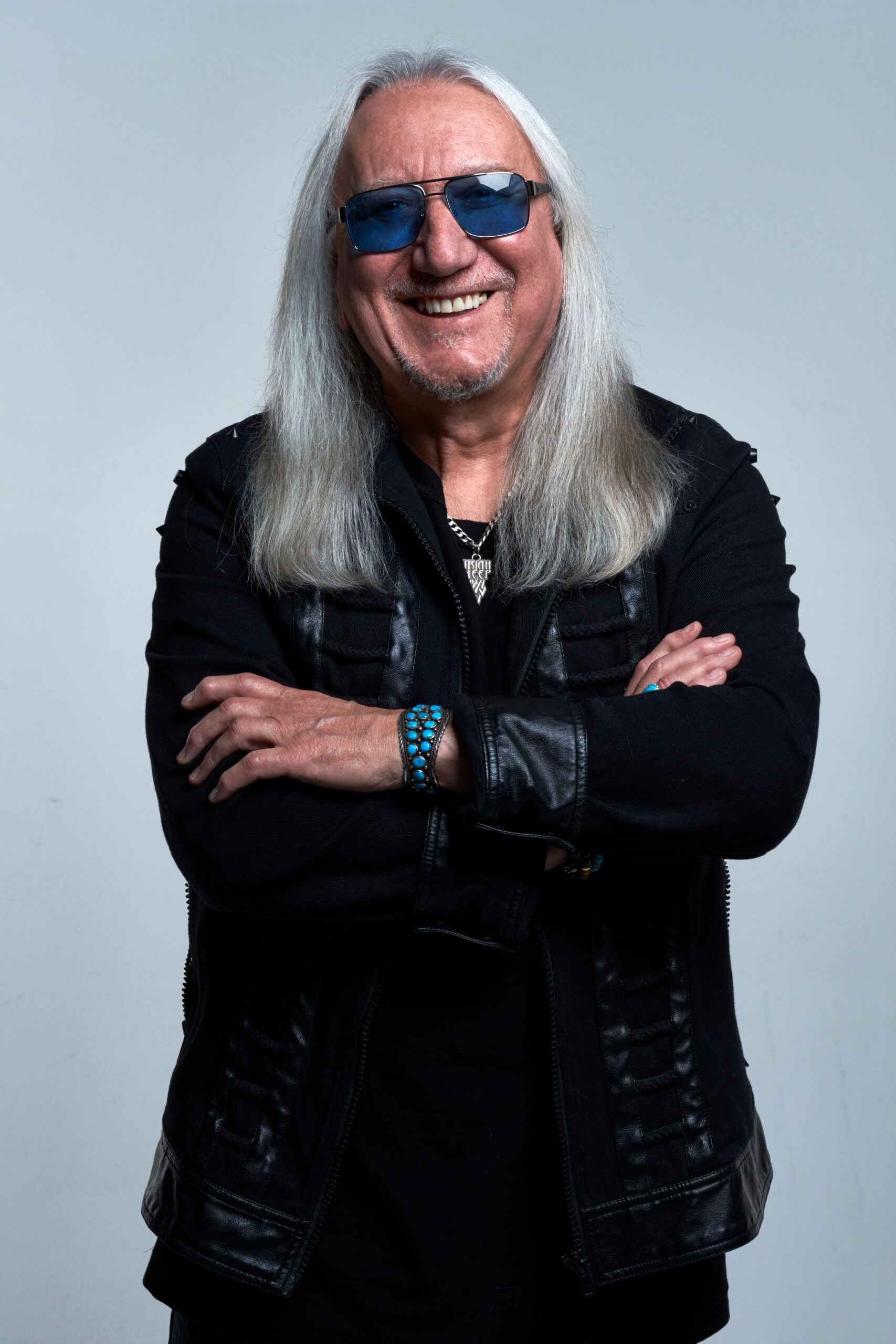
Mick Box has been leading Uriah Heep for 50 years
Does he have any regrets, looking back?
“I don’t regret anything personally. But I do regret that there was no – in the days when – in the crazy days – that there wasn’t any place for people to go and get help”. Also, he adds, growing sombre – and “I’m going to talk specifically about David Byron and Gary Thane… If the management had not been so short-sighted, and we’d come off the road and addressed the problems, I think we may have had a different outcome”.
Heep recorded an incredible 10 albums in seven years, 1971-77, meanwhile also touring for nine months a year. “We were pushing so hard,” recalls Mick; it was clear – had someone only bothered to intervene – that the wheels were about to fall off. His own marriage collapsed in those years, unable to bear the strain. (He has a 44-year-old son by that first marriage and another son, 21-year-old Romeo, from his second marriage; the older son is a drummer, Romeo an aspiring rapper.) It was obviously insane to be burning out so recklessly, fuelled by drink and drugs – then again, those were crazy times in general. “When people point the finger at bands doing drugs – I mean, the entire industry were doing it! You were an outcast if you didn’t do it… Accountants, lawyers did it, everyone.”
The irony, of course, is that everyone was living so fast because fame was perceived as being fleeting, like youth. “Hope I die before I get old,” sang The Who in ‘My Generation’, getting old being viewed as inert and pointless, the ultimate failure – but then the world changed and ‘his’ generation became the lucky ones, able to be reckless and rebellious in youth and (assuming they survived) still vibrant in old age.
“It’s amazing,” laughs Mick. “If you’d told me [back then] I’d be looking at 50 shows this year, to celebrate the 50th anniversary at the age of 75, I wouldn’t have believed you.” The tour sounds punishing, the two nights in Cyprus followed by nine shows in 11 days in the UK (one of them, a big celebration in Gateshead, features two different sets, an acoustic one followed by an electric one), then Holland, Belgium, France, Switzerland and just about every European country in the two months to December. How does he do it? “I think, over the years, you tend to either – um, buckle down… or you can go the other route, which is not a pleasant one! So we choose to keep fit, eat correctly, get the right amount of sleep. Because we know that once we finish this show we’re on to the next show, and the next show.”
It’s not much fun, in the old sense of fun – especially now with Covid, which pretty much rules out meeting fans after the show. “We have to kind of stay in a bubble,” sighs Mick, which is sad (he loves “the social side”) but they can’t risk being forced to cancel shows if someone gets sick. It’s going to be two months of bus rides, sound checks, playing music, then back to the hotel room for eight hours’ sleep. Still, let’s not pretend this is just a normal life for a 75-year-old.
“I think the essence of what we do keeps you young,” he explains. “Your mind’s always active, you’re always writin’ songs, performin’. Communicating with people… All those things come into play, they keep you young.”
Doesn’t he miss the fun and games of actually being young, though?
“It’s not like I haven’t done enough of that in my life!” he replies, creasing up with laughter again. “So I’m not missing anything, no. In fact, here we are with a cup of tea, look!” He extends his hand, brings a mug into the Zoom frame and takes a long swig. “I love a cup of tea, mate. It’s my lifeblood. If I didn’t ’ave a cup of tea, my mother would roll in her grave.”
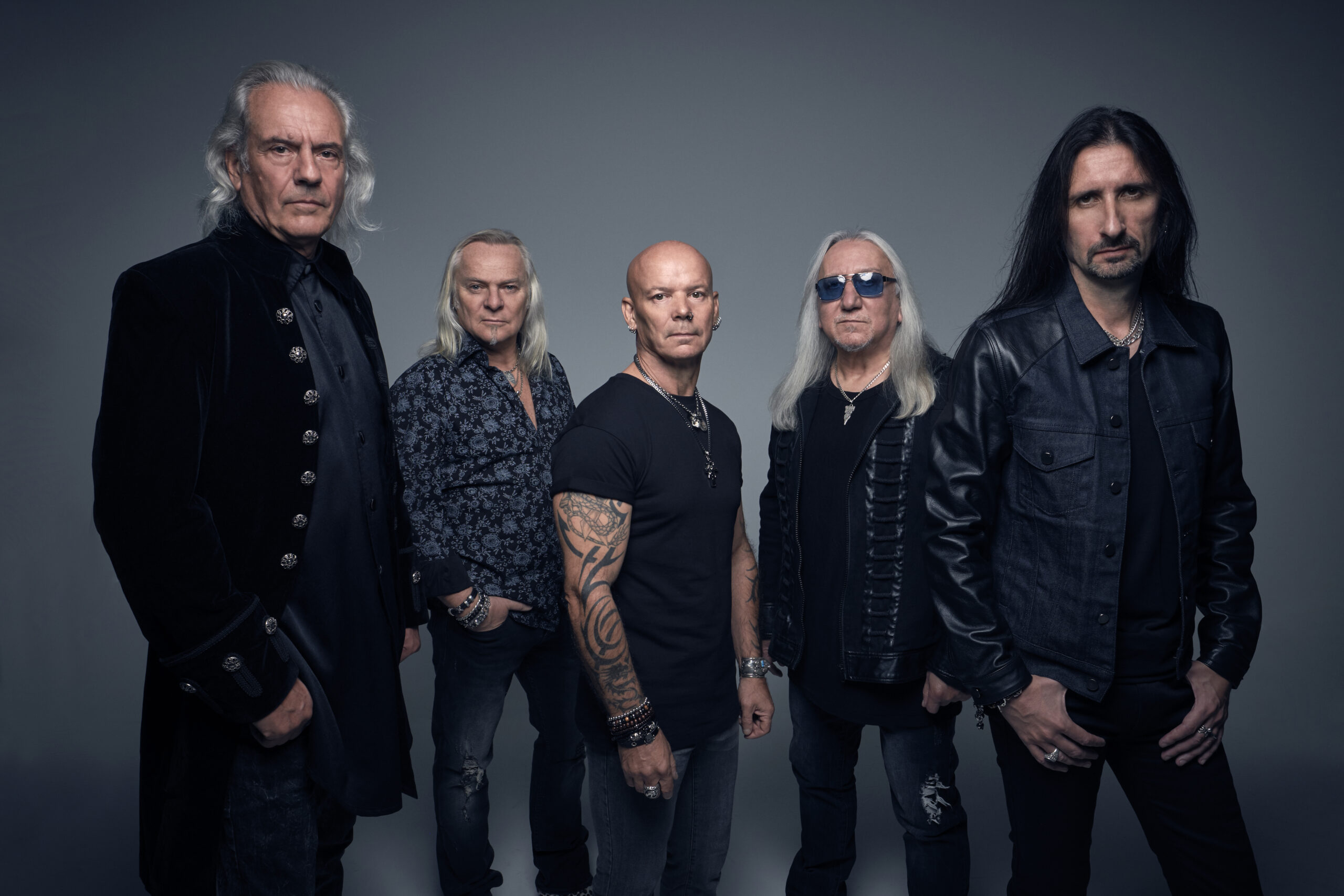
The current Uriah Heep line-up
Mick Box has a right, all things considered, to be whooping with joy. Some might even say he’s led a charmed life. He had a happy childhood, raised by his mum (she was “a darling”) after the death of his father. He and David Byron formed a band called Spice in 1967, which became Uriah Heep – named for the Dickens character – three years later. He became successful in his 20s, and remains successful 50 years later. He writes songs (or bits of songs) every day, his creativity always in full flow; “I’m one of those people that just can’t stop.” Yes – but it’s also true that his childhood was deprived, that his mum had very little money, that success came at a price, that he lost good friends along the way. It’s actually been quite a turbulent life; but, as he says, “I look to the positive all the time”.
That, in the end, may be what allowed him to survive – that tendency to look to the positive, coupled with a certain low-key philosophical spirit. He believes in “a fickle finger of fate that guides you through these avenues,” says Mick with a deep chuckle, though he won’t be drawn when I ask about the cross around his neck. (It’s just “an iconic piece of jewellery. I have my own beliefs, which I keep to myself… I’m very spiritual.”) Uriah Heep are iconic as well – and have also been his cross to bear occasionally, though he wouldn’t have it any other way. Has he changed much, over the years? Does he still recognise himself from five decades ago, that young guitarist with stars in his eyes?
Mick leans forward, as if straining to understand the question. “’Course I recognise him, yeah!” he replies at last, laughing delightedly. “Same person. Same person! I ain’t changed, no. Don’t wanna change, no, no.” He shrugs, with the air of a man arriving at a fundamental truth: “I mean, success can come and go – but as long as I’m playing music, I’m a happy man”. 50 years, and still going strong.




Click here to change your cookie preferences