
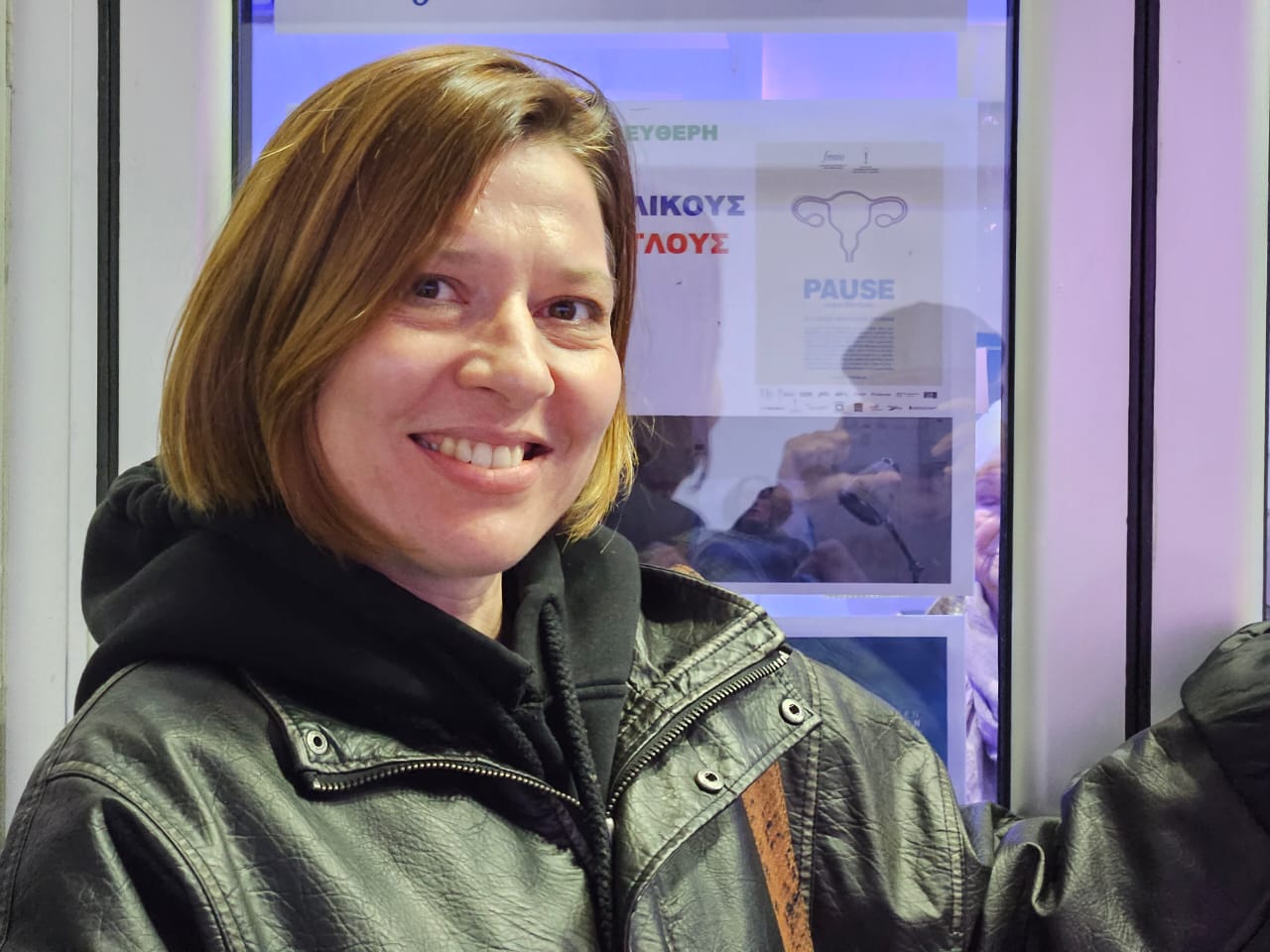
A well-known Ukrainian actress in Cyprus recently says her craft is not about aesthetics but ethics, but what is the role of art during wartime?
Oksana Cherkashyna tells a story about death. Actually a near-death experience, an account of being on a plane that developed ‘technical problems’ during landing – a polite way of saying they were probably going to crash. Panic erupted, people around her screaming and praying.
Oksana is a person with her fair share of fears. (She can’t stand the sight of blood, for instance.) On this occasion, though, faced with the very real prospect of death, she felt no fear at all, she reports, slightly perplexed by her own reaction. “If I die, I want to open the door to eternity with my leg!” she recalls herself thinking – a Ukrainian phrase meaning “like a boss”, she explains, and karate-kicks the air as we walk down a Nicosia street to illustrate her point.
Maybe her profession had something to do with it. 37-year-old Oksana, after all, is among the best-known film and (especially) theatre actors in Ukraine – and acting is famously a case of discovering nerves of steel when the curtain goes up and it’s suddenly showtime.
Then again, the story is appropriate in another way too – because death, and the prospect of death, underlies our whole conversation, intertwined with the “genocide” being perpetrated since 2022 on the people of Ukraine.
She herself was in Poland four years ago, when war broke out, having been invited a year earlier “to become part of the ensemble of one of the most – uh, prestigious Warsaw theatres,” she recounts in accented English. “I was the first Ukrainian ever to be invited to an ensemble of a European theatre.”
The contract was for four years, but she’s still in Warsaw now – though she goes back often, to Kyiv and her hometown of Kharkiv where her parents live. Alas, Oksana’s own flat in Kharkiv is in a block that’s been struck by missiles three times already, so she’ll probably be staying in Poland a while longer.
But she’s been in missile attacks. Can you actually hear a missile coming?
No, she replies. You can hear a drone (Russian attacks usually start with an onslaught of hundreds of drones), it makes “a very specific sound… It’s like ‘krr, krr’” – but a missile comes so fast it’ll hit you before you know it. That’s why it’s important to seek shelter at once – though most people don’t, especially the elderly and especially in winter.
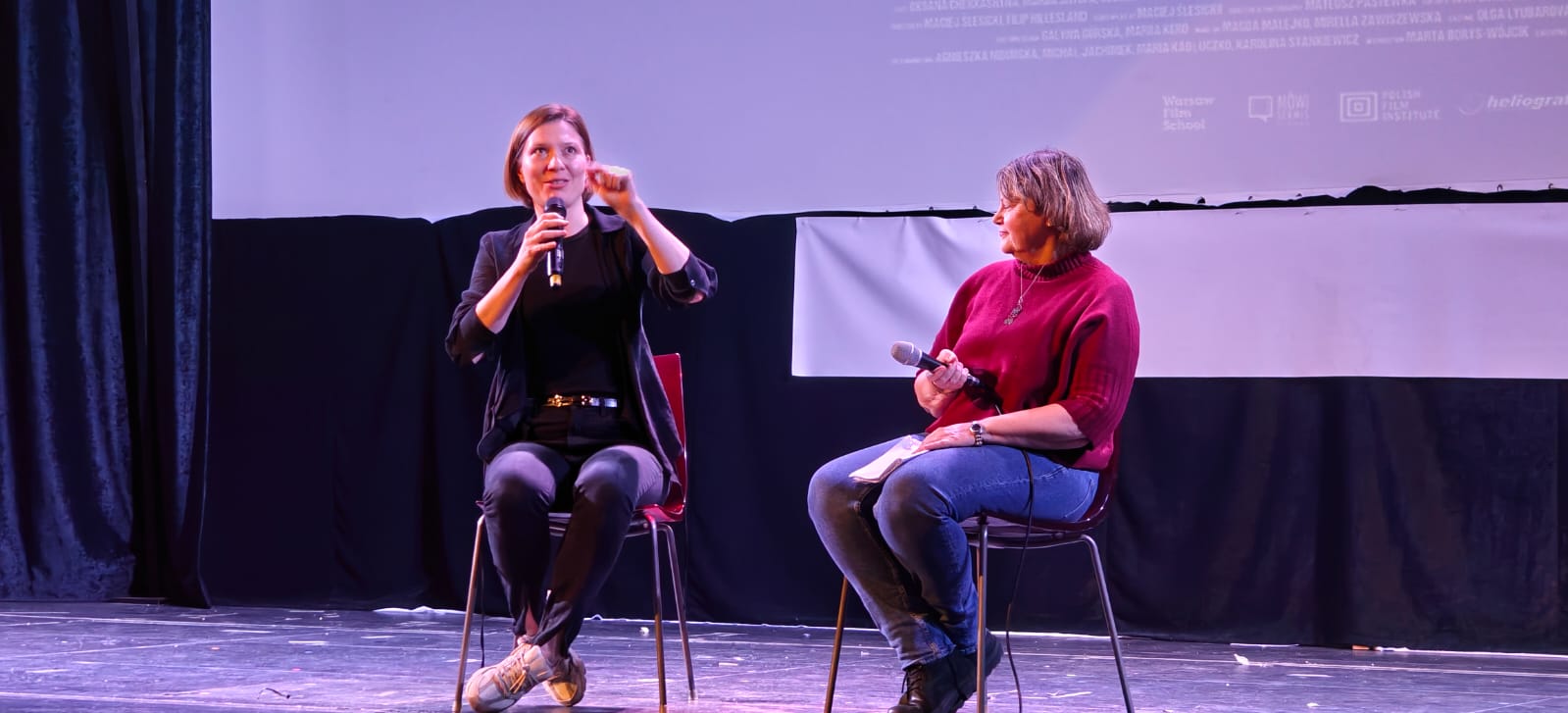
“The truth is that when I was in Kyiv in summer, shooting my new movie for two months there, I was every night in the shelter. Because it’s summer, and it’s warm. But in January” – she means this year, when Ukraine’s energy grid was repeatedly targeted – “no power on Earth could make me get out from my bed”.
Even the prospect of death?
Oksana shrugs: “It’s impossible”. It was “minus-four degrees in flats, no water, no electricity”. People swaddled themselves in blankets, put on layers of clothes and tried to help those who couldn’t cope – an old person, say, or a mother with a toddler, forced to walk up 10 flights of stairs because the elevator wasn’t working. Getting up at night, in the bitter cold, to head to a shelter, was just too daunting, most stayed in bed and took their chances – not to mention that the shelters (except for a few metro stations) were freezing-cold too.
“This also was a genocide,” she sighs, shaking her head. “I am sorry for using this word for the second time in this interview, but when I was in Kyiv I was like – I was in shock… This winter was a humanitarian catastrophe.”
How do people in Ukraine feel right now?
“People are exhausted,” she replies with a touch of asperity. “Come on, it’s like 12 years of war and four years of this – uh, very active war. People are tired. People are exhausted.”
She herself has been deeply shaken, undergoing what she calls an “inner crisis”. Inner life is every actor’s hallmark, of course – but Oksana’s seems to be especially meaningful.
Some actors like to be flamboyant, sporting noisy laughs and dramatic gestures – but she’s thoughtful (a mutual friend calls her “soulful”), sipping herbal tea as we sit in a café an hour before her presentation. She’s always been an actress, never out of work since being hired by a state theatre in Kharkiv right after graduation – and her biggest strength, I suspect, lies in authenticity, creating an “inner personality” for the characters she plays.
At one point she says something that could probably serve as shorthand for her whole philosophy: “Acting is not about aesthetics. Acting is about ethics”.
The onset of war was a shock for everyone – but it’s no surprise, given that particular philosophy, that it led Oksana to a moral crossroads. “At the beginning I felt like art doesn’t change anything,” she recalls, “and I had this crisis – inner crisis – asking myself why I’m doing this. Like, ‘Who needs this? Now it’s time to do other stuff’.”
For about six months, “I did a lot of volunteering work – like helping people to cross the border, to find apartment… And then I just understood that acting is something I really like – that I don’t need to be a politician, or influence a lot of people. For me it’s enough even if, with the help of my art – of my presence, on stage or screen – even if one heart will change. For me it’s enough.
“So, step by step, I’m trying to find reasons to make art. I think we need it somehow.”
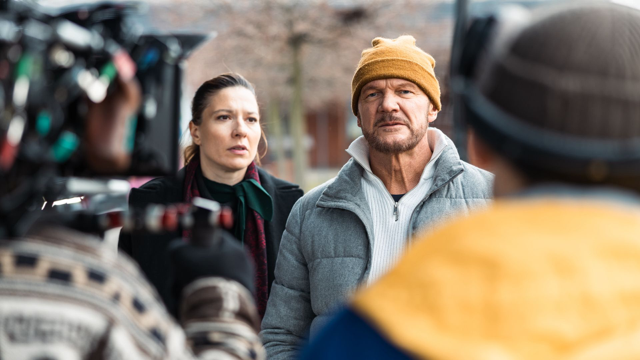
One major reason is that, for the past few years, she’s combined making art with becoming a kind of ambassador for Ukraine, going around the world to “tell people the truth, which I witnessed” – which is why she was in Cyprus for a few days, for a screening of a film called Ludzie (People), made in Poland about Ukrainians. Oksana plays one of several heroines, “a woman who could leave the country when the war started, but decided to stay – and, unfortunately for her, it ended tragically”. Films skew dark when it comes to Ukraine.
The past four years have changed her in another way as well. “Some time ago – I would say before the war – the word to describe me was ‘passion’. But it changed… I think the other word, which I’m having right now, is ‘kindness’.”
“Of course I was passionate,” she says, meaning about her career. Some discover acting late in life – but she’s been doing it since youth theatre at the age of 12. “I’ve reached a lot of success. I did a lot of work. It was all about being – like an Olympian, like a sportsman… Being successful was the main goal of my generation – Millennials, they call us. And it’s true. But then you somehow feel that it’s not enough.”
Passion turns to kindness, a play in two acts. It’s actually not too uncommon – and in fact Oksana puts it down to growing older, looking (even more) thoughtful when I protest that the war surely had something to do with it.
“Probably you’re right,” she agrees. “Probably it’s because of the war, I wasn’t thinking about it like this. When you understand that your life can end so quickly, it’s better to spend your life in the mode of being kind and generous – and calm. I’ve become more calm. It’s interesting.”
Calm, yes – but also righteously angry (“Anger is a good emotion, we need it somehow”), at Putin and the world, and the way “everything changed”. Even in her own middle-class family in Kharkiv, without any loved ones on the front lines, things have changed considerably.
Her dad works at the city’s biggest thermal power station – and was left with two broken legs after a Russian attack in November. (He’s mostly recovered now.) Her mum used to own a logistics company, but the work was in eastern Ukraine so the company had to shut down – though this particular change comes with a silver lining, since her now-retired mother has discovered a new passion: acting.
“Two years ago I directed a [stage] performance, and invited my mother to play the lead part.” That was her debut, at the age of 60, and more parts have followed. I ask about a short called Fuck Them All, about a pregnant woman who wants an abortion because she doesn’t want to bring new life into this godforsaken world (films really skew dark when it comes to Ukraine) – but in fact the Internet Movie Database has it wrong, it’s not Oksana who appeared in the film but her mother Olga, as the protagonist’s own mother.
This is not just a cute little detail. After all, the role of art – if any – during wartime is part of our whole conversation. For those facing death (or the prospect of death), art can be therapeutic. For the rest – including us, the outsiders looking on in horror – it can teach empathy, which is also the whole point of acting.
“It’s about being vulnerable,” says Oksana, speaking of her craft: “You, as an actor, have to be vulnerable, and you have to be able to accept another life into yourself”. Even more, however, “being another person is the most radical act of empathy which we could do. How can you understand another person? When you become someone else, you literally, with your body, feel how it is to be [them]…
“And I think it’s very important for people outside – who are willing to support us – to understand that. Of course, we are challenging your empathy. But that’s what actors also do.”
The war in Ukraine does indeed ‘challenge our empathy’. It’s become a war of attrition, painful and ugly and seemingly endless. Yes, you feel sorry as the country gets pounded. Yes, you feel angry and upset – but “it should be more,” she insists. “It should be much, much, much more actions.”
From Europe?
“Yeah, from Europe, from the Western world. I’m not a child, I see what’s happening – and it feels like there are no decisions [being] made to protect us, and to stop Russia, and to stop evil.”
What more can the EU do, though? There are already sanctions. Billions of euros have been pumped in. Putin is a designated war criminal. What more?
“That’s the work of politicians,” she replies. “That’s a good question for them… I’m an artist. I have my questions about what should I do.”
Maybe it sounds like a cop-out – but it’s actually true, Oksana Cherkashyna is (and always has been) an artist. If she’s working now as a kind of envoy, it’s not for political reasons but out of empathy – for her people, her country, her loved ones and friends, including fellow artists.
I ask her, if she could, to share a memory – some human detail, something she saw or experienced in her ravaged homeland. “Let me think…” she says. I’m fully expecting another story about death – but the moment she shares is instead about solidarity and resilience, even friendship, even – can the word still have a meaning? – even hope.
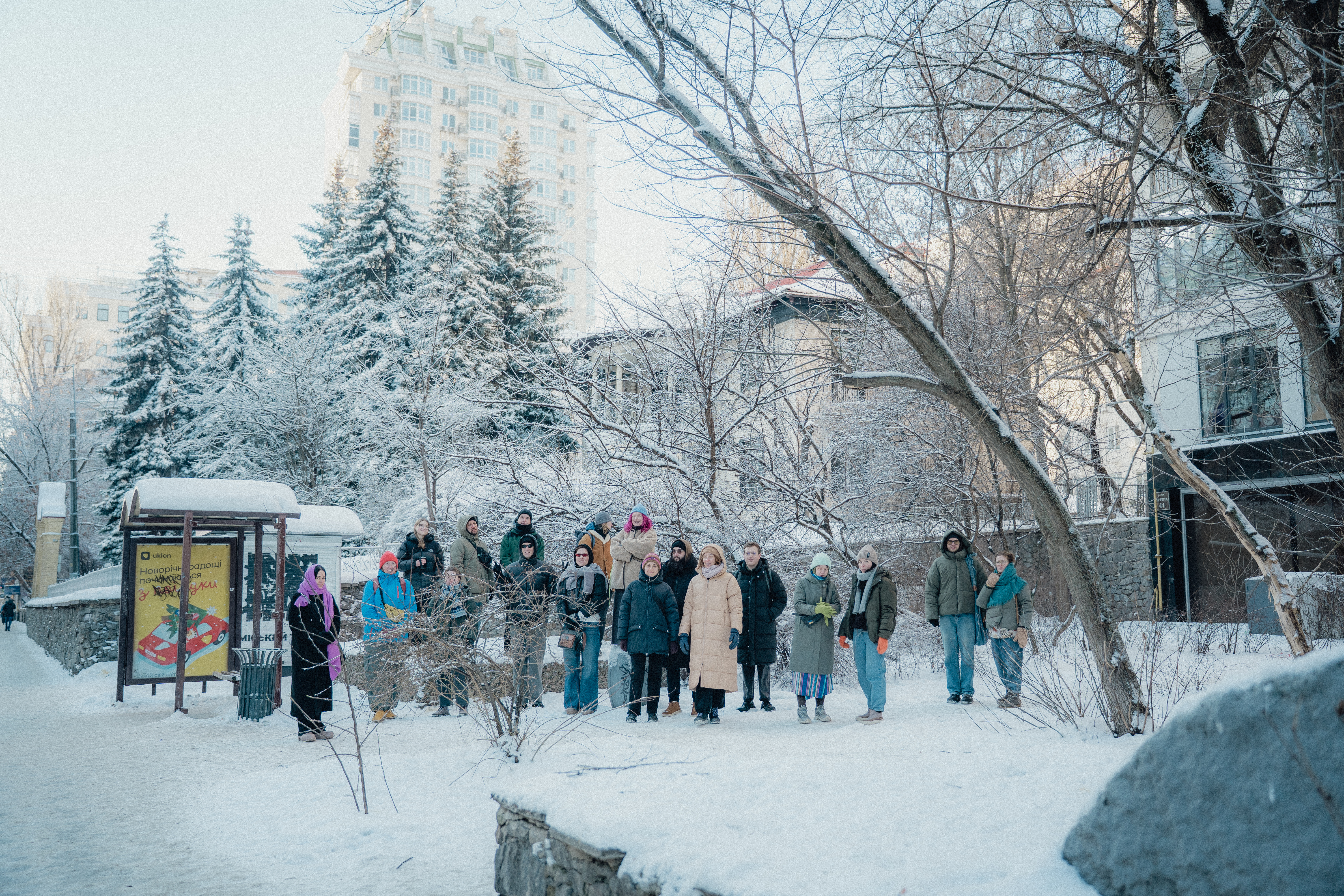
Her friend Dima Levytsky, “a famous Ukrainian dramaturgist”, has opened a theatre situated inside a kiosk in Kyiv – a kind of street performance with people passing by, open to everyone. He invited all his friends to take a photo, says Oksana – and they all gathered there this past January, in the winter cold, and took a picture together.
“And it was a very beautiful moment – just to come, and to share it… And it’s really very cold, believe me, it’s minus-20! And we are smiling, and sharing it together. And as Dima said, it’s like the memory of this winter.” Years from now, she muses, if she makes it – God willing – to old age, “I will see this photo, and show it to my children and say: ‘Hey, your mama during wartime in Kyiv, with her friends!’.
“I want to tell the readers,” she goes on, “that we Ukrainians are very grateful for everyone who are thinking about us, helping us… And also to say that resilience is not always [about] fighting.
“Resilience is also being kind to each other. Even if the circumstances are tragic.”




Click here to change your cookie preferences