
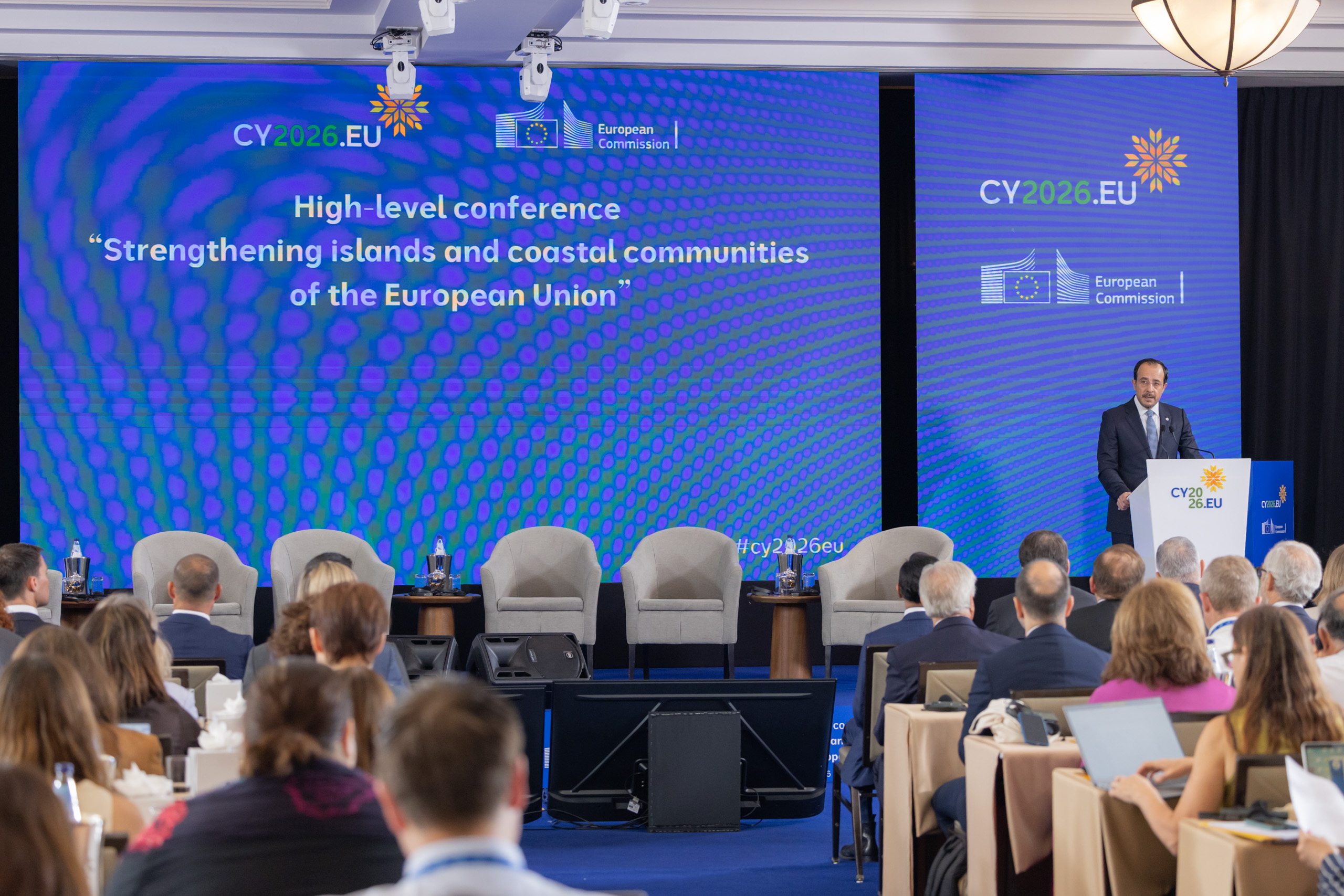
Cyprus’ EU presidency had delivered “concrete and substantial results”, President Nikos Christodoulides said on Friday as the island hosted the final major event of its six-month term with a high-level conference on strengthening EU islands and coastal communities.
Speaking in Paphos, Christodoulides said the conference carries both practical and symbolic significance, taking place at the southeastern edge of the European Union and in his home town, only days before the Cyprus presidency of the EU Council comes to an end.
The high-level conference, titled Strengthening EU Islands and Coastal Communities, was organised by the Cyprus presidency in cooperation with the European Commission, following the Commission’s presentation on June 10 of two new strategies for islands and coastal communities.
Christodoulides said the two strategies mark the first time the EU has provided a comprehensive and coherent framework to address the specific challenges faced by island and coastal regions, while also making use of their opportunities and strategic potential.
“Coastal and island regions may be geographically on the periphery of the European Union, but they are at the heart of European policies,” he said.
The president said Cyprus’ presidency had treated its six-month term as a “national mission”, handling and negotiating issues of major geopolitical importance, as well as demanding legislative files, including the EU’s next long-term budget.
He said the presidency had worked on issues ranging from “defence and security to competitiveness, energy, health, education, labour rights and air passenger rights”, adding that it had managed to “close cases which had been pending for more than a decade”.
Christodoulides said the work of the Cyprus presidency had been recognised by EU institutional leaders and member states, adding that this made him “particularly proud” of the country and its people.
Referring to the new EU strategies, the president said 17 million European citizens live on more than 4,000 inhabited islands, while 95 million people live in coastal areas stretching across around 70,000 kilometres of coastline.
He said 17 EU member states have island regions, while 22 have coastal areas, giving the issue a truly European dimension.
Christodoulides said island and coastal communities are central to the EU’s economic cohesion, environmental protection, resilience and security, but also face daily challenges linked to connectivity, climate change, energy and water security, rising sea levels, coastal erosion and the need to maintain viable local communities.
For island member states, he said, these challenges have direct consequences for access to international markets, competitiveness, tourism, fisheries, aquaculture, infrastructure and everyday life.
The president said the new strategies were closely aligned with Cyprus’ own national priorities, stressing that European and national action should not operate in parallel but reinforce one another.
As an example, he referred to Cyprus’ blue economy, saying the sector has recorded steady annual growth of between four and five per cent over the past 15 years, supporting economic activity in coastal areas, creating jobs and strengthening the resilience of coastal communities.
He also referred to investments of €150 million in Cyprus, co-funded through EU cohesion policy, for the modernisation and digitisation of the electricity grid.
These investments, he said, include smart management systems, new energy infrastructure and storage systems, aimed at strengthening energy security, expanding the use of renewable energy sources and making the country’s energy system more resilient.
For Cyprus, as an island and energy-isolated EU member state, such investments are essential for the green transition, competitiveness and the EU’s strategic autonomy, he added.
Christodoulides also stressed that islands and coastal regions often form the EU’s external borders, placing them on the frontline of challenges linked to security, defence, the protection of critical infrastructure and migration management.
“By supporting these regions, we support the European Union as a whole,” he said.
The president said the launch of the strategies from Cyprus sent a strong message that the EU’s island and coastal communities are not marginal, but central to Europe’s future.
The event closes one chapter of the Cyprus presidency, Christodoulides said, but also opens “a new path” for Europe’s islands and coastal regions.


Click here to change your cookie preferences