

The strategy is stronger than a typical policy vision document. It understands Cyprus’s structural weaknesses and proposes institutions, infrastructure, sector-specific applications and governance mechanisms.
Its central weakness is execution credibility.
The strategy describes what Cyprus should build, but it does not provide a consolidated costed implementation plan showing how much each programme will cost, which organisation owns each deliverable, where the funding will come from and what must be completed each year.
My assessment:
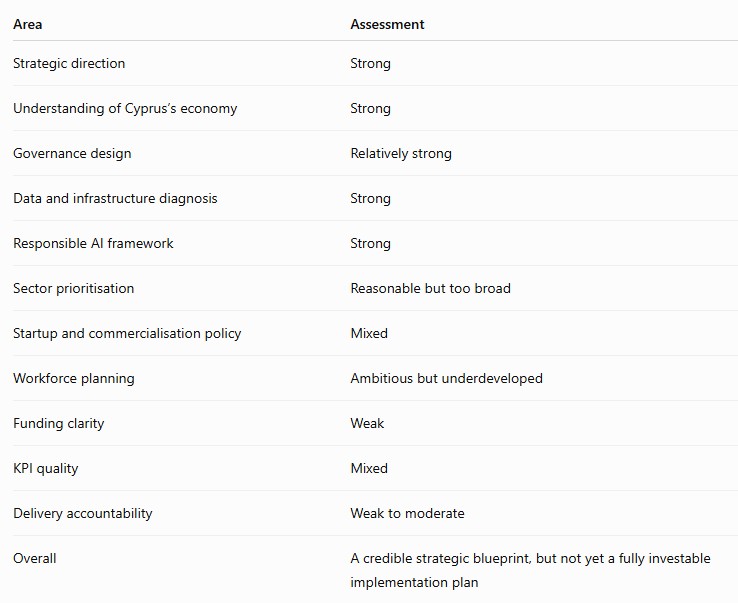
The strategy could become effective. But it needs a separate, binding delivery plan before it can be described as execution-ready.
The main strengths (pros) are:
1. It starts with Cyprus’s real economic structure
The strategy does not try to present Cyprus as a future competitor to the United States, China or France in frontier-model development.
It concentrates on sectors where Cyprus already has economic activity and regulatory knowledge such as Government, Financial services, Healthcare, Tourism, Legal services, Education, Shipping and Entrepreneurship. It doesn’t include the growing ICT sector.
This is broadly the right approach for a small services economy. The strategy connects AI adoption to productivity, compliance, service quality and exports rather than treating AI research as an end in itself.
The emphasis on regulated services may provide genuine differentiation.
Cyprus is more likely to build an advantage in AI assurance, maritime applications, compliance technology and multilingual public services than in training globally competitive foundation models.
2. It correctly identifies data fragmentation as the central obstacle
The strategy recognises that AI adoption cannot be separated from data reform.
It proposes a federated national data architecture, common standards and metadata, secure APIs, sectoral data spaces, controlled research access, a national data layer and a National Intelligent Digital API Fabric.
This is one of the strategy’s strongest sections. It addresses the less visible work required before useful AI systems can operate across government. The federated model is also sensible. It seeks interoperability without placing every sensitive dataset in a single central repository.
3. The “build once, reuse everywhere” model is appropriate
The strategy proposes reusable capabilities such as document intelligence, case routing and multilingual assistants instead of allowing every ministry to purchase separate systems. It also calls for mandatory Applied AI Strategies for ministries, quarterly portfolio reviews and common platforms.
This could reduce duplicate procurement, vendor fragmentation, inconsistent security standards, repeated development costs and incompatible systems.
This resembles the practical strengths of Estonia’s digital-state approach, where shared infrastructure and reusable government services matter more than isolated AI demonstrations.
Estonia already operates the Bürokratt public-service assistant across several institutions and is developing a common governance layer for public-sector AI.
4. Governance is treated as an economic capability
The strategy does not frame regulation solely as a burden. It proposes using EU AI Act compliance, assurance, testing and regulatory predictability as a market advantage.
That is a credible position for Cyprus.
A National AI Authority, an Interministerial AI Council, specialised committees, AI Officers and a National AI Compliance Framework could create a more predictable environment for businesses and government buyers.
The lifecycle approach is also sound.
Projects are expected to move through problem definition, data readiness, validation, deployment, monitoring and possible withdrawal rather than being treated as one-off software purchases.
5. Human oversight and citizens’ rights are clearly recognised
The strategy includes human review for sensitive decisions, explainability and contestation rights, bias monitoring, risk-based transparency, auditability, withdrawal criteria and security and resilience requirements.
These commitments are particularly important in healthcare, education, social benefits, justice and public administration.
The strategy is stronger on responsible AI than many growth-led strategies. The UK’s AI Opportunities Action Plan, for example, places greater emphasis on compute, growth zones, infrastructure and frontier capabilities. Cyprus gives more space to administrative accountability and citizens’ rights.
6. It understands that public procurement can create demand
The Government Innovation Hub and the portfolio of reusable public-sector applications could turn government into an early customer for local and European AI companies.
This matters in Cyprus, where research and startup support often stop at pilots or grants. A structured path from public problem to prototype, validation and procurement could be more valuable than creating another general accelerator.
7. The infrastructure approach is proportionate
The strategy does not argue that Cyprus should independently build every layer of the AI stack.
It proposes sovereign capacity for sensitive workloads, national shared infrastructure, G-Cloud integration, the Pharos-CY project, EuroHPC access, European AI Factory participation and International partnerships for additional scale.
This balance between national control and European access is appropriate for a small country. The strategy also recognises vendor lock-in, portability, interoperability and supply-chain resilience.
8. It includes several useful operational ideas
Some initiatives are more concrete than the headline vision:
- AI Officers in ministries
- A National AI Skills Observatory
- Stackable workforce micro-credentials
- Sector-specific training
- Data sandboxes
- An AI investment matching fund
- Quarterly portfolio reviews
- Pilot evaluation before expansion
- Shared compliance and adoption frameworks
The proposed matching fund is particularly relevant because it links public investment to commitments from independent institutional investors instead of allowing the state to select companies alone.
Let’s review the challenges and cons of the Cyprus National AI strategy
1. There is no consolidated financial plan
This is the most important weakness.
The strategy proposes:
- National AI infrastructure
- Research and innovation funds
- An AI Innovation Fund
- Centres of Excellence
- A Government Innovation Hub
- Sandboxes
- Skills programmes
- New authorities and committees
- Shared government platforms
- Startup incentives
- Talent-attraction schemes
But it does not present a consolidated budget for these programmes.
The only broad public-sector financing principle states that budget allocations will be aligned with performance goals agreed by the Ministry of Finance and the Deputy Ministry of Research, Innovation and Digital Policy.
For the sovereign AI infrastructure, the strategy says that a roadmap, governance model and funding plan should be developed by 2028. In other words, the financing of one of its central assets remains a future task.
This is a major difference from stronger international plans.
Singapore has attached concrete financing to implementation, including a S$150 million Enterprise Compute Initiative providing companies with compute, tools, training and engineering support.
France has connected its AI strategy to large public and private investment commitments, including infrastructure investment, France 2030 financing and announced private-sector investment exceeding €100 billion. Cyprus cannot match France’s scale, but it should still state what it intends to spend.
A credible Cypriot implementation plan should identify annual expenditure, EU funding assumptions, national co-financing and operating costs through 2032.
2. Accountability remains institutionally complicated
The strategy creates or assigns roles to numerous bodies:
- National AI Authority
- Interministerial AI Council
- National AI Taskforce
- Specialised committees
- Deputy Ministry
- Chief Scientist
- AI Officers
- Government Innovation Hub
- Centres of Excellence
- Sectoral steering bodies
- Regulators
This may improve participation. It may also generate overlapping authority.
For example, monitoring involves both the National AI Authority and the National AI Taskforce. The Deputy Ministry bears implementation responsibility, while the Chief Scientist is described as the accountable custodian and catalyst.
The strategy needs a clearer distinction between:
- Political ownership
- Budget ownership
- Regulatory supervision
- Programme delivery
- Technical assurance
- Independent evaluation
Each major initiative should have one named accountable owner. Advisory committees should not share operational responsibility.
3. The timetable is too general
The main timetable uses broad periods:
0–8 months, 6–12 months, 12–24 months, 2026–2032
These periods overlap and do not establish a critical delivery path.
There are some more concrete dates for the G-Cloud. However, the strategy does not provide annual milestones for most of the strategy’s major components.
It should state, for example:
- When the National AI Authority becomes operational
- When legislation or Cabinet decisions are required
- When the first shared AI services will launch
- When ministries must complete data inventories
- When the national AI registry will operate
- When sandboxes will accept applicants
- How many government systems will move beyond pilots each year
- When independent evaluations will be published
The UK AI strategy provides a useful contrast. Its AI Opportunities Action Plan contains 50 actions and is supported by a public delivery dashboard. A January 2026 update reported that 38 of the 50 commitments had been met.
Cyprus needs a similar public tracker for AI and other public initiatives.
4. Some headline economic targets are insufficiently justified
The strategy refers to:
- Up to 15 per cent productivity improvement
- 12 per cent GDP expansion
- More than 3,000 AI professionals
- 3,000 high-skilled jobs
- Increased foreign investment
The strategy acknowledges that the productivity figure is an upper-bound scenario dependent on investment and execution. But it does not provide a transparent economic model explaining how the 12 per cent GDP expansion or 15 per cent productivity improvement was calculated.
The figures risk becoming political slogans unless the government publishes baseline assumptions, sector-level contribution estimates, adoption rates, capital expenditure assumptions, labour displacement estimates, productivity attribution methodology, sensitivity scenarios and an independent economic assessment.
The word “recommended” attached to several targets also weakens accountability. A national target should either be formally adopted and measured or described as a scenario.
5. Adoption targets appear inconsistent
The strategy contains different adoption ambitions.
One section sets a target of 50 per cent AI adoption across government and priority sectors by 2032. Another section refers to a 75 per cent AI adoption target by 2032, aligned with the EU Digital Decade.
These may refer to different populations or definitions, but the distinction is not sufficiently clear.
The strategy needs one measurement framework defining:
- What counts as AI adoption
- Whether the target covers companies, ministries or individual services
- Whether experimentation counts
- Whether purchased generative AI tools count
- Whether the system must be in production
- How safe and productive use will be verified
Without a precise definition, adoption figures can be increased by counting low-value subscriptions or pilots.
6. Eight priority sectors are too many for a small state
The strategy describes its approach as focused. But eight priority sectors, six research focus areas, multiple moonshots and 16 flagship programmes create a wide portfolio.
For a country with limited specialised talent, administrative capacity and compute, this risks reproducing the fragmentation the strategy itself criticises.
Cyprus should probably identify three first-wave missions:
- Intelligent public administration
- Regulated services, including finance, legal and compliance
- Maritime, tourism or healthcare data applications
The remaining sectors could enter later phases once shared data, procurement and assurance infrastructure is functioning.
Singapore’s approach is broader in national ambition, but it operates with deeper technical institutions, larger budgets and stronger delivery capacity. Its latest model also places strategic direction under a National AI Council chaired by the prime minister.
Cyprus needs sharper sequencing to compensate for its smaller capacity.
7. The “three unicorns” target is weak policy design
The strategy proposes an AI Innovation Fund intended to support SMEs and attract startups, including three unicorns. A government cannot reliably plan the creation or attraction of unicorns.
Valuation depends on international capital markets, investor sentiment, corporate structure and financing conditions. It is also not a reliable measure of domestic economic impact.
Better indicators would include:
- Number of AI companies with substantive operations in Cyprus
- Locally owned intellectual property
- AI export revenue
- Follow-on private investment
- Scaleups reaching €10 million or €50 million annual revenue
- Research commercialisation agreements
- High-productivity jobs created
- Procurement awarded through competitive processes
- Survival and growth after public support ends
The target may encourage headline-driven incentives for relocating corporate structures without building real research, employment or decision-making capacity in Cyprus.
8. Startup policy is still too supply-side
The strategy proposes funds, accelerators, sandboxes, compute access and mentorship. These can help. However, Cyprus already has many ecosystem support mechanisms.
The harder problems are usually:
- Lack of demanding early customers
- Limited follow-on capital
- Weak research commercialisation
- Small domestic markets
- Public procurement barriers
- Limited corporate adoption
- Insufficient international sales capacity
The strongest part of the startup section is therefore not the proposed incubation system. It is the possibility of using government and regulated industries as reference customers.
The strategy should place more weight on challenge-based procurement, pre-commercial procurement, regulatory access and export support. It should place less weight on creating additional support organisations.
9. The talent target needs occupational precision
The strategy aims for approximately 3,000 AI professionals. It includes AI engineers, data scientists, no-code developers, prompt engineers and certified specialists.
These categories have very different levels of technical depth.
Counting prompt engineers, short-course graduates and experienced machine-learning engineers under one indicator could produce an inflated number without increasing national capability.
The skills framework should separate:
- AI researchers
- Machine-learning engineers
- Data engineers
- AI security professionals
- Data stewards
- AI assurance and audit specialists
- Sector professionals with advanced AI capability
- General AI-literate workers
The strategy also needs retention indicators. Training people is not sufficient if they leave Cyprus or work remotely for foreign organisations without contributing to domestic capability.
Finland’s AI 4.0 programme provides a useful model because it combines industrial adoption, skills, sustainability, defined development areas, measures and monitoring indicators rather than using one aggregate talent number.
10. The strategy is stronger on workforce augmentation than on labour-market disruption
The strategy repeatedly states that AI should augment rather than replace workers. That is a reasonable policy preference. It is not a guaranteed outcome.
AI adoption may reduce demand for some administrative, legal, financial, customer-service and back-office tasks. These are important parts of the Cypriot services economy.
The strategy needs stronger provisions for:
- Occupational exposure analysis
- Worker consultation
- Transition support
- Income and employment monitoring
- Collective workplace governance
- Redeployment obligations in the public sector
- Protection against automated worker surveillance
- Assessment of job quality, not only job numbers
The commitment to reskilling is positive, but reskilling cannot be assumed to offset every displaced job.
11. Independent oversight is not strong enough
The strategy places significant responsibility within government-led bodies.
For high-impact public-sector AI, Cyprus should also establish independent scrutiny through:
- The Commissioner for Personal Data Protection
- The Ombudsman
- The Auditor General
- Sector regulators
- Academic and civil-society experts
- Citizen representatives
The National AI Authority may promote adoption, operate shared platforms and oversee compliance. Combining promotional, operational and assurance functions can create a conflict of interest.
An authority encouraging deployment should not be the only body judging whether that deployment is safe, lawful and effective.
12. Public transparency should be more explicit
The strategy supports monitoring, auditability and reporting, but it should commit to a public register covering government AI systems.
For each system, the register should disclose the responsible public body, its purpose, the supplier, the contract value, the risk classification, the categories of data used, the human-review process, the impact assessment, the performance indicators, any known limitations, and details of incidents and corrective actions.
The Netherlands offers a relevant comparison. Its government-wide generative AI policy explicitly connects AI use to transparency, public values, fair algorithmic operation and accessibility.
Cyprus refers to these principles, but should convert them into mandatory publication duties.
13. Environmental commitments are not measurable
The strategy mentions Green AI and energy sustainability. But it does not establish measurable limits or reporting requirements for:
- Data-centre electricity use
- Water consumption
- Carbon intensity
- Hardware lifecycle
- Model efficiency
- Renewable energy sourcing
This matters because sovereign compute and new data infrastructure could impose significant energy and cooling requirements.
The strategy should require lifecycle reporting and energy-efficiency criteria in public procurement.
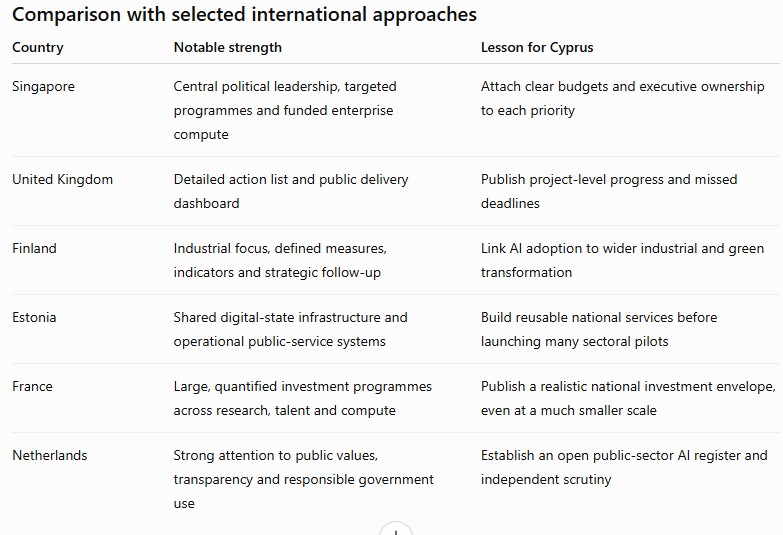
International comparison does not mean Cyprus should copy large countries.
The most relevant lessons are institutional: fewer priorities, clearly assigned owners, costed actions, public deadlines, measurable results, independent evaluation, and regular strategy updates.
What should be added before implementation
The government should publish a separate delivery document containing five elements. The strategy should include a costed portfolio. Every flagship programme should state its capital cost, annual operating cost, funding source, EU contribution, national contribution, procurement timetable and expected measurable return.
It should also include a clear responsibility matrix. Each action should have one accountable minister or authority, one delivery organisation, clearly identified supporting organisations, defined approval requirements and a fixed reporting frequency.
A public implementation dashboard should track whether each initiative has not started, is in procurement, is at the pilot stage, is in production, has been scaled, is delayed, has been suspended or has been discontinued. The dashboard should also publish budgets, contracts and outcome metrics.
The first phase should be narrower and focused. During the first 24 months, Cyprus should prioritise national governance and independent oversight, public-sector data inventories and standards, shared government AI services, G-Cloud and secure deployment environments, AI procurement rules, skills mapping and two or three high-impact production systems. The country should avoid launching dozens of disconnected pilots.
An independent annual review should assess the strategy’s economic impact, public-sector performance, effects on rights and discrimination, cybersecurity incidents, labour-market impact, procurement concentration, vendor dependence and environmental impact. It should also determine whether programmes should be expanded, redesigned or stopped.
Final conclusion
The Cyprus National AI Strategy 2032 is strategically serious. It correctly identifies data, skills, governance, infrastructure and institutional fragmentation as the main constraints. Its strongest ideas are shared national capabilities, responsible AI controls, European integration and a focus on sectors where Cyprus already has economic strengths.
But it currently promises more than its delivery structure can guarantee.
The strategy tries to cover almost every major sector, create several new institutions, build sovereign infrastructure, transform public services, produce thousands of professionals, attract unicorns and generate double-digit economic gains. It does so without a consolidated budget, a precise annual roadmap or sufficiently clear accountability.
The strategy should therefore be viewed as a blueprint, not yet as an implementation programme.
Its success will not be determined by whether Cyprus creates an AI authority, launches more pilots or announces new funds. It will be determined by whether a small number of useful systems reach production, improve measurable outcomes, protect citizens, create domestic expertise and survive beyond the initial funding cycle.
The Cyprus National AI Strategy is currently on public consultation. People can contribute here.





Click here to change your cookie preferences