
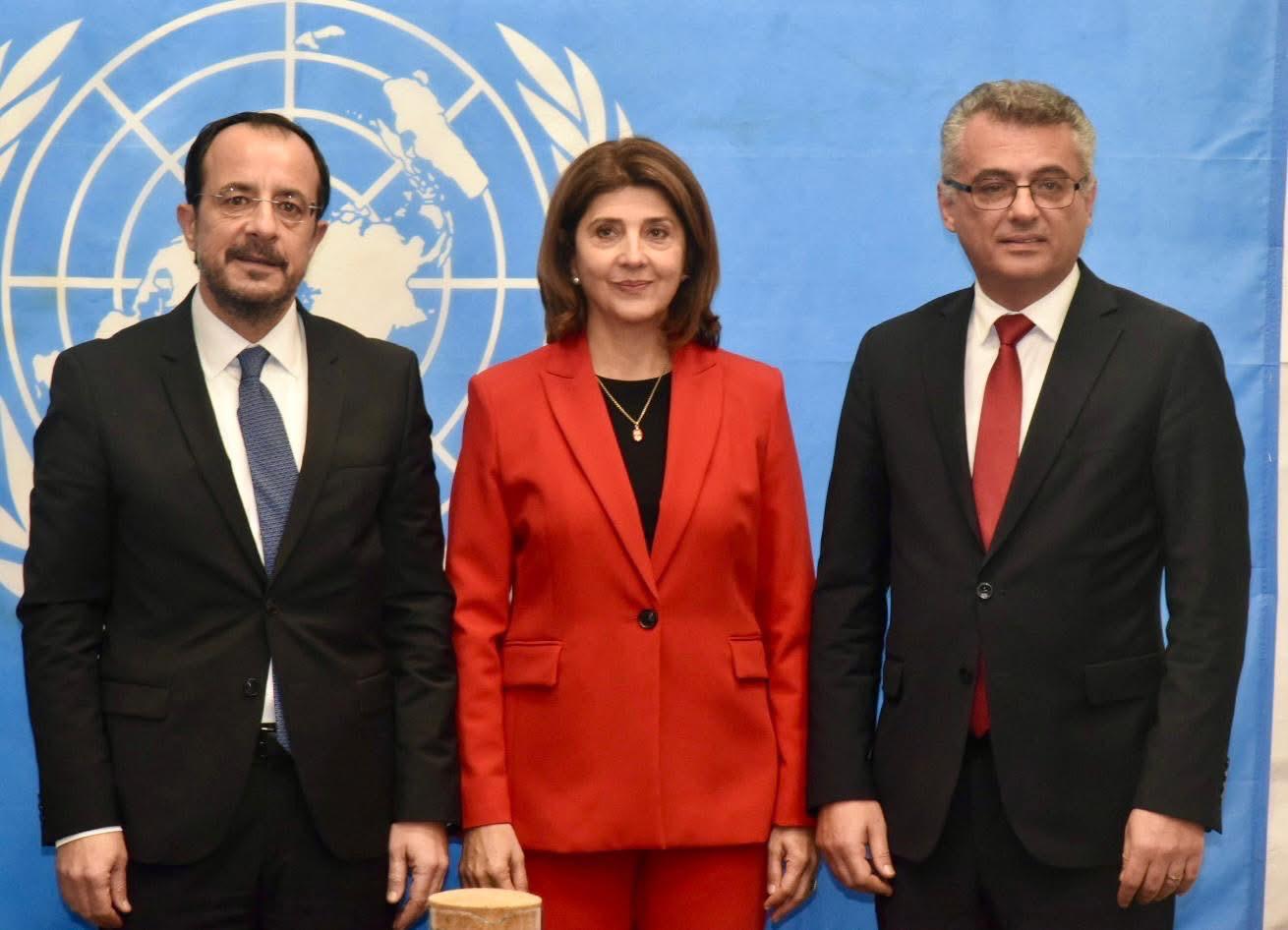
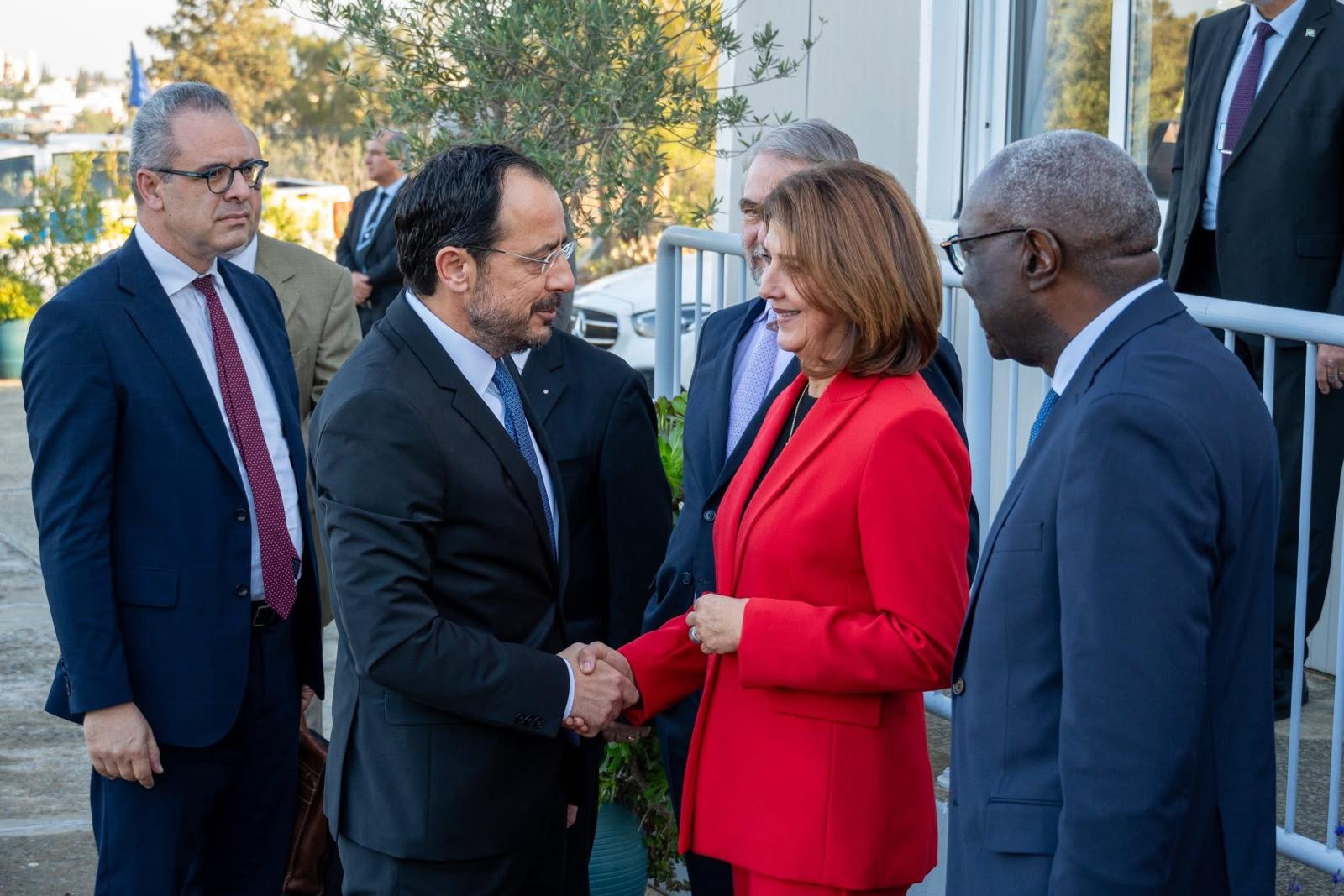
President Nikos Christodoulides and Turkish Cypriot leader Tufan Erhurman agreed “that the real aim is the solution of the Cyprus problem with political equality as described by the United Nations security council resolutions” during a joint meeting with UN envoy Maria Angela Holguin on Thursday, the UN said.
Meanwhile, Christodoulides left the meeting saying it had been held in a “very good atmosphere”.
Later in the evening, he said that the “reference to the United Nations resolutions is important”, and that he and Erhurman had “agreed to focus on specific issues”.
Those issues, he said, included the matter of missing persons, with the pair having visited the Committee on Missing Persons’ laboratory earlier in the day, and “the occupation regime’s taxation of products”.
He also pointed out that the meeting had lasted for almost three and a half hours and said that it is “positive that we discussed the substance of the Cyprus problem”.
Additionally, he said he would be ready “next week” to “participate in an expanded meeting” which would involve the island’s two sides, the UN, and its three guarantor powers, Greece, Turkey, and the United Kingdom, though no date for such a meeting was set on Thursday.
On the matter of the date of the next enlarged meeting, he said Holguin will travel to Greece on Friday to meet the country’s Prime Minister Kyriakos Mitsotakis and Foreign Minister Giorgos Gerapetritis, before travelling to Turkey to meet the country’s Foreign Minister Hakan Fidan.
“You understand that after these meetings and in particular the meeting with [Fidan], we will be able to talk more specifically about the date of this enlarged meeting,” he said.
He also said that he and Erhurman had spoken about the matter of crossing points, and that he had “raised the issue of a pedestrian crossing point in Nicosia”, but that this suggestion was “not accepted” by Erhurman.
Then, he was asked whether any of Erhurman’s four points for negotiations to recommence in earnest were discussed during Thursday’s meeting, and said that there was “no extensive discussion on this specific issue”.
“On this issue in the previous meeting, I had expressed my position on all four points. There was no discussion on the methodology. There was a discussion on the substance. I know the methodology is part of the substance, but I am talking about the aspects of the Cyprus problem and the confidence-building measures,” he said.
Those four points, sometimes referred to as “preconditions” – a term Erhurman resents – foresee that the Greek Cypriot side accept political equality, time-limit negotiations, and preserve all past agreements, and that the UN guarantee that embargoes placed on the Turkish Cypriots be lifted if the Greek Cypriot side leaves the negotiating table again.

The UN, meanwhile, said it included a “stocktaking discussion on previously agreed trust building initiatives”, as well as a discussion on new ideas.
“They agreed to concentrate on achieving new agreements as soon as possible, especially on the issue of the opening of new crossing points, the halloumi issue, and the construction of pipelines from the Mia Milia water treatment plant,” it said.
It added that the pair also “agreed to increasing the staff for services required at the crossing points”, and welcomed the European Union-funded works to widen the Ayios Dhometios crossing point in western Nicosia, while also “looking forward to its completion in the coming months”.
“Both leaders also reaffirmed their commitment to participate in the next informal meeting in a broader format to be convened by the UN Secretary-General [Antonio Guterres],” it said.
Ahead of that meeting, it said, “they committed to continue to work in the meantime in Cyprus to produce tangible results for the benefit of Greek Cypriots and Turkish Cypriots and to ensure the success of the next informal meeting in a broader format”.
“To this end, they expressed their willingness to meet as often as needed and instructed their representatives to continue their regular meetings,” it said.
On Thursday evening, Erhurman held a press conference to evaluate the day’s contacts, beginning by saying that his meeting with Christodoulides and Holguin had been held “in a harmonious atmosphere”.
The first subject of note about which he spoke was halloumi, and he said that “a clear agreement has been reached between the sides to complete the implementation by the end of January” and thus to allow Turkish Cypriot halloumi producers awarded the EU’s protected designation of origin (PDO) certificate to export their product to the wider EU.
He also said that “significant progress has also been made regarding crossing points”, with seven police cabins set to “operate actively” on the Greek Cypriot side of the Ayios Dhometios crossing point.
Additionally, he said, it will also now be possible for insurance and MOT certificates for Turkish Cypriot vehicles to be obtained at both the Astromeritis and Dherynia crossing points.
“This arrangement is expected to significantly ease crossing procedures,” he said.
He then stressed the importance of the reference to “political equality” in the UN’s statement and said that he and Christodoulides has “considered the approach of shared sovereignty areas, which envisages that in certain fields, decisions can only be made jointly”.
He also made reference to his four points, saying that the mention of political equality in Thursday’s meeting is “only the first half of political equality”.
“From our point of view, the first point is not complete. Moreover, comprehensive negotiations cannot begin until all four points are fully met,” he said.
He added that the next enlarged meeting “must be an innovative and meaningful process” and said that while Thursday’s meeting saw “small advances” achieved, the day’s achievements are “not sufficient to create an environment conducive to comprehensive negotiations”.
“It is not appropriate to proceed with an enlarged meeting without more comprehensive solutions, including crossing points,” he said.
The press conference concluded with Erhurman saying that “steps have been taken and some progress has been made … but this is not yet sufficient for a comprehensive solution process”.




Click here to change your cookie preferences