
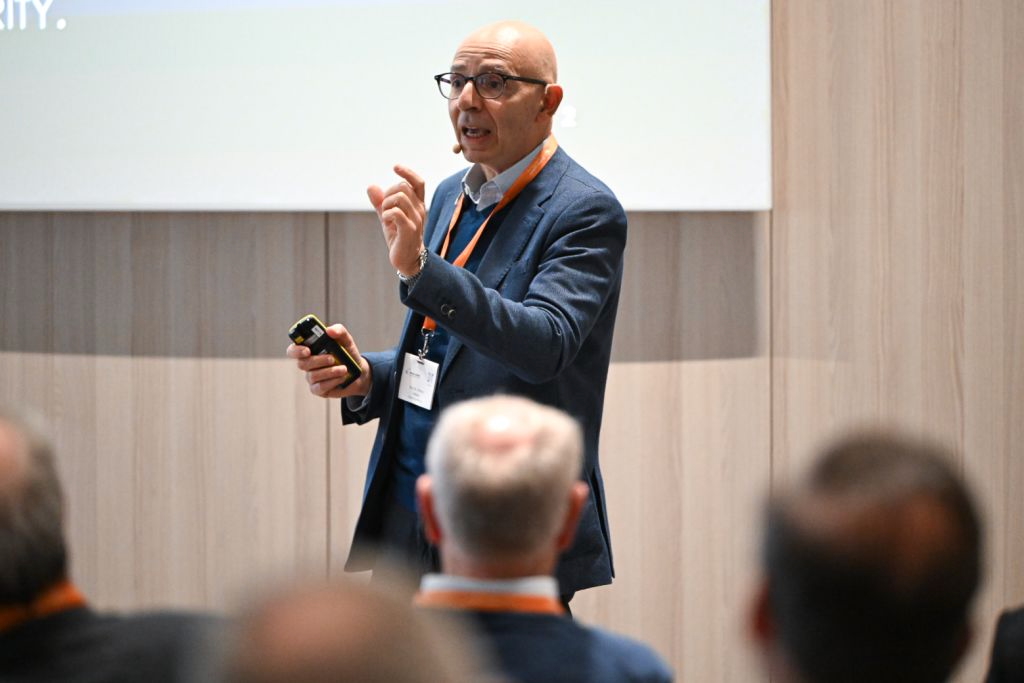
Talk outlined a verification-driven pathway for physics-informed models, transformer surrogates, and digital twins—turning rapid AI predictions into flightline-ready evidence.
Bauhaus Luftfahrt: The Aviation Think Tank and a research institution convening cross-sector leadership on the future of air transport, invited Professor Dimitris Drikakis (University of Nicosia) to deliver a talk at the Bauhaus Luftfahrt Symposium 2025, held on 18–19 November 2025 at Munich Airport.
A convening platform with real system impact
The Bauhaus Luftfahrt Symposium brings together international aviation experts and decision-makers from industry, research, and politics to advance the path to climate-neutral aviation—showcasing leading concepts while initiating joint projects that translate ideas into implementation pathways.
The 2025 edition, themed “From 2005 to 2070 – Our Journey to the Future of Aviation,” marked Bauhaus Luftfahrt’s 20th anniversary, reinforcing the Symposium’s long-horizon perspective on technology, policy, and market feasibility.
Eminent speakers spanning policy, industry, finance, and frontier engineering
The programme reflected the multidimensional nature of aviation’s transition—linking economics, sustainability, airport operations, alternative fuels, propulsion innovation, and AI assurance. Among the speakers were:
- Florian Allroggen, Principal Research Scientist & Executive Director LAE, MIT
- Thomas Conlon, Professor of Finance, University College Dublin
- Florian Herrmann, State Minister, Free State of Bavaria
- Jost Lammers, CEO, Munich Airport
- Andreas Hermann, Head of Sustainability Roadmap & Business Integration, Airbus
- Peter Lyu, Field CTO, Luminary Cloud
- Jean-Baptiste Rouffet, AI & Safety Expert, Airbus Protect
- Klaus Schneider, Managing Director, Liebherr-Aerospace Lindenberg
- Nina Sproedt, Head of Sustainability, Lufthansa Group
- Professor Dimitris Drikakis, Dean of Sciences & Engineering, University of Nicosia
The Symposium also foregrounded the economic and policy realism required for climate neutrality, including a Day 1 plenary on “Economics of our Transition to Climate Neutrality,” highlighting the scale of the economic challenge and the need for levers that lower the financial burden across stakeholders.
Professor Drikakis’ invited talk about turning “scientific AI” into certifiable engineering evidence
Professor Drikakis spoke on the subject of “Transformative Role of AI: Potential and Pathways,” a theme centered on frameworks for safe, trustworthy, and certifiable AI, and on cross-domain integration across the aviation lifecycle.
His talk, “From Prototype to Flightline: Operationalising AI Safely and at Scale,” emphasized that:
“Transforming aviation hinges on scientific AI: physics-informed models, transformer surrogates, and digital twins delivering fast, testable predictions—validated via rigorous Verification and Validation, data scrutiny, and uncertainty-aware KPIs to bridge prototype to flightline.”
In practical terms, the talk emphasized a governance-and-engineering pathway in which speed is not the endpoint. Instead, acceleration becomes operationally meaningful only when paired with:
- Physics-informed modelling that embeds conservation laws and constraints to reduce unreliable extrapolations in safety-critical regimes.
- Transformer-based surrogate models designed for rapid scenario exploration while preserving traceability of assumptions and data provenance.
- Digital twins that support continuous alignment between models, test evidence, and operational realities.
- Rigorous Verification & Validation (V&V), including disciplined data scrutiny and uncertainty-aware key performance indicators (KPIs)—so performance claims remain auditable, testable, and decision-grade as systems transition from prototype environments to operational deployment.
This framing positions AI as a system-level enabler that must be operationalised through trustworthy and certifiable pathways, treating AI assurance as a first-order constraint—not an afterthought.





Click here to change your cookie preferences