
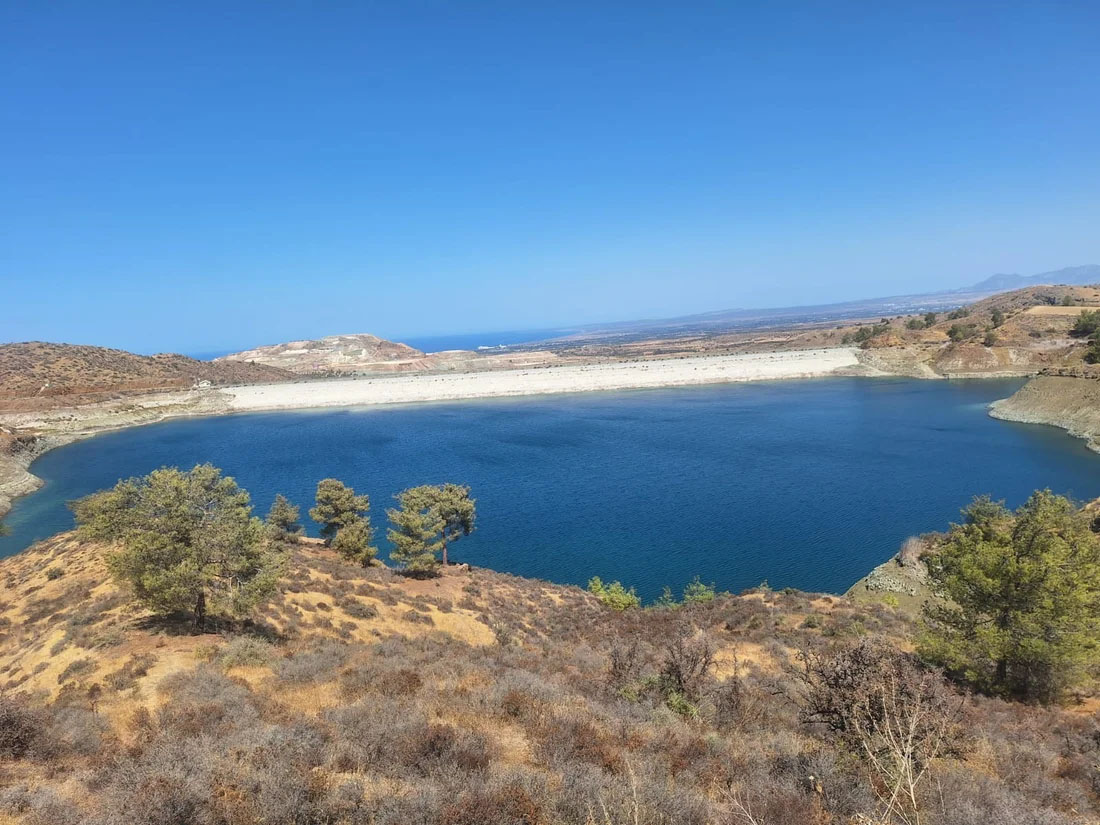
I got the story in the end but had to tread the tortuous civil service obstacle course first
Of all the various stories I wrote in 2025, the one about the dam in Solea – ‘A dam full of water going to waste’, to quote the headline – wasn’t necessarily the most consequential.
Still, it encapsulated much of what I find interesting about the job, both this past year and in general.
For a start, there was the way I heard about the story – not through a press release or a news conference, but randomly, by talking to people.
Having gone to the farmers’ market (a weekly ritual) on a Saturday morning, I got chatting with someone from the area of Solea, on the northwestern foothills of Troodos, and found out, quite casually, about their local dam, which was built in 2013 but never quite completed.
This, you might say, is the romantic idea of journalism as a bridge between the people and the powers-that-be – finding stories from the bottom up, rather than having them imposed top-down.
There was more old-school journalism in the way I delved into the story – not on purpose, it just seemed more efficient that way.
The biggest challenge was the relevant government authority, the water development department.
Clearly, writing the story would be impossible without getting their input. But civil servants are notoriously bad at answering their phones (and good at saying they’re not the right person, when they do answer them) – and this was summer, when the city was half-empty anyway.
Rather than making endless phone calls, leaving messages and sending emails, I found the address and decided to go there in person.
This brings up an important issue, not just limited to the civil service. Simply put, Cyprus – once a trusting society where institutional and public spaces were freely accessible – has increasingly become a landscape of enclosures and barriers, governed by safetyism.
Schools, for instance, now resemble prisons, vague concerns about child protection having been used as a pretext to put up fences. It makes you wonder what kind of message kids are unconsciously absorbing about the outside world.
One might argue that schools, in particular, have to prioritise safety – but most government departments (which, lest we forget, exist to serve the public) have also become more like fortresses. Civil servants have locked themselves away, a trend accelerated by Covid.
For journalists trying to do their job, it’s become a real challenge.
Obviously, I’m not expecting people to drop everything and make time for some random reporter. Still, it’s starting to feel like an obstacle course. Almost everywhere, there’s security blocking entry now – and the upshot is often that we’re told to send our questions by email, sometimes only through the press office.
I hope it doesn’t sound too self-serving to say that this is wrong. Managers may imagine they’re making the service more ‘European’ – but in fact it only makes it more opaque, obscures accountability, and enables the state to respond to troublesome queries with emailed platitudes, or not at all.
In any case, I did indeed trek to the water development department for the Solea dam story, showing my press card to the not-unfriendly security guard – and, to her great credit, Nicosia district engineer Monica Stylianou Andreou agreed to see me, providing useful information on what was, after all, quite an embarrassing story.
That’s the other reason why this particular article resonates fondly in my memory: namely, the story itself.
The dam at Solea was built 12 years ago – but, for whatever reason (it’s explained in the article), no government ever installed the network of pipes that would enable the water to run to nearby communities.
The dam, in other words, is a kind of huge puddle – the 12th-biggest dam on the island, with a capacity of 4.5 million cubic metres – that just sits there, with no official way of getting the water where it’ll actually do some good.
It’s a great (if depressing) joke, official ineptitude in all its glory – but in fact it gets even better.
After a few years, the authorities did come up with a temporary solution, allowing farmers to access the water through existing irrigation ditches, the idea being that local ‘irrigation divisions’ would channel it as needed and extract payment.
This, however, is where human nature comes into play – because, as so often in Cyprus, everyone found good reasons to let things slide.
Many farmers dragged their feet about paying. After all, it was just a temporary solution – and it wasn’t their fault that the dam wasn’t finished. The state, having outsourced the problem, largely forgot about it. The irrigation divisions (which are just small local groups) didn’t want to play bad cop.
The upshot, after some years of this, was that locals owed thousands of euros – and the government, having finally taken them to court, cut off the water.
This, you might say, is a story that has everything, typifying all the issues that plague projects on the island: inefficiency, some low-level illegality, mistakes on both sides – and an outcome that ends up creating a problem out of an attempted solution. All this, and human nature too.
For a journalist, it doesn’t get much better.




Click here to change your cookie preferences