
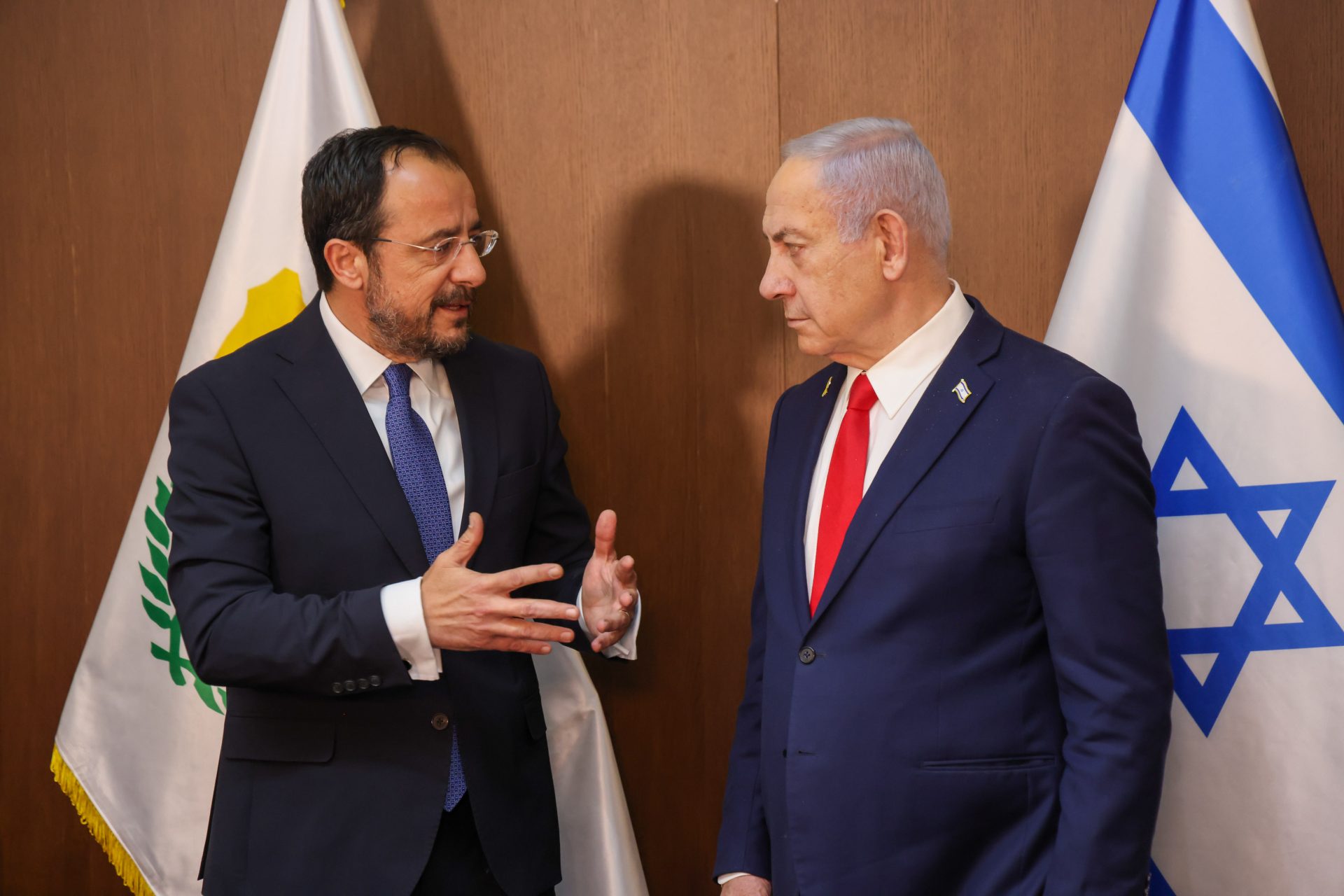
President Nikos Christodoulides and Israeli Prime Minister Benjamin Netanyahu on Sunday held a telephone conversation in which they discussed, among other matters, the Great Sea Interconnector and the planned ‘India-Middle East-Europe Economic Corridor’ (Imec), deputy government spokesman Yiannis Antoniou said.
He said the call came off the back of the trilateral meeting attended by the pair and Greek Prime Minister Kyriakos Mitsotakis last month, and that the pair also discussed “the promotion of cooperation on energy issues” and “defence cooperation between the two sides”.
Additionally, he said, “reference was also made to the progress of the implementation of the United States president [Donald Trump]’s peace plan for Gaza”.
“The two leaders reaffirmed the strategic importance of relations between Cyprus and Israel and their will to continue close coordination and cooperation,” he said.
The reference to the Great Sea Interconnector, which, if completed, will connect the energy grids of Cyprus, Israel, and Greece, comes after Cypriot Energy Minister Michael Damianos had last month insisted that the project “will not collapse”.
Much of the attention related to the project so far has been related to the interconnection of Cyprus and Greece, with the two countries’ governments having appeared to have been at odds over the matter in recent months, though Damianos had on this matter insisted that they now have “a common line on this specific issue”.
This, he said, was “established during the brief discussion” he held with his Greek counterpart Stavros Papastavrou on the sidelines of the European Union’s transport, telecommunications, and energy (TTE) council meeting in Brussels last month.
He said that in that meeting, he and Papastavrou had “agreed that the project is progressing normally”, and that at the same time, “the corresponding assurances were received” from Nexans, the French company contracted to construct the interconnector cables.
Those reassurances were offered after it was reported that Nexans had withdrawn tenders it had put out in relation to the interconnector and informed interested companies that the project is not moving forward in accordance with its set timetable, though the company did not withdraw from the project in its entirety.
Instead, it has been reported that it will issue a revised programme to interested parties as and when needs require.
Cyprus is not a party to the memorandum of understanding regarding the creation of Imec. That memorandum was signed in 2023 at a G20 summit in New Delhi by India, the US, Saudi Arabia, the United Arab Emirates, the European Union, France, Germany and Italy.
The reference to cooperation in the field of defence, meanwhile, comes after Cypriot Defence Minister Vasilis Palmas had been force to deny reports that the governments of Cyprus, Israel, and Greece are planning to combine to create a military “rapid reaction force” to counter Turkish forces in the eastern Mediterranean.
“I am telling you that these issues which have such a high level of decisions are made by the political leadership, and as the political head of the defence ministry, I am telling you that no such issue has been raised and we have not discussed any issue,” he said.
Asked whether the idea would be an “unlikely or fantasy scenario”, he said that “even if a meeting were to take place which had different contents, it would be wrong for us to bring some confidential issues to light”.





Click here to change your cookie preferences