
All the usual culprits prophesying disaster with AI putting its oar in
It’s that time of the year again and also probably good news that Cyprus does not seem to feature in the Doomsday predictions for 2026.
That doesn’t mean that if the rest of the world goes to s**t in 2026, Cyprus will be insulated especially as the island is located in such a volatile region in an increasingly volatile world.
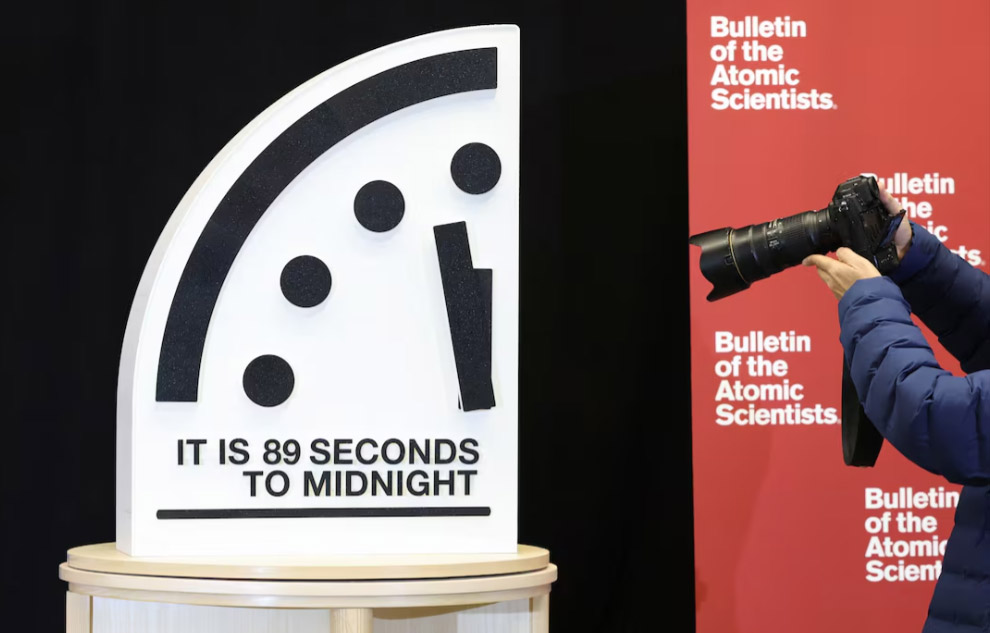
In January 2025 the Doomsday Clock, managed by the Bulletin of the Atomic Scientists was reset at 89 seconds to midnight, the closest it’s been to Armageddon in 78 years. This was based on the ongoing threat from nuclear war, climate change, pandemics and AI technologies.
For 2026 the hand of doom will be updated in mid-January… if we last that long.
In addition to the clock, there’s now a Doomsday Scoreboard (DS) that tracks every single apocalyptic prediction ever made throughout history. The good news is that there are 278 failed doomsdays so far. But 15 are still pending and two are currently active.
It’s been 72 days since the last failed prediction. According to the DS, following two failed Rapture prophecies for September and early October 2025, South African preacher Joshua Mhlakela declared that Jesus revealed to him the “true” dates via a dream and urged believers to prepare. The claim was popular on TikTok… because of course it was.
The dates passed without incident. “Mhlakela offered no follow-up explanation or apology and went silent online,” the website said.
The DS lays out four pending predictions for 2026. Two are still active as they had 2026 as the year of reckoning with 2020 and 2005 as start dates.
The first, based on computer modelling, was predicted by Donella Meadows, et al., MIT System Dynamics Group World3 model team, commissioned by the Club of Rome, an international think-tank founded in 1968 that is composed of scientists, economists, business leaders and former heads of state.
In The Limits to Growth (1972), a well-known report, Meadows and colleagues, modelled global developments. “Their ‘business as usual’ scenario projected industrial output peaking around 2020 and population peaking 2025–2030, followed by decline from resource depletion and pollution,” the DS said. “Later analyses, including in 2024, reaffirm a similar overshoot-and-collapse dynamic.”
Some might say the Club of Rome makes economic and war predictions and then makes them come true – but that’s just conspiracy nonsense like all the other conspiracy theories that were never, ever proven.
The second ‘active’ prediction 2005-2026 is called ‘The Fourth Turning’. In their 1997 book The Fourth Turning: An American Prophecy, historians William Strauss and Neil Howe predicted that between 2005 and 2026 the United States would experience a crisis – a period of social upheaval on the scale of the Revolution, Civil War, or Great Depression. “The cycle is set to resolve by 2026” one way or the other.
The DS also lays out three 2026-specific pending predictions and another that has a time scale of 2026 to 2030.
“Canadian social-media figure – nuff said – Brent Dmitruk claims that a massive tectonic ‘blockage’ will soon rupture, triggering what he calls The Culebra Event. He predicts an earthquake of magnitude 10 to 10.3 will strike Japan by mid-2026, unleashing a chain-reaction of megaquakes worldwide and Pacific-wide tsunamis,” the site says.
This next guy Guy R McPherson, an American scientist, professor emeritus of natural resources and ecology and evolutionary biology at the University of Arizona, was predicting in 2018 that we would have near-term human extinction due to climate no later than 2026. Even climate alarmists say his claims are exaggerated.
Without getting into detail on the remainder, a religious group says an asteroid will end us this year. Another for 2026, is included here for its specific date of November 13. “In 1960, physicist Heinz von Foerster published a paper predicting that on November 13, 2026, human population would reach ‘infinity’, symbolising doomsday via runaway overpopulation.”
It seems however that apart from the computer modelling of the Limits to Growth, and the vague pseudoscience from a few others everything starts veering into woo-woo territory from there on out but no doomsday article would be complete without a mention of Nostradamus. There, done.
But wait, there is a ‘new Nostradamus’ apparently, a young Brazilian named Athos Salome who is said to have predicted the Covid pandemic and the death of Queen Elizabeth.
Salome said of the year ahead that there would be direct confrontation with Russia and the West over the Arctic.
He is also concerned about solar storms in 2026. To be fair, this is a topic that never seems to be given enough coverage. Salome predicts mass disruption and power outages. Anyone could predict that from paying attention to the Nasa and Noaa websites but Salome hones in on March 2026 so he’s really sticking his neck out. We’ll see shortly.
No doomsday predictions would be complete without Bulgarian seer, the late Baba Vanga who is said to have predicted 9/11 and the death of Princess Diana. She reportedly left behind predictions up until the year 5079. Detractors say many are too vague. However, she also ‘saw’ for 2026 the first confirmed contact with aliens in November. Finally.
Baba Vanga’s other warning for 2026 is reportedly that “our civilisation is approaching a moment where it discovers it has gone too far.” Perhaps that’s more of a fact than a prediction, especially in technology.
Speaking of which, the new kid on the block in terms of prophecy would be our new overlords-to-be.
AI predictions for 2026 suggest significant political and social shifts driven primarily by the rapid integration and impact ho-hum… of AI. It’s almost like AI in its own view is the Second Coming.
Then again, the original prophecy did say Jesus would come back on the clouds.
“AI will become a central political topic, AI sovereignty will gain steam,” says the Great Prophet of Tech. “AI will be used as a political weapon, there will be major workforce transformation coupled with increased resistance and public backlash against AI with a possible offline renaissance.”
Oh, no. Surely nothing positive could come of people spending more time offline.
And naturally of course, in the spirit of every Doomsday prophecy ever, AI also predicts potential large-scale natural disasters, economic downturn, dissatisfaction with traditional governments and a possible global war.
Prophecy? No. Just reading the room.




Click here to change your cookie preferences