
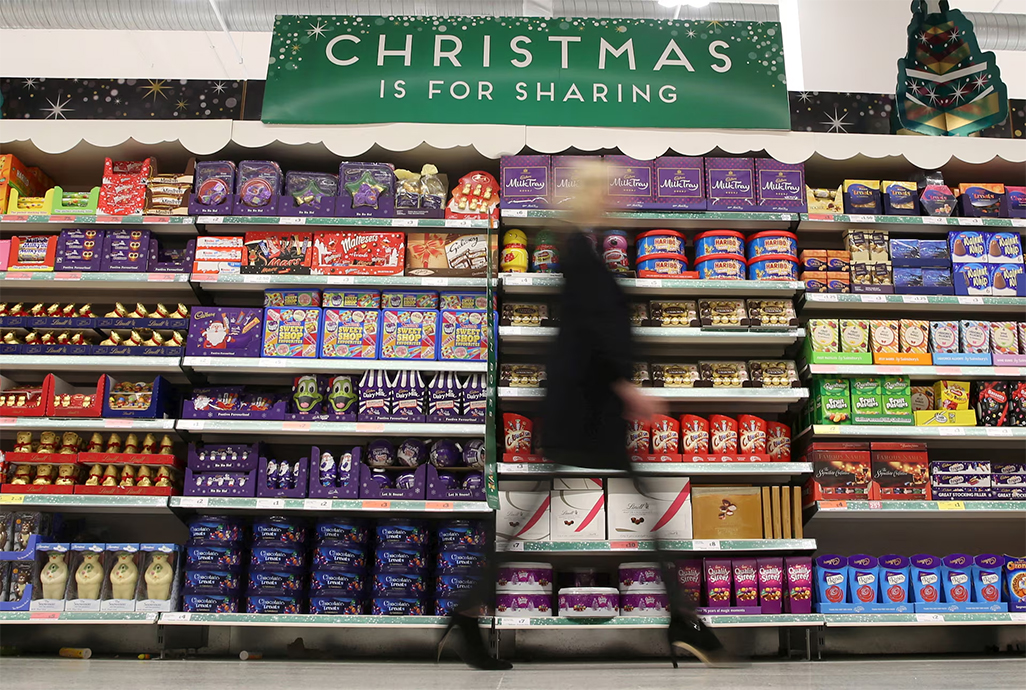
Britons prioritised festive food but thought twice about spending on clothing and gifts over Christmas, trading updates from Tesco, Marks & Spencer and Primark showed on Thursday.
December’s solid food sales offered some relief for major retailers, but lingering consumer caution and stubborn inflation cloud the outlook for 2026.
Tesco, Britain’s biggest food retailer, reported a 3.2% rise in underlying UK sales for the six-week festive period, calling it a “strong” Christmas, with its market share hitting a decade high.
However, with sales growth below the summer’s 4.6% and slightly under analyst forecasts its shares fell 5.5%, paring gains over the last year to 16%.
M&S’ CLOTHING SALES FALL
Marks & Spencer’s underlying food sales jumped 5.6% in the Christmas quarter, but clothing, home and beauty dropped 2.9%, hit by weak demand and the tail end of fallout from last year’s cyber hack.
That dovetailed with Primark owner Associated British Foods ABF.L, which said Britain’s clothing market was “difficult” in the Christmas quarter.
Its shares slumped 12% after it also warned of falling sales in continental Europe and tough trading for its food businesses in the United States. Profit in its 2025/26 year would fall, it said.
Greggs GRG.L, Britain’s biggest fast-food chain, flagged subdued consumer confidence and guided to flat profit this year. CEO Roisin Currie told Reuters she remained cautious about prospects in 2026. Greggs shares fell 7%, extending losses over the last year to 38%.
‘COUNTING EVERY PENNY’
Tesco CEO Ken Murphy said UK consumers were keen to treat themselves at Christmas, with many trading up to premium ranges. Tesco sold 21 million pigs in blankets from its Finest range and 2.5 million bottles of Prosecco, while party food sales soared 22%.
But he said consumer confidence was mixed: “You are seeing consumers whose household budgets are in pretty good shape and then you’re seeing a lot of people that are really counting every penny.”
In 2026, Murphy expects a continuation of the trend of consumers eating more at home rather than dining out to save cash and the building of a trend of people wanting to eat more healthily while still indulging at weekends.
He was unsure whether rising demand for GLP-1 weight-loss drugs in Britain would have a big impact on food sales this year. “We’ll stay very close to how customers are behaving and what they’re looking for and respond accordingly,” he said.
EMPLOYMENT PRESSURES
Recent data and surveys have shown UK consumer confidence remains fragile as unemployment rises. Official data last month showed Britain’s jobless rate at its highest since early 2021.
On Tuesday, fashion retailer Next reported better-than-expected Christmas sales but warned growth would slow in 2026. CEO Simon Wolfson said he feared employment pressures would weigh on spending as the year progresses.
He believes employment is facing the triple pressures of rising costs, increasing regulation, and displacement through mechanisation and AI.




Click here to change your cookie preferences