
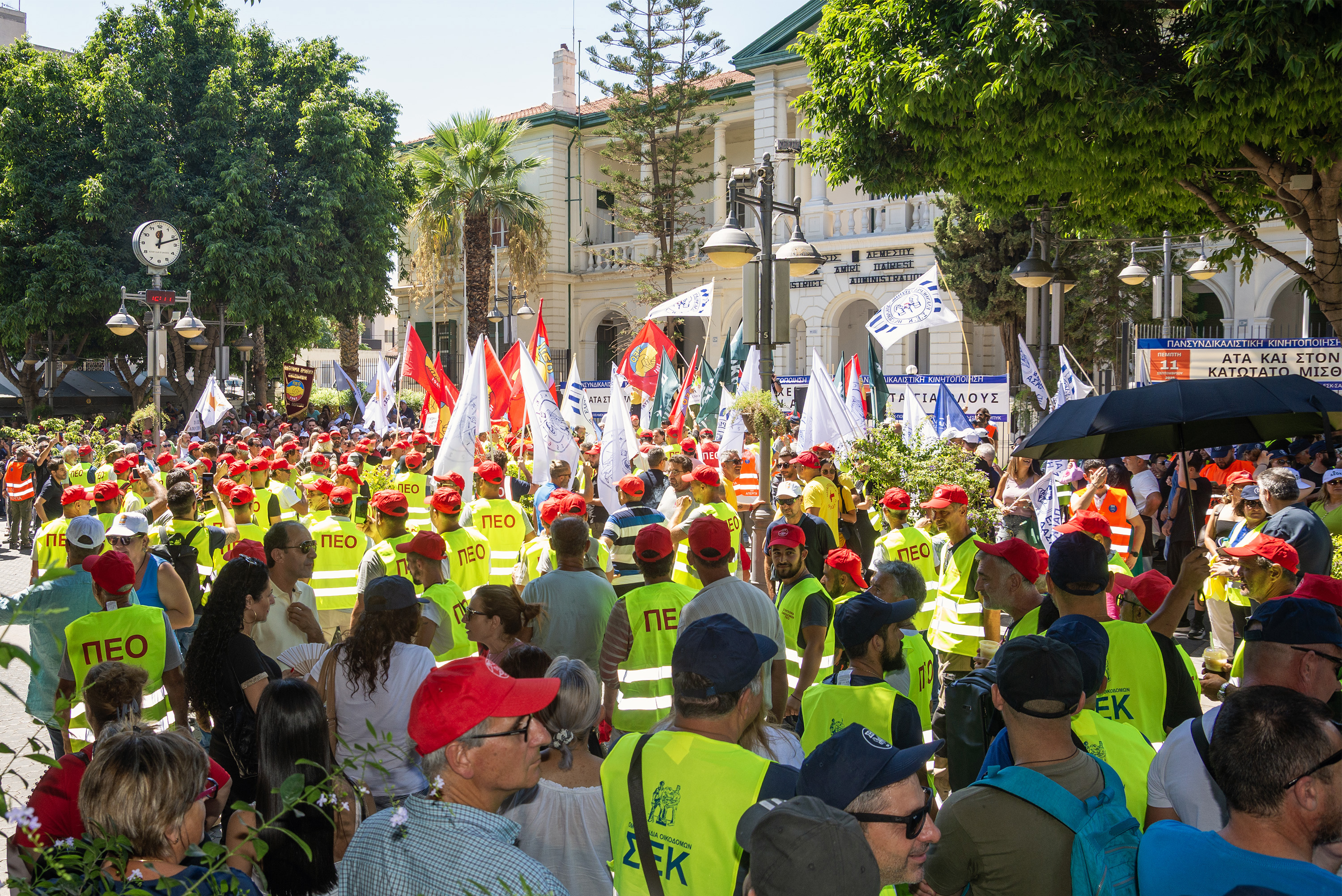
The bosses of the three big unions on Monday sent President Nikos Christodoulides a memo listing four demands regarding the minimum wage, collective agreements, employment of third country nationals and the operation of the Ergani data system.
For the union bosses, the most important issue is the national minimum wage, which they believe is too low even after the 8.8 per cent increase imposed by the state from the start of this year. The minimum wage, which was set at €1000 soon after the election of Christodoulides will now rise to €1,088, but the unions consider this inadequate.
Speaking to Cyprus News Agency, the leader of the Sek union federation, Andreas Matsas, argued that the wage was inadequate and was far off the real needs of the workers at a time of a high cost of living. He tried to introduce some rationality to his case by saying the salary was out of line with median wage and with its hourly rate, before reverting to his emotional discourse. The lowest-paid workers would be left out on limb, said Matsas adding that “we should tell the vulnerable that the debate is over.”
Matsas is playing the communications game, presenting the government as having the choice between helping the “vulnerable” or leaving them to suffer. He knows that Christodoulides is concerned about his public profile and would not want to be seen as uncaring and insensitive to the plight of Matsas’ “vulnerable”.
The president has only himself to blame for this predicament. He should never have become involved in industrial disputes such as CoLA and the minimum wage because now union bosses want to negotiate with him, as if labour relations were the job of the president. Now the three unions want to discuss their four demands directly with the president in the presence of the labour minister. And if the president does not grant them an audience, they could accuse him of not caring about the vulnerable and their “real needs”.
It was a big mistake for the president to engage directly with the unions and creating the impression that his government was happy to intervene in the labour market, setting the minimum wage and increasing CoLA. Increasing the minimum wage by decree every couple of years is not a good practice for a market economy, as it allows the unions to constantly demand that wages are determined by the state rather than by demand and supply.
This is what Matsas is currently doing – pressuring the government to increase, yet again, the minimum wage, which has just been increased by 8.8 per cent. He has decided that the new minimum wage does not cover the real needs of the lowest earners, as if this were an economic argument. How much should it be to cover their needs? €2,000 or €3,000 per month?
Christodoulides must not see the union bosses and accept that he will get a bad press. But he must be make it clear that the government will not be constantly intervening in the labour market and setting a new minimum wage.





Click here to change your cookie preferences