
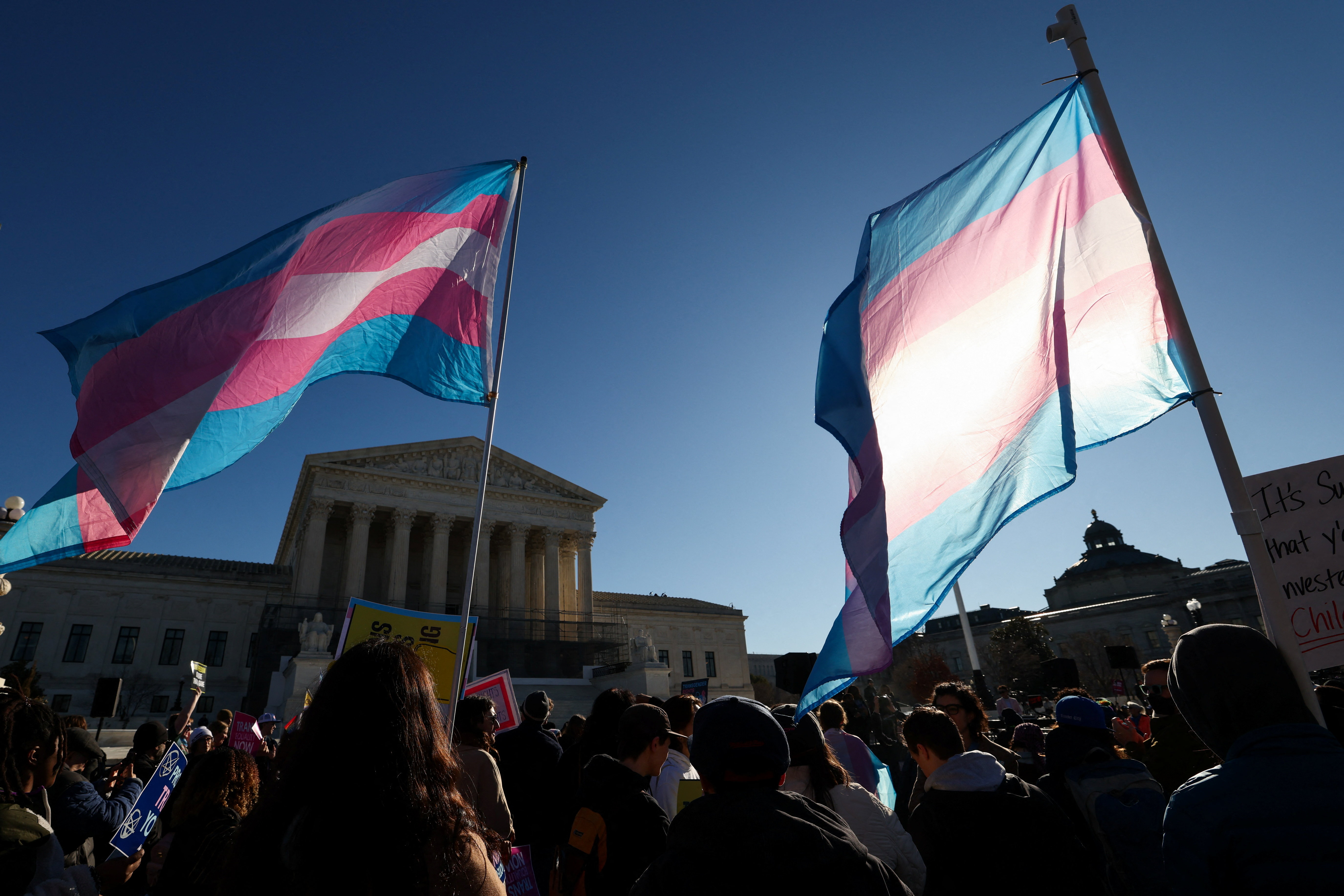
The U.S. Supreme Court heard arguments on Tuesday over the legality of laws banning transgender athletes from participating on female sports teams amid escalating efforts by dozens of states and Republican President Donald Trump’s administration to restrict the rights of transgender people.
The justices are considering appeals by Idaho and West Virginia of decisions by lower courts siding with transgender students who challenged the bans in the two states as violating the U.S. Constitution and a federal anti-discrimination law. Twenty-five other states have similar laws on the books.
Trump’s administration is backing the states in the arguments.
Alan Hurst, Idaho’s solicitor general arguing for the state, kicked off the arguments by defending the state’s law.
“Idaho’s law classifies on the basis of sex, because sex is what matters in sports,” Hurst said. “It correlates strongly with countless athletic advantages, like size, muscle mass, bone mass and heart and lung capacity.”
“If women don’t have their own competitions, they won’t be able to compete,” Hurst added.
The arguments were ongoing.
The case could have wider repercussions for transgender people and affect whether other measures targeting them in the public sphere – including military service, bathroom access, treatment in classrooms and designations in official documents such as passports – can be enforced.
The Idaho and West Virginia laws designate sports teams at public schools including universities according to “biological sex” and bar “students of the male sex” from female athletic teams. The states said the laws preserve fair and safe competition for women and girls.
“Gender identity does not matter in sports, and that’s why Idaho’s law does not classify on the basis of gender identity. It treats all males equally and all females equally regardless of identity. And its purpose is exactly what the (state) legislature said – preserving women’s equal opportunity,” Hurst said.
The challengers claimed that these measures discriminate based on an individual’s sex or status as a transgender person in violation of the Constitution’s 14th Amendment guarantee of equal protection under the law, as well as the Title IX civil rights statute that bars discrimination in education “on the basis of sex.”
Some of the justices focused on how the Idaho law treats people differently, whether based on sex or their status as transgender individuals, and whether that would require the court to more skeptically review the reasons expressed by the states for adopting such measures – a form of judicial review called intermediate scrutiny.
“There’s no question here that a male who identifies as a female, but is a male, is being excluded from a female sport,” liberal Justice Sonia Sotomayor told Hurst. “By its nature, that’s a sex classification. And all sex classifications, we have said repeatedly in our case law, require intermediate scrutiny.”
A HISTORY OF DISCRIMINATION
The court in 2020 delivered a landmark ruling protecting transgender people from workplace discrimination under a different law, called Title VII, that contains wording similar to Title IX.
Conservative Justice Neil Gorsuch, who authored the Title VII decision, questioned Hurst’s claim that the Idaho law does not classify people based on transgender status.
Gorsuch asked Hurst about discrimination in the United States against transgender people in areas such as immigration and family law and statutes involving cross-dressing. “A laundry list,” Gorsuch said.
“There has been some discrimination against transgender people – significant discrimination against transgender people – in the history of this country. The same can be said of many groups,” Hurst responded.
Hurst noted, for example, that women and Black people in the past were barred from voting or property ownership, and said of the discrimination questions raised in the current transgender case: “These things don’t compare. They’re just not alike.”
The Supreme Court, which has a 6-3 conservative majority, backed other restrictions on transgender people in rulings issued last year. It let Trump ban transgender people from the military and bar passport applicants from selecting the sex reflecting their gender identities for the document.
The Republican president has taken a hard line since returning to office last year, casting the gender identity of transgender people as a lie and issuing multiple executive orders to limit their rights including one involving sports participation.
The court last June in a case from Tennessee let states ban medical treatments such as puberty blockers and hormones for people under age 18 experiencing gender dysphoria, the clinical diagnosis for significant distress that can result from an incongruence between a person’s gender identity and sex at birth.
The challenge to West Virginia’s law was brought by Becky Pepper-Jackson and her mother Heather Jackson. Pepper-Jackson, now 15 years old and in 10th grade, attends high school in Bridgeport, West Virginia and participates in shot put and discus.
The Idaho challenge was brought by Lindsay Hecox, a transgender Boise State University student who previously participated in soccer and running clubs at the public university.
Hecox, 25, recently decided to quit playing sports and sought to dismiss the case in part due to a fear of harassment and growing intolerance toward transgender people. Hurst argued that this does not make Hecox’s challenge moot.





Click here to change your cookie preferences