

Staffing crisis exposes deeper problems in Cyprus’ public transport system
A persistent shortage of bus drivers has forced the suspension of Nicosia’s park-and-ride Pame Express service, exposing deeper structural challenges in Cyprus’ public transport system at a time when the country already records the lowest public transport usage in the European Union.
Cyprus Public Transport (CPT), the operator responsible for bus services in the Nicosia and Larnaca districts, announced that the Pame Express route linking the GSP Stadium park-and-ride facility with central Nicosia will be suspended from Monday, March 23.
The company clarified that the decision concerns only the Nicosia route, while other services remain in operation.
CPT explained that the decision was unavoidable after months of attempting to maintain the service despite a lack of drivers.
“The reason we are proceeding with the suspension of the service is none other than the lack of workforce,” CPT financial director Tryfonas Hadjichristos told CyBC radio.
“The shortage of drivers is a nationwide problem, affecting our company as well as other operators.”
The Pame Express service was designed as a fast park-and-ride connection intended to reduce congestion in central Nicosia by encouraging commuters to leave their cars at the GSP stadium and complete the final leg of their journey by bus.
According to the operator, the service relied on a small group of drivers dedicated exclusively to the route.
“Seven drivers were assigned specifically to the express service,” Hadjichristos said.
“With those seven drivers we were running about 80 routes per day, but we have been forced to divert drivers from other lines to keep it running.”
As staffing pressures intensified, the company faced a choice between maintaining core bus routes or continuing the additional express service.
“We are obliged by contract to operate the main line services,” he said.
“The express is an additional service, even though it has been very successful.”
The suspension therefore reflects operational priorities rather than weak demand.
“This is a service we want to keep, but when there are not enough drivers, we have to prioritise the base network.” Hadjichristos admitted.
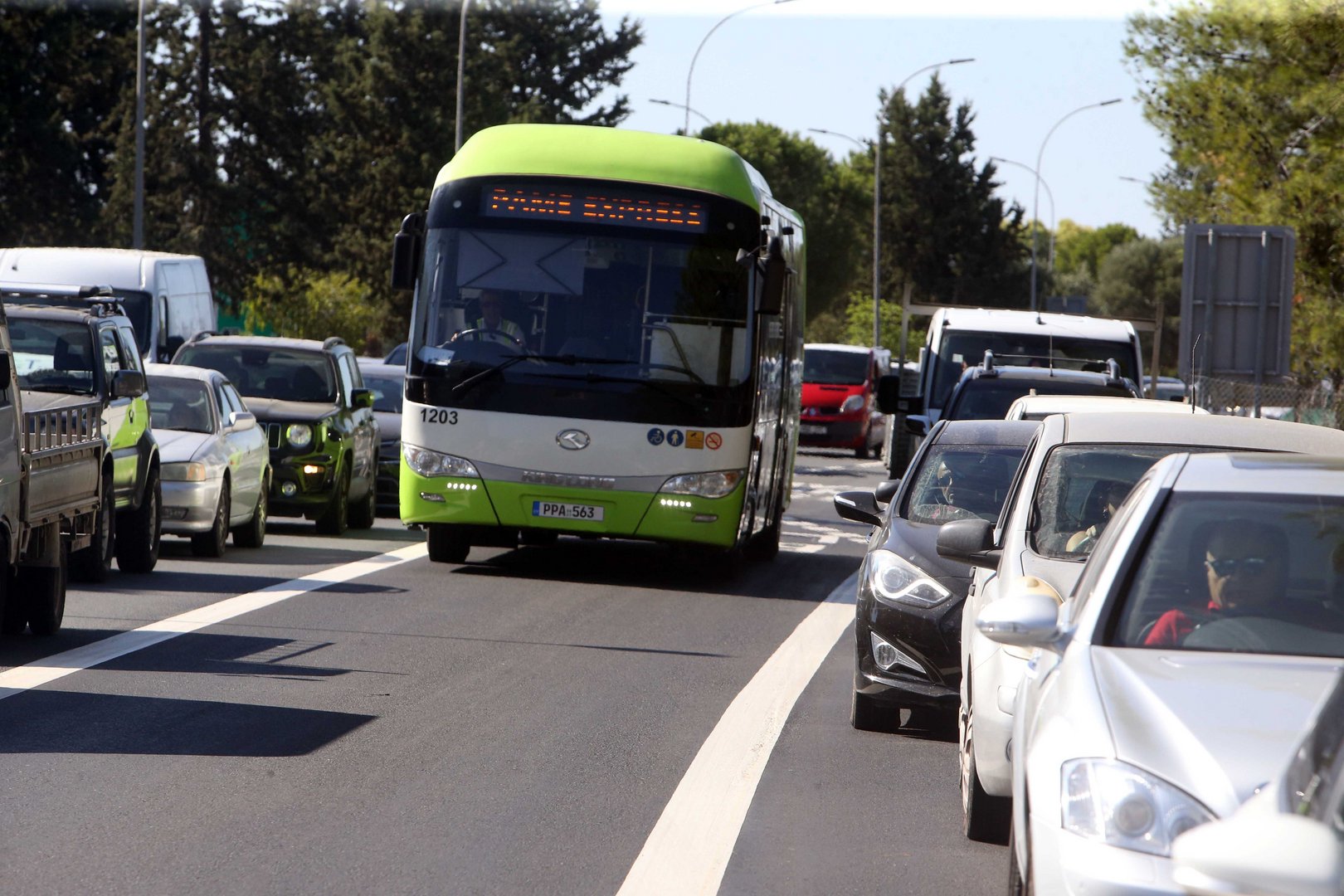
The issue has triggered a dispute over responsibility between the operator and the transport ministry.
CPT informed the government of the suspension through a formal letter earlier this month, prompting criticism from officials who argued the company is contractually responsible for maintaining sufficient staff.
Transport ministry spokesman Antonis Constantinou confirmed that the government had been notified but emphasised that recruitment remains the operator’s responsibility.
“The company sent a letter informing us that the service will stop on March 23 due to a lack of drivers,” he remarked.
“But it is the company’s responsibility to provide drivers under the terms of its contract.”
Constantinou acknowledged that the reality of a labour shortage yet stressed that regulatory constraints complicate recruitment.
“In Cyprus the law requires bus drivers to be at least 24 years old and to speak both Greek and English,” he said.
“In many European countries the minimum age is 21, so we are examining how national legislation can be aligned with European rules.”
However, he warned that legal changes cannot be implemented quickly.
“Adjusting national law to meet European requirements is a process that cannot happen overnight,” Constantinou cautioned.
“The ministry is in communication with the company, but legislative changes require careful consideration.”
Industry figures say these requirements significantly narrow the pool of potential recruits.
Hadjichristos described the language rule as a major obstacle when trying to hire drivers from abroad.
“There is free movement of workers across the European Union, but in Cyprus the driver must speak Greek well,” he said.
“That becomes an obstacle because many potential drivers cannot meet that requirement.”
Professional drivers must obtain a category D licence and a certificate of professional competence, qualifications that typically take several months to complete.
Training from beginner to professional driver usually takes around seven to eight months, with written examinations administered by the road transport department and available in English, Greek or Turkish.
The total cost of training, certification and driving lessons from beginner to fully qualified professional driver is approximately €1,600.
Recruitment difficulties are also linked to the ageing profile of the workforce.
![Cyprus Public Transport insisted that its workers "now operate brand new, air-conditioned buses and benefit from a fundamentally improved working environment" [Photo: CNA]](https://cyprus-mail.com/wp-content/uploads/2025/07/DOC.20250731.8834076.apergia-larnaca.jpg)
“Drivers are leaving faster than they are being replaced,” Hadjichristos said.
“As older drivers retire, staff numbers are simply not being renewed at the same rate.”
While the problem is acute in Cyprus, the driver shortage is not unique to the island.
Across Europe, transport operators are struggling to fill vacancies as the workforce ages and fewer younger workers enter the sector.
According to the Confederation of Passenger Transport, Europe faced a shortfall of more than 4,000 bus and coach drivers as of late 2025.
In response, the EU has approved legislation allowing member states to lower the minimum age for bus drivers from 24 to 21, and in some cases 18 if additional professional qualifications are held.
The directive is intended to expand the recruitment pool, though national governments retain discretion over whether to adopt the lower age limits.
Member states have until 2028 to amend their legislation.
Safety advocates have expressed concern over the proposal.
The European Transport Safety Council warns that younger drivers are statistically more likely to be involved in serious road accidents.
Research cited by the organisation shows that drivers aged 18 to 24 are involved in more injury or fatal collisions per 10,000 licences than older drivers, partly due to inexperience and risk-assessment factors.
Higher wages have also not fully resolved recruitment difficulties.
Salaries for bus drivers in Cyprus generally range from about €1,500 to more than €2,000 per month, with total earnings potentially reaching €3,000 including overtime and bonuses.
Operators typically offer additional benefits such as a 13th salary, provident fund contributions and training programmes to attract candidates.
Yet, the profession still struggles to compete with other sectors.
Across Europe, improving working conditions has become a central focus in efforts to retain drivers.
Reports from Transport for London indicate that mental health pressures and musculoskeletal injuries are among the leading causes of long-term sick leave among bus drivers, reflecting the physical demands of the job.
These factors underline broader structural challenges for public transport in Cyprus, where the transport system operates in a country heavily dependent on private cars.
Data from Eurostat shows that in 2024 Cyprus recorded the lowest use of public transport in the EU, with 85 per cent of the population reporting they did not use buses or other public transport services at all during the year.
By comparison, the EU average share of people who did not use public transport was 50.6 per cent.
Countries such as Luxembourg, Estonia and Sweden reported the lowest levels of non-usage.
Despite relatively high numbers of buses per capita compared with some European countries, Cyprus lacks alternative public transport systems such as metro, tram or light rail networks.
As a result, buses remain the only mass transit option, while high car ownership continues to dominate mobility patterns.
The Pame Express service was introduced partly as an attempt to change that imbalance by offering commuters a faster and more convenient route into central Nicosia.
While the route itself proved popular with passengers, staffing shortages made it increasingly difficult to sustain alongside core bus services.
Hadjichristos said the company continues to search for solutions and is working with the transport ministry to expand recruitment.
Speaking to the Cyprus Mail, he said regulatory and administrative requirements continue to restrict the pool of available drivers even as the company attempts to broaden hiring.
“Before 2023, someone had to live in Cyprus for six months to obtain a local criminal record certificate before they could work as a driver,” he said.
“That has now changed for European Union citizens. Their criminal record from their home country can be accepted.”
However, he said the language requirements continue to create complications.
“The contract requires drivers to speak both Greek and English,” he said.
“But in reality many drivers themselves struggle with English, so the requirement should not become such a major obstacle.”
Under EU transport directives governing professional drivers, companies must ensure that drivers possess sufficient language skills to understand safety instructions, regulatory documentation and operational communication in the country where they work.
In Cyprus, this effectively requires a working knowledge of Greek for many roles, a condition industry representatives say further complicates recruitment from outside the EU.
particularly for companies seeking to employ third country nationals in the sector.
Recruitment could also expand, industry figures suggest, if similar administrative flexibility were extended to third-country nationals.
Under current rules, non-EU citizens must still reside in Cyprus for at least six months before obtaining a local criminal record certificate.
Transport operators say recognising criminal record checks issued in drivers’ home countries, as is already done for EU citizens, could significantly expand the available labour pool.
Hadjichristos also rejected suggestions that the shortage could be resolved simply by reallocating drivers from other routes.
“If we start moving drivers from less popular lines, then we leave other communities without a service, this is not a realistic solution”, he stressed.
According to him, the suspended park-and-ride route had in fact been one of the system’s stronger-performing services.
“Pame Express was one of the most successful routes we had,” he said. “At one point we were even proposing around 13 additional express routes because the concept was working.”
However, the fundamental problem remains a lack of workers willing to enter the profession.
“Of course it would be ideal if more Cypriots wanted to do this job,” he said.
“But the reality is that many simply do not want this type of work, much like what we see in the service sector.”





Click here to change your cookie preferences