
By Dawoud Abu Alkas, Catherine Cartier, Edward Carron and Rami Ayyub
As Israel moved the blocks marking its armistice line with Hamas deeper into one Gaza neighbourhood in December, it destroyed dozens of buildings and displaced Palestinians in violation of a U.S.-backed ceasefire deal, according to satellite imagery reviewed by Reuters and resident testimony.
In areas across Gaza, Israel has placed the concrete blocks meant to demarcate its “Yellow Line” dozens or sometimes hundreds of metres inside Hamas-controlled territory, and its military has built up at least six fortifications to station troops, the satellite imagery shows.
The imagery depicts how Israel has unilaterally shifted its line of control in Gaza — and cordoned off more land where Palestinians could live — even as President Donald Trump presses ahead with a ceasefire plan that calls for further Israeli troop withdrawals.
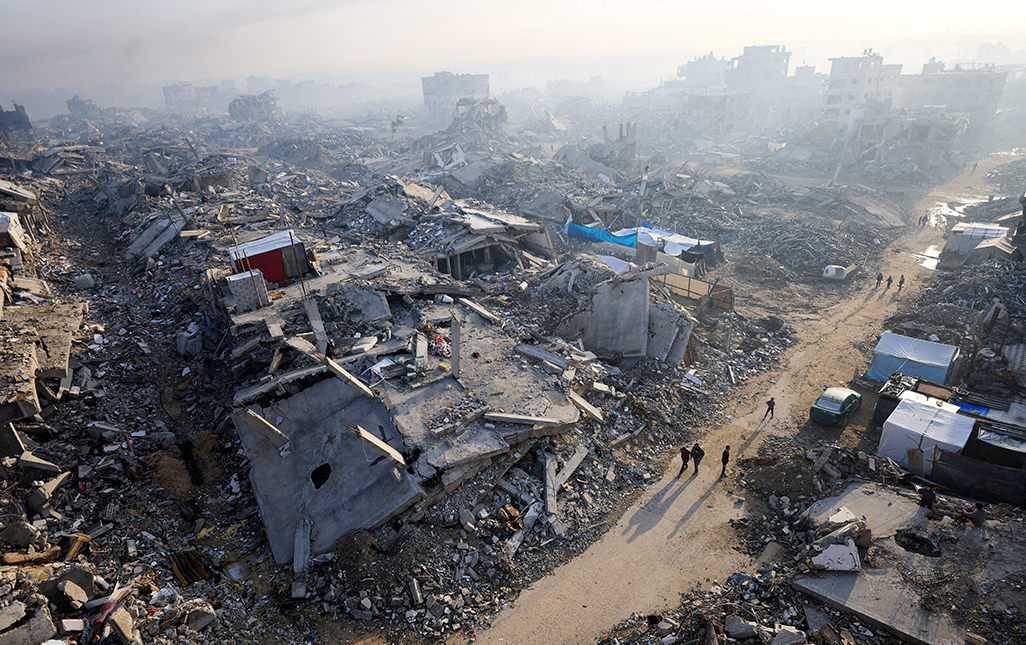
Nowhere is Israel’s widening zone of control more stark than in Al-Tuffah, once a historic quarter of Gaza City but now a wasteland of destroyed buildings and mangled metal following two years of Israeli bombardment.
Thousands of Palestinians took shelter in Al-Tuffah after the October ceasefire, which was meant to see Israeli troops retreat to a yellow line marked on military maps that runs nearly the full length of Gaza and hugs the neighbourhood’s eastern edge.
But satellite images of Al-Tuffah taken December 2 and 13 show that Israel initially placed blocks on the Hamas-controlled side of the Yellow Line and then moved them roughly 200 metres further in.
After moving the yellow-painted blocks, the military began razing the area, destroying at least 40 buildings, a Reuters analysis of the imagery shows. Few buildings remain standing between the newly positioned blocks and the Yellow Line.
It was unclear how Israel demolished the buildings. In the past, it has used a combination of aerial bombardment, controlled explosions and bulldozers to raze structures.
The Israeli military said it was checking Reuters’ questions on why the blocks were moved and why the buildings were destroyed. The military has said it has continued operations against Hamas since the ceasefire, including by targeting its tunnel network under Gaza.
A military source said it was not possible to mark the Yellow Line exactly as it appeared on maps because homes, buildings or other obstacles often stand in the way. The source described the yellow line depictions published by the military and the Trump administration as “illustrations”.
Trump’s 20-point plan to end the Gaza war, which underlies the ceasefire deal, called for an immediate halt to fighting, saying: “All military operations, including aerial and artillery bombardment, will be suspended, and battle lines will remain frozen until conditions are met for the complete staged withdrawal.”
‘FORCED TO LEAVE’
Manal Abu Al-Kas is one of many Palestinians who say they were forced to flee eastern Al-Tuffah after Israel moved the blocks beyond where they were living.
Abu Al-Kas and her husband said two sons had been killed and buried in Al-Tuffah along with other relatives. She said the family was living happily there, “until they put up these yellow stones and we were forced to leave” and she fled, along with her husband and another son, both of whom had legs amputated.
The military moved the blocks in mid-December and they decided to flee in January, she said, adding: “If there weren’t shells falling on us in our homes, we wouldn’t have left our house.”
Beyond Al-Tuffah, the satellite imagery shows that Israel has placed the blocks firmly in Hamas-controlled territory in areas across Gaza.
In Khan Younis, in southern Gaza, the military in December placed a block some 390 metres beyond the line, the images show, and another about 220 metres beyond it.
During that time, multiple buildings were destroyed and two tent clusters meant to house displaced people were dismantled, the images show.
The imagery also shows the military has built up at least six large fortifications, all on the Israeli side within 700 metres of the line of control. One of them, in Beit Hanoun in north Gaza, is around 264 metres from the line.
The military said it was checking Reuters’ questions on Khan Younis and on the fortifications. The military source said the fortifications, crafted mostly from mud and earth, were temporary in nature and meant to protect troops from incoming fire.
‘CRAMMED INTO A NARROW STRIP’
Hazem Qassem, a Hamas spokesperson, said the Yellow Line’s expansion had caused thousands to flee west.
“It also means that the entire people of the Gaza Strip will be crammed into a narrow strip in the west of the Gaza Strip, in an area that is less than 30% of the strip’s area,” Qassem said.
The U.S.-backed deal called for a complete ceasefire but left Israel in control of well over half of Gaza, with further troop withdrawals tied to Hamas disarmament. On Thursday, Trump launched his “Board of Peace” after announcing a Palestinian technocratic committee last week in a bid to move the deal to its next phase.
Nearly all of Gaza’s 2 million people have been forced into a narrow coastal strip where Hamas has retained control and where most live in tents or damaged buildings. Officials have voiced concerns about a de facto partition of the territory, with reconstruction likely to be limited to Israeli-controlled areas.
Israel has repeatedly shot at people in areas around the Yellow Line since the ceasefire deal was struck in October, often accusing militants of trying to cross the line or attack troops.
In Al-Tuffah, videos taken in early January and verified by Reuters show Israel flying quadcopters, or small drones, over buildings some 500 metres inside the Yellow Line as it patrols the area. The military had no comment on its use of quadcopters.
More than 460 Palestinians, including many children, have been killed by Israel since the October deal came into effect, according to Gaza medics, while militants have killed three Israeli soldiers. Both sides have accused each other of ceasefire violations.
Israel launched its offensive in Gaza after a Hamas-led cross-border attack on October 7, 2023 that killed 1,200 people, according to Israeli tallies. Israel’s assault has killed 71,000 Palestinians, Gaza’s health authorities say.





Click here to change your cookie preferences