
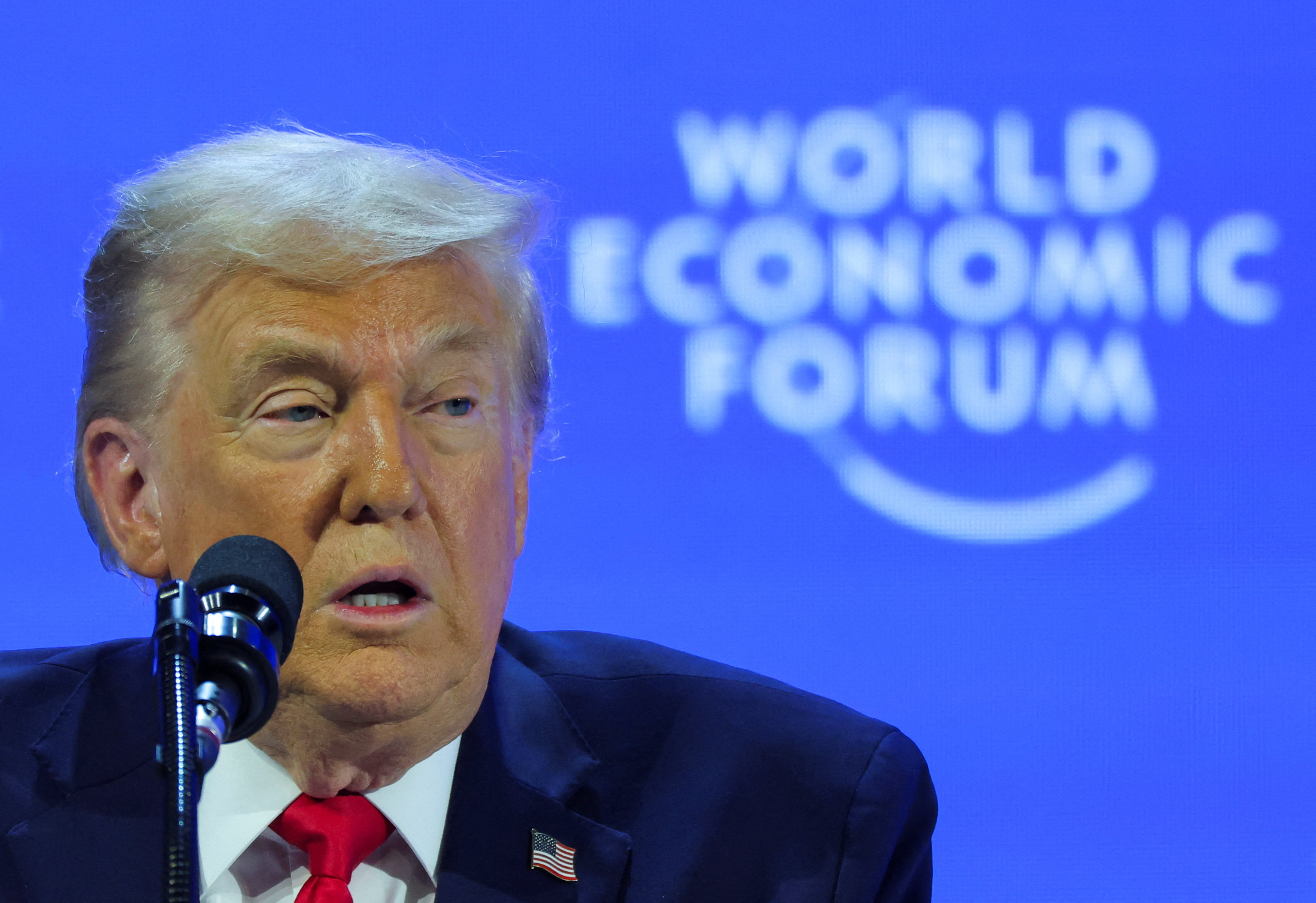
Basically, nothing unless he personally, and then the US, stands above everybody else in every field
Economists have long tried to tackle the question of how much is enough without reaching any conclusive answer. This, of course, is no different from many other questions confronting our much-maligned profession.
Today, however, I want to approach it from a slightly different angle, in the hope that doing so sheds some light on the increasingly odd behaviour of US President Donald Trump. From whatever perspective one examines it, the recent publication in The New York Times of a text exchange between the presidents of Norway and Finland on the one hand and Trump on the other highlights the bizarre state of mind of the US president. I reproduce the exchange below in full.
Text message from Mr Støre to Mr Trump on Sunday, Jan. 18, 3:48 p.m.:
Dear Mr President, dear Donald – on the contact across the Atlantic – on Greenland, Gaza, Ukraine – and your tariff announcement yesterday. You know our position on these issues. But we believe we all should work to take this down and de-escalate – so much is happening around us where we need to stand together. We are proposing a call with you later today – with both of us or separately – give us a hint of what you prefer! Best – Alex and Jonas
Text message from Mr Trump to Mr Støre on Sunday, Jan. 18, 4:15 p.m.:
Dear Jonas: Considering your country decided not to give me the Nobel Peace Prize for having stopped eight wars, PLUS, I no longer feel an obligation to think purely of peace –although it will always be predominant – but can now think about what is good and proper for the United States of America. Denmark cannot protect that land from Russia or China, and why do they have a “right of ownership” anyway? There are no written documents; it’s only that a boat landed there hundreds of years ago – but we had boats landing there also. I have done more for Nato than any other person since its founding, and now Nato should do something for the United States. The world is not secure unless we have complete and total control of Greenland. Thank you! President DJT.
For Trump, it is increasingly evident that nothing is ever enough – unless he personally, and then the United States as a country, stands above everybody else in every field and by every conceivable yardstick. This mindset is cultivated within modern capitalism to ensure that we continue consuming and buying more, not because we genuinely need these goods, but because we feel compelled to measure ourselves against neighbours and friends. We fall into the trap of striving for the bigger car, the more exotic holiday, or whatever else elevates us within an imaginary pecking order of our own making.
Nowhere is this notion more prevalent than in the United States. Although the desire to come first emerges at a very young age, many societies gradually come to recognise that cooperation, not antagonism, is perhaps more valuable. As we grow older, we teach our children compassion and empathy, and that they do not always have to be first to be happy. In the US, these ideas appear less deeply embedded, and in the case of Donald Trump, he seems to have missed that lesson altogether. The “America First” doctrine springs directly from this worldview.
The implication is that governments are no longer focused solely on their country’s absolute well-being, but increasingly on their relative position vis-à-vis others. This distinction may sound subtle, but it matters deeply. A paper co-authored by World Bank economist Aaditya Mattoo, together with Michele Ruta and Robert Staiger (Geopolitics and the World Trading System), makes this point clearly. An “absolute welfare” mindset supports trade cooperation, but unravels, the authors argue, “if rivalry eclipses any consideration of own-country well-being”. Trump’s angry rhetoric about America being “ripped off” by competitors reflects precisely this shift in mentality.
For decades, America was content, as the leading global power, to promote cooperation and draw the rest of the world into greater prosperity, secure in the knowledge that its own absolute well-being was rising as well. No longer. Trump is dissatisfied unless the United States also boasts the highest growth rates. In his own words, the US must be “the hottest country on earth”, even if, in the process, it incinerates the common values that bind the world together.
The text exchange above illustrates this point clearly. Trump’s fixation on winning the Nobel Peace Prize appears motivated not by a genuine desire for peace, but by the urge to rank above President Obama, who was awarded the prize. His claim that he has done more for Nato than any individual since its founding is another example of his need to top an imaginary league table that exists largely in his own mind.
Against this backdrop, it is unlikely that anything will ever satisfy Trump: for him, nothing is enough. After posting on social media an AI-generated image of himself planting the American flag on Greenland, he followed it by sharing a map of North America depicting Greenland and Canada as parts of the United States.
Canadian Prime Minister Mark Carney has described the changes in the global order as a rupture rather than a transition. In a forceful speech that received a lot of praise at Davos, he emphasised the need for countries that share common values to stand together and resist Trump’s approach. Undoubtedly, there are dangers ahead. The recent deployment of a small number of European Nato troops to Greenland was a step in the right direction.
Trump’s reaction was characteristically ferocious: he threatened new tariffs on those countries and escalated his rhetoric that Greenland would become part of the United States “one way or the other”.
Yet amid the chaos and anxiety triggered by Trump’s bullying tactics, there are signs that he may have overreached. His erratic behaviour – both over Greenland and in his attempted power grab at the Federal Reserve – appears to have emboldened some Republican senators to take a firmer stance. It seems increasingly likely that the additional tariffs he announced lie beyond his unilateral powers and will require Senate approval.
By the time of writing this, Trump appeared to back down in Davos, saying that he ruled out military intervention in Greenland and that imposing tariffs were off the table for now, as he had agreed a Greenland negotiations framework with Nato secretary-general Mark Rutte. At the same time the US Supreme Court after hearing oral arguments, appears to have indicated that the dismissal of Fed governor Lisa Cook was not likely to be successful.
It is too early to tell what exactly influenced President Trump to call a temporary truce over Greenland. The abrupt fall in financial markets, the sign of a united front by Europeans, the pushback by Republican senators? Whatever the case, we can only hope that, at last, on the one-year anniversary of Trump coming to power, there are individuals who are willing to draw a line to the insatiable desire for more and say to the president that enough is enough.
P.S. Readers interested in the broader question of “how much is enough” may wish to consult Edward and Robert Skidelsky’s 2012 book, How Much Is Enough? Money and the Good Life.





Click here to change your cookie preferences