
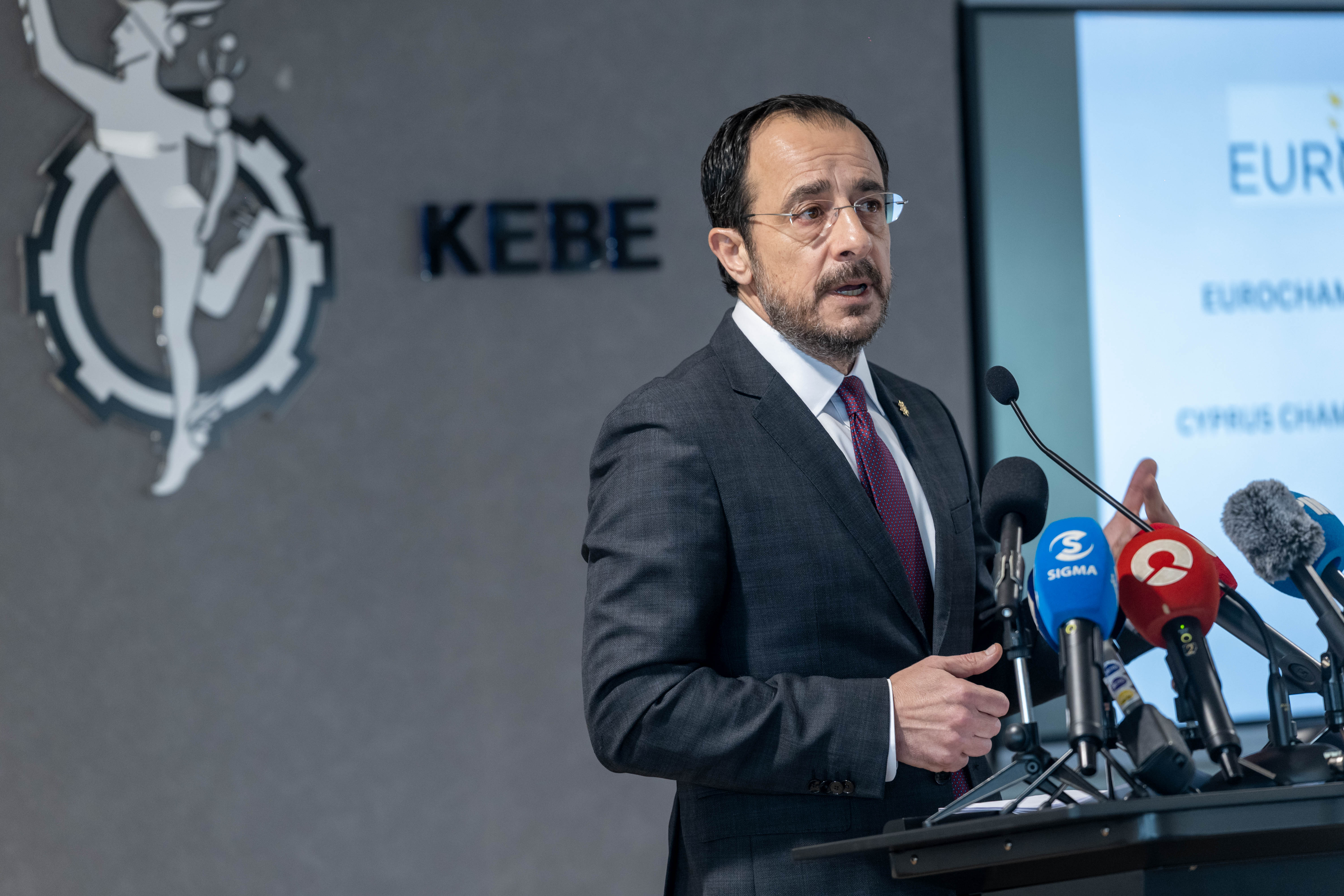
President Nikos Christodoulides on Thursday outlined Cyprus’ business, trade and competitiveness priorities at the Eurochambres presidency meeting hosted by the Cyprus Chamber of Commerce and Industry (Keve) in Nicosia.
Addressing the gathering of the Brussels-based network, which represents 1,700 regional and local chambers across the EU, Christodoulides framed Cyprus’ agenda as closely aligned with the interests of European businesses, particularly in the context of the country’s assumption of the Presidency of the Council of the European Union.
“Your presence here at this particular juncture, less than a month after we assumed the Presidency of the Council of the European Union, truly matters,” the president told European chamber leaders.
Christodoulides stressed that a close partnership with the business community is now more critical than ever for Europe.
“At this very moment, when we need to build the union up, a very close partnership with the business community is more vital than ever,” he stated.
The president described Eurochambres as a key institutional partner for the EU’s economic direction.
“Eurochambres, as the representative network of more than 20 million companies, is the leading voice for the broad business community at EU level,” he said.
Turning to trade and investment, Christodoulides highlighted an upcoming visit to India in May as a strategic priority for Cyprus and European business ties.
“I consider the invitation from the Prime Minister of India to be a particularly important development,” he remarked on the sidelines of the meeting.
“He was in Cyprus and in less than a year he has officially invited us to India,” Christodoulides added.
The visit, he explained, will have a strong commercial focus.
“The trip will include New Delhi and Mumbai, which is India’s business centre, and I will go there together with a business delegation,” he said.
He also clarified that a business forum will be organised as part of the visit to strengthen commercial links.
Christodoulides said the visit comes at a pivotal time for EU-India relations following recent developments at European level.
“Following the announcements by the president of the European Commission and the president of the European Council in India on the completion of negotiations for the trade agreement, I consider this to be particularly important,” he explained.
India’s growing interest in Cyprus was presented as a strategic opportunity for European companies.
“We are seeing India approaching Cyprus as the entry point to the EU, to the single market of 450 million people,” Christodoulides said.
“And we have already seen investments in our country from Indian companies,” he added.
In his address, the president placed competitiveness at the core of Cyprus’ EU Presidency agenda.
“The Cyprus Presidency is a responsibility and an honour that we undertake with a deep sense of duty and ambition, with a single, central aim, to deliver for Europe and for its citizens,” he stressed.
He described Europe as standing at an inflection point amid global instability.
“A union that stands boldly in a world that is rapidly shifting, stable and reliable in a backdrop of instability and unpredictability,” he said.
Christodoulides argued that economic strength is inseparable from geopolitical relevance.
“We cannot truly be a global strategic actor as a Union without being competitive,” he underlined.
Referring to the war in Ukraine, the president warned against complacency.
“It shattered our long-held assumption, illusion even, that stability in Europe can be taken for granted,” he said.
From Cyprus’ perspective, security and resilience are not abstract concepts, he explained.
“From this corner of our Union, as a frontline member state in a volatile region, it is absolutely clear what is at stake,” he stated.
He said that European autonomy has moved from theory to necessity.
“European autonomy is no longer debatable, it is not theoretical, it is an imperative that we need to deliver on with urgency,” Christodoulides said.
Moreover, he linked autonomy directly to business fundamentals. “Autonomy is also the foundation of European competitiveness,” he explained.
“It translates into affordable and secure energy, resilient supply chains, strong industrial capacity, modern digital networks, and a single market that works without fragmentation,” he added.
The president emphasised that openness remains central to Europe’s economic model.
“Autonomy is not about turning inwards, it is about being extrovert from a point of internal strength,” he said.
Competitiveness and simplification were identified as immediate priorities for the EU.
“Europe must regulate better, not more,” Christodoulides stated.
“Reducing administrative burden, cutting red tape and simplifying reporting obligations will be a cross-cutting priority for our Presidency,” he explained, referring to the Omnibus Simplification Packages.
On trade policy, the president stressed the importance of a more extrovert EU approach.
“If we truly aspire to be a global power, we must deepen partnerships, including through free trade partnerships,” he said.
He highlighted the strategic importance of Europe’s south-eastern neighbourhood and the Gulf.
“This region, our neighbourhood, the greater Middle East, must be part of the equation,” Christodoulides said.
He referred to Cyprus’ recent diplomatic and economic engagement in the Gulf, including Bahrain.
“The wider Middle East and Gulf is vital for the EU precisely because it is inextricably linked with Europe’s long-term security and prosperity,” he explained.
Turning to public finances and growth, the president pointed to Cyprus’ recent economic performance as evidence of reform momentum.
“Numbers speak louder and clearer,” he told the audience.
“In 2024 we achieved a growth rate of 3.9 per cent, one of the highest in the eurozone,” Christodoulides said.
“The forecast for 2025 is more than 3.2 per cent and I expect it to be close to 4 per cent,” he added.
Labour market performance was also highlighted. “Unemployment has fallen below 5 per cent, with youth unemployment showing the largest decline among EU countries,” he said.
On fiscal metrics, Christodoulides pointed to improving debt dynamics. “The primary surplus for 2024 has exceeded 4 per cent, while public debt is already below 55 per cent of GDP,” he stated.
He also underscored the importance of restored investor confidence. “For the first time since 2011, all major rating agencies have restored Cyprus to ‘A’ investment-grade status,” the president said.
Furthermore, Christodoulides linked Cyprus’ domestic reforms with its European ambitions.
“Cyprus stands not only as a symbol of resilience, but as a European economic success story,” he said.
“Our presidency is committed to listening, engaging and above all delivering,” he concluded.





Click here to change your cookie preferences