
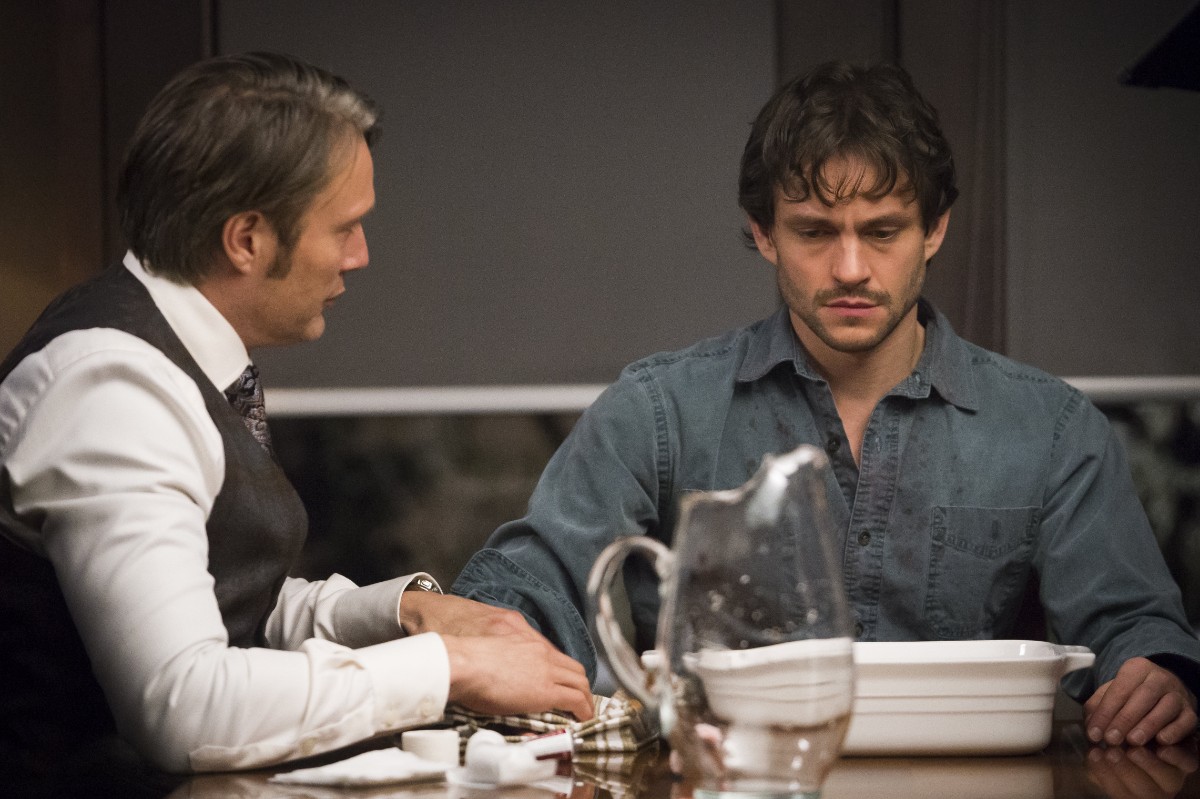
Hannibal proved not so much a crime series as a staged baroque performance, a modern opera disguised as cable television. Bryan Fuller’s adaptation of Thomas Harris’ mythology rejects realism in favour of ritual and esoteric symbolism.
From its opening moments, the show announces that it will operate on a different register, one where psychology and violence is choreographed with almost religious duty. Episodes unfold like movements rather than plots, driven by mood, repetition and escalation.
The show is not interested in how crimes are solved, but in what they reveal about desire, identity and transformation.
At the centre of this dark opera is Mads Mikkelsen’s Hannibal Lecter, a figure of exquisite control. Mikkelsen plays him as a conductor presiding over human weakness, guiding others toward ruin with a soft voice and a sartorial wardrobe to match.
His Lecter is not flamboyant but precise, every gesture economical, every pause deliberate.
He believes beauty justifies cruelty, and the show dares the viewer to consider the argument.
Hugh Dancy’s Will Graham is his tragic counterpart, the fragile tenor to Hannibal’s baritone. Will’s character renders him porous, unable to distinguish his own thoughts from those he pursues manically.
Dancy gives a performance of raw exposure, charting Will’s descent into delirium not as madness but as an awakening that feels both terrifying and inevitable.
Their relationship is the true narrative engine of the series, eclipsing law enforcement, morality and even plot.
It is here that Hannibal reveals its most daring dimension, especially considering its release in 2013, the unmistakable romantic undercurrent between its two leads.
Hannibal does not merely wish to destroy or dominate his counterpart, but to be known by Will and more disturbingly shape him in his own image. The show treats their connection as a romance warped by predation and consent, echoing the grand traditions of tragic opera, where desire and death are inseparable.
Hannibal’s seduction of Will is framed as an act of aesthetic creation, and Will’s resistance carries the anguish of someone fighting both corruption and longing. Few television series have explored obsession with such frankness or such elegance.
Hannibal is certainly not one for casual viewing, its tone unyielding, its pleasures certainly disturbing. Yet for those willing to engage on its terms, it stands as one of television’s most audacious achievements.
Hannibal runs for three seasons on Prime Video.





Click here to change your cookie preferences