
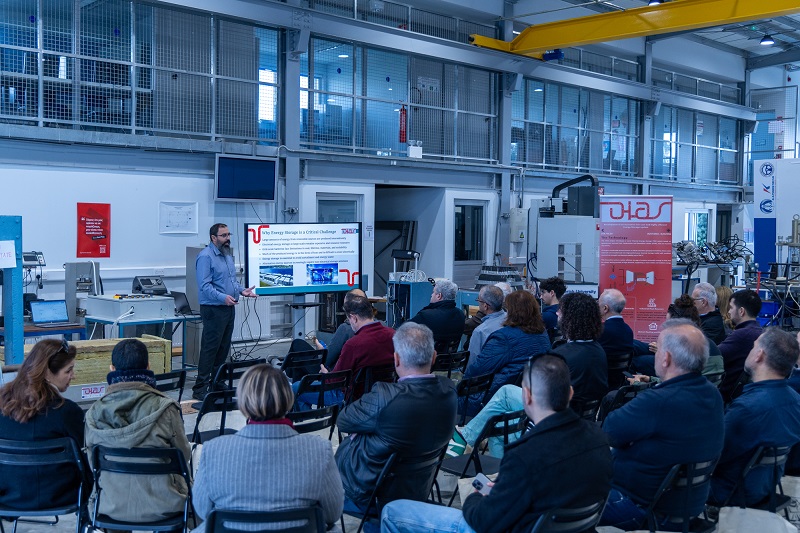
On January 26, 2026, the Frederick Research Center, one of the leading research institutions in Cyprus specialising in areas such as materials science and sustainable engineering, and RTD Talos, a key research and development and innovation player in Cyprus, presented an innovative thermal energy storage system developed within the framework of the “Development of an Innovative low-cost and highly efficient Energy Storage System” (DIAS) research project.
The prototype system was developed on a small scale at the Engineering Laboratory of the Frederick University Polytechnic School, with Professor Dimitris Nikolaidis as the scientific coordinator and Dr Pavlos Mavrommatidis and Dr Ioanna Giannopoulou as the main researchers.
The attendees at the system presentation were welcomed by the General Manager of RTD Talos, Dr Alexandros Michaelides, and Professor Nikolaidis.
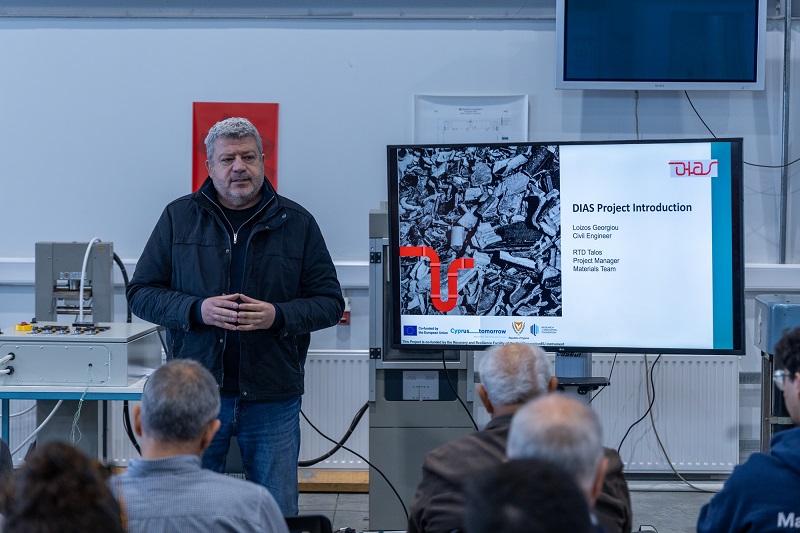
Loizos Georgiou, a Civil Engineer and scientist at RTD Talos, discussed the challenges the DIAS project had to overcome. As he explained, despite Cyprus having one of the highest prospects for solar energy use, a significant portion is lost due to the lack of effective storage solutions. At the same time, large quantities of construction and demolition waste (building waste) remain un-utilised. The DIAS project addresses both of these challenges by developing an innovative system that stores excess thermal energy while simultaneously reusing construction waste.
In turn, Dr Mavrommatidis stated that, by utilising construction waste and through the use of geo-polymerisation technology, a new material was developed which demonstrated excellent strength and thermal stability up to 700°C, enabling the efficient storage of excess energy from renewable sources (photovoltaics) and significantly reducing energy waste. Additionally, it allows for the release of thermal energy during periods of high demand. In Cyprus, existing thermal energy storage systems (usually made of concrete) do not exceed thermal stability up to 400°C.
The system will now be tested on a large scale, with the aim of implementing it in industrial facilities.
The DIAS project is funded by the Research and Innovation Foundation (RIF) and the EU’s NextGenerationEU Recovery and Resilience Facility, and is fully aligned with the goals of environmental and economic sustainability, supporting a more stable and resilient energy network.





Click here to change your cookie preferences