
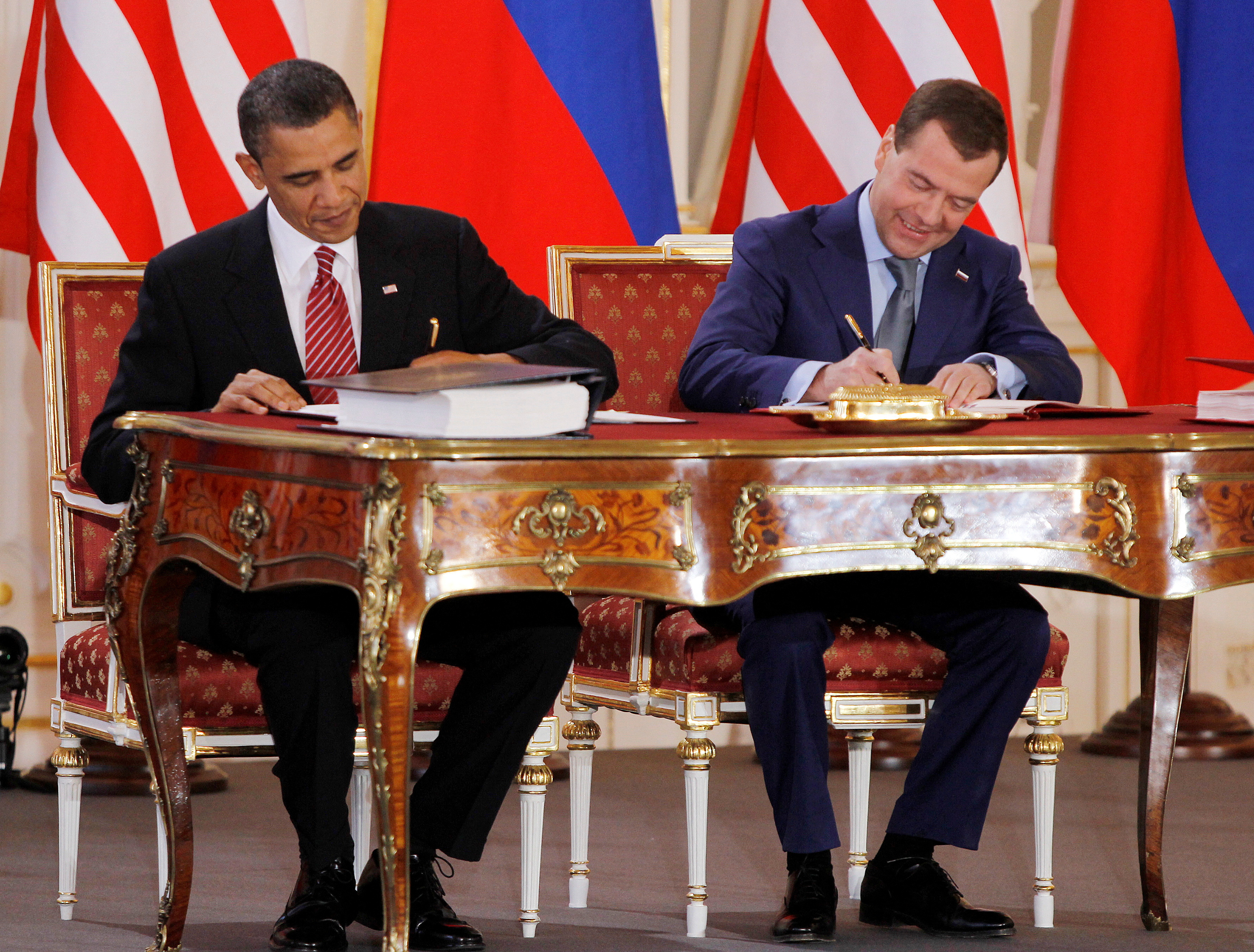
The last nuclear treaty between Russia and the United States is due to expire within hours, raising the risk of a new arms race in which China will also play a key role.
The web of arms control deals negotiated in the decades since the 1962 Cuban Missile Crisis, considered the closest the world ever came to intentional nuclear war, was aimed at reducing the chance of a catastrophic nuclear exchange.
Unless Washington and Moscow reach a last-minute understanding of some kind, the world’s two biggest nuclear powers will be left without any limits for the first time in more than half a century when the New START treaty expires.
COSTS COULD CONSTRAIN NEW ARMS RACE
There was confusion about the exact time it would lapse, though arms control experts told Reuters they believed this would happen at 2300 GMT on Wednesday – midnight in Prague, where the treaty was signed in 2010.
As the clock ticked towards expiry, Pope Leo urged both sides not to abandon the limits set in the treaty.
“I issue an urgent appeal not to let this instrument lapse,” the first U.S. pope said at his weekly audience. “It is more urgent than ever to replace the logic of fear and distrust with a shared ethic, capable of guiding choices toward the common good.”
Matt Korda, associate director for the Nuclear Information Project at the Federation of American Scientists, said that if there was no agreement to extend the treaty’s key provisions, neither Russia nor the United States would be constrained if they wanted to add yet more warheads.
“Without the treaty, each side will be free to upload hundreds of additional warheads onto their deployed missiles and heavy bombers, roughly doubling the sizes of their currently deployed arsenals in the most maximalist scenario,” he said.
What is the New START nuclear treaty
WHO SIGNED NEW START, AND WHAT DID IT SAY?
New START was signed in 2010 by U.S. President Barack Obama and Dmitry Medvedev, an ally of Vladimir Putin who served a single term as Russia’s president. At the time, relations between the two countries were undergoing a “reset”. The treaty came into force the following year.
It set limits on strategic nuclear weapons – the kind that each side would use to strike the opponent’s vital political, military and industrial centres in the event of a nuclear war. It capped the number of deployed strategic warheads at 1,550 on each side, with no more than 700 deployed ground- or submarine-launched missiles and bomber planes, and 800 launchers.
WHAT STOPPED EITHER SIDE FROM CHEATING?
The treaty included a system of short-notice, on-site inspections so each side could satisfy itself that the other was complying. But in 2023, Putin suspended Moscow’s participation because of U.S. support for Ukraine in the war with Russia. That brought a halt to inspections – which in any case had been suspended during the COVID pandemic – and forced each side to rely on its own intelligence assessments of what the other was doing. However, both sides said they would stick to the treaty’s numerical limits, which have remained in force until now.
WHY DON’T THE TWO SIDES JUST EXTEND THE TREATY?
The treaty text says it can only be extended once, and this has already happened – in 2021, just after Joe Biden became U.S. president. With expiry looming, Putin proposed last September that each side should agree informally to stick to the warhead limits for another year. As of Wednesday, the treaty’s final day, U.S. President Donald Trump had not responded.
In the U.S., opinions are divided on whether Trump should have accepted. Those in favour say it would have demonstrated political will to avoid an arms race and bought time to figure out a way forward. Others say the U.S. should free itself now from the New START limits in order to boost its arsenal to take account of a rapid nuclear build-up by China, and that doing otherwise would send a signal of weakness.
WHY DOES IT MATTER IF THERE’S NO TREATY?
If Moscow and Washington cease observing mutual limits on their long-range nuclear arsenals, it will mark the end of more than half a century of constraints on these weapons. The expiry of New START leaves a void, as no talks have taken place on a successor. Arms control advocates fear that raises nuclear risks, especially at a time of heightened international tension because of wars in Ukraine and the Middle East. Experts say the value of nuclear treaties lies not just in setting numerical limits but in creating a stable, transparent framework to prevent arms races from spiralling out of control.
WITHOUT A REPLACEMENT DEAL, WHAT MIGHT BOTH SIDES DO?
Each side would be free to increase its missile numbers and deploy hundreds more strategic warheads. However, experts say this poses some technical and logistical challenges and would not happen overnight – it would take at least the best part of a year to make significant changes. Longer term, the concern is that an unregulated arms race would ensue, in which each side would keep on adding weapons based on worst-case assumptions about what the other was planning.
WHAT WOULD IT TAKE TO AGREE A REPLACEMENT TO NEW START?
Trump says he wants a new, better treaty but experts say this would be a long, hard process. A successor treaty would probably need to address other classes of nuclear weapons, including short- and intermediate-range, as well as “exotic” new systems that Russia has developed since New START was agreed, such as the Burevestnik cruise missile and Poseidon torpedo.
Apart from the fact such deals are complex and technical, there isn’t even agreement on who should take part. While Trump has stated he wants to pursue “denuclearisation” with both Russia and China, Beijing says it is unrealistic to ask it to join negotiations with countries whose arsenals are still many times larger than its own. Russia says the nuclear forces of NATO members Britain and France should also be up for negotiation, which those countries reject.
Korda said it was important to recognise that the expiry of New START did not necessarily mean an arms race given the cost of nuclear weapons.
U.S. President Donald Trump has given different signals on arms control. He said last month that if the treaty expired, he would do a better agreement.
So far, Russian officials said, there has been no response from Washington on President Vladimir Putin’s proposal to extend the limits of the treaty beyond expiry.
THE DEATH OF ARMS CONTROL
Total inventories of nuclear warheads declined to about 12,000 warheads in 2025 from a peak of more than 70,000 in 1986, but the United States and Russia are upgrading their weapons and China has more than doubled its arsenal over the past decade.
Arms control supporters in Moscow and Washington say the expiry of the treaty would not only remove limits on warheads but also damage confidence, trust and the ability to verify nuclear intentions.
Opponents of arms control on both sides say such benefits are nebulous at best and that such treaties hinder nuclear innovation by major powers, allow cheating and essentially narrow the room for manoeuvre of great powers.
Last year, Trump said that he wanted China to be part of arms control and questioned why the United States and Russia should build new nuclear weapons given that they had enough to destroy the world many times over.
“If there’s ever a time when we need nuclear weapons like the kind of weapons that we’re building and that Russia has and that China has to a lesser extent but will have, that’s going to be a very sad day,” he said in February last year.
“That’s going to be probably oblivion.”





Click here to change your cookie preferences