
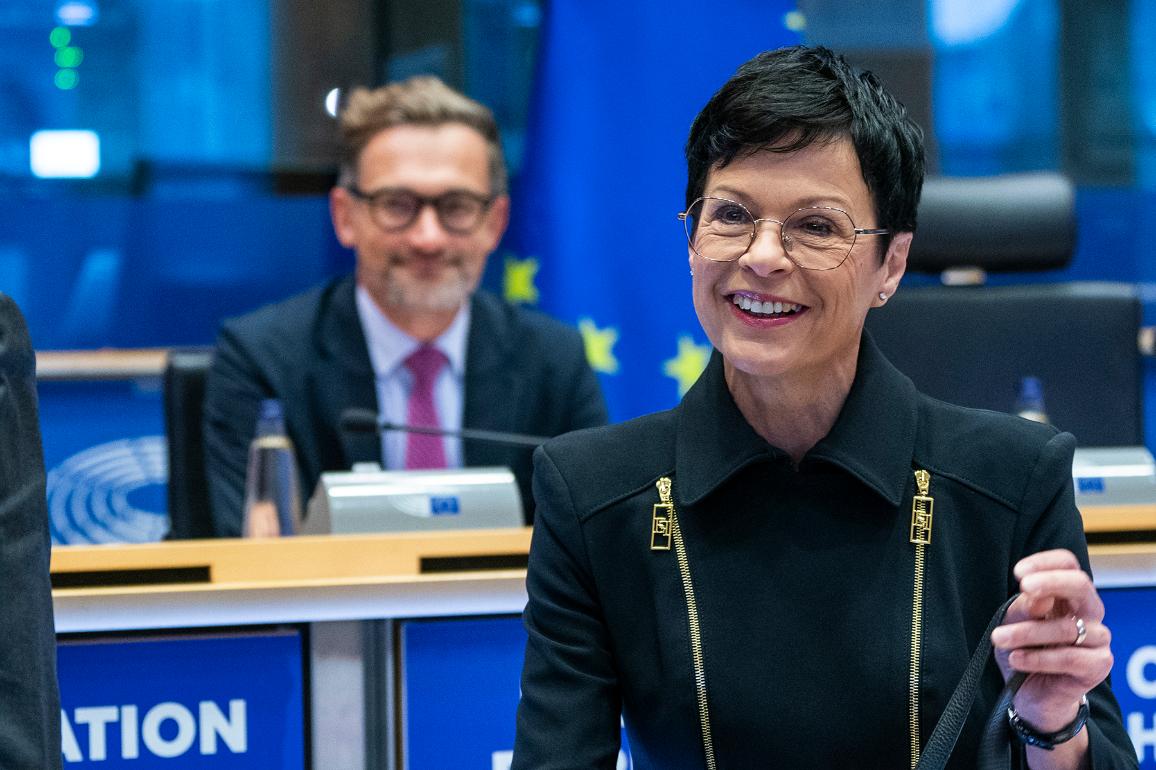
European Enlargement Commissioner Marta Kos has spoken of an “opportunity” for Turkey to progress its process towards accession to the European Union through a new round of talks to resolve the Cyprus problem.
“We know that any progress is connected to bilateral relations, not just Cyprus, but also with the … new Cyprus settlement talks. It is now a big opportunity to continue,” she told Turkey’s Anadolu Agency ahead of a visit to Turkey this week.
She stressed that “there really is more that connects the EU and Turkey than what is dividing us”, and as such said that “we really should work on this” as the economies of both Turkey and the EU are “very much independent”.
“We are really living in challenging times. The world is changing around us. We are seeing the return of imperial behaviour as China, Russia, and the US are aggressively building their spheres of interest,” she said.
To this end, she said Turkey can play an important role during and after the signing of a peace agreement in Ukraine, highlighting the country’s role as a “very important player” in the Black Sea region.
She went on to say that the EU “cannot exclude Turkey” if it “takes together economic and geopolitical logic” and then added that “we would love to see Turkey involved deeper in some of our policies”.
However, she said, “there are some conditions which have to be fulfilled”.
On this front, she said that Turkey’s EU accession process has been at a “standstill” since 2018, but stressed that the bloc still “considers Turkey as a candidate country”, even if it has “seen steps away from EU standards, especially on the rule of law and democracy”.
“I know that Turkey has a very long democratic tradition and also a strong civil society, and this is what we would like to strengthen, and this would build trust between the EU and Turkey,” she said, before speaking of the “immense possibilities” of adding Turkey’s 80-million-strong population to the EU’s single market.
“If we could put new energy into the development of the field of democracy, I think we could do really, really much more,” she said.
She then turned her attention to the matter of defence, and said that Turkey is a “very important, reliable Nato partner”, before highlighting the role of Turkish drones in the war in Ukraine.
“We have also seen the role Turkey is playing in the war. For all of these reasons, Turkey is a kind of natural partner for Europe, and it would be good both for us if we could work more together,” she said.
On this front, she said that Turkish companies can “cooperate” and “be a part of our rearmament programmes” under “certain conditions” – namely if they have subsidiaries within the EU.
However, she did say that “personally, I would really like to see … stronger involvement of Turkey in the security of Europe”.
She then said that this would depend on the stances of the EU’s member states, and to this end said that “the new Cyprus settlement talks are a great opportunity for improvements in this area”.
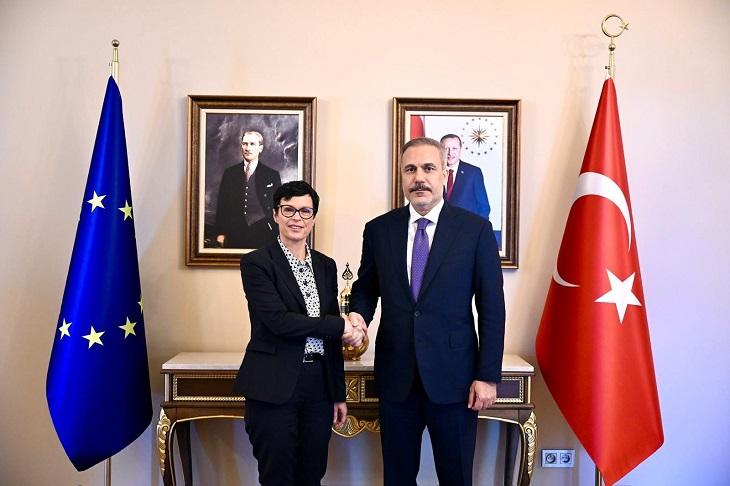
Both the Republic of Cyprus and Greece stood in the way of Turkey’s participation in the EU’s Security Action for Europe (Safe) programme, which saw the EU allocate €150 billion for defence spending.
Greek Defence Minister Nikos Dendias had been asked last year about the prospect of Turkey joining the Safe programme and said that “if someone threatens the EU itself, it is obvious that they cannot participate in the mechanism which is built to deal with this aggression”.
Around the same time, Cypriot Defence Minister Vasilis Palmas had said that “a state which has a declared expansionist policy cannot join the programme in question”.
“The situation in Cyprus, with the occupying forces maintained at particularly high levels and Turkey having established itself in the defence sector, leaves no room for complacency,” he said.
European Council president Antonio Costa had said during a visit to Cyprus in September last year that the Safe programme’s rules are “clear”, and that the programme is “open to third countries, but to third countries which do not constitute a threat to the security of any member state”.
Later, Greece’s foreign ministry’s spokeswoman Lana Zochiou confirmed that her country intended to veto Turkey’s participation in the programme unless the country rescinds a parliamentary resolution signed in 1995 regarding both country’s claims in the Aegean sea.
The Turkish parliament had declared at the time that any unilateral action by Greece beyond 12 nautical miles from the country’s coast in the Aegean sea would constitute a “casus belli” – a reason to go to war.
“As long as the casus belli remains, Greece will not accept Turkey’s participation in Safe. The lifting of the casus belli is a necessary condition for the discussion to begin,” Zochiou said.




Click here to change your cookie preferences