
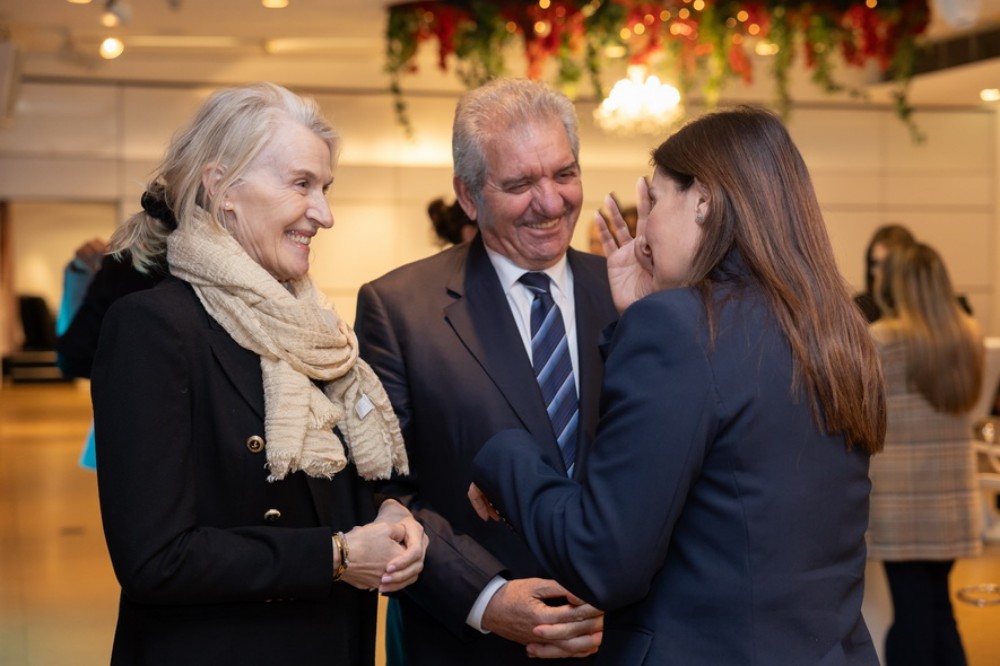
Columbia Plaza in Limassol served as the backdrop for the debate “Shipping through times of turbulence and innovation”, organised by Cyprus Shipping News (CSN).
According to its announcement, the event gathered senior industry figures to examine the dual forces reshaping shipping, namely geopolitical shifts and the transition toward a greener and increasingly digital future.
The debate took place in the presence of Shipping Deputy Minister Marina Hadjimanolis, who addressed attendees and reaffirmed the government’s commitment to the maritime sector.
It was followed by a keynote speech by Cyprus Shipping Chamber (CSC) president Andreas Neophytou, who set the tone by referring to the resilience and strategic importance of the Cyprus maritime cluster.
The first part of the discussion focused on the geopolitical reconfiguration of global trade.
Moderated by Vasilis Mouyis of Doric Shipbrokers, the panel examined the rise of US protectionism and its re-industrialisation agenda, with tariffs and trade disputes increasingly used as instruments of national security and, in turn, prompting changes in global trade patterns.
Although the term de-globalisation often dominates public debate, speakers described a more nuanced picture.
Trade routes are being reshaped through reshoring, nearshoring and friendshoring, yet the overall volume and value of traded goods remain broadly proportionate to global GDP growth.
The conversation also addressed international flashpoints, including the Russia-Ukraine war and tensions in the Middle East, particularly Iran and the risk of disruption to chokepoints in the Arabian Gulf and the Red Sea.
At the same time, the depreciation of the US dollar over the past 15 months was discussed as supportive of trade activity, even as its dominance as a reserve currency shows gradual shifts.
Attention then turned to decarbonisation. Participants reviewed EU ETS and FuelEU Maritime regulations alongside the International Maritime Organisation’s (IMO) 2050 net-zero ambition.
The recent decision to postpone adoption of the Net-Zero Framework by one year was largely viewed as a welcome pause, allowing further refinement so the transition remains technically and economically workable.
Technical aspects were also discussed, including the current relevance of EEDI, EEXI and CII in ship design and operations. With roughly 20 per cent of the global fleet expected to be alternative-fuel ready by 2030, emphasis was placed on energy-saving technologies such as propeller ducts and wind-assistance systems, as well as the growing potential of carbon capture.
The debate concluded with digitalisation and artificial intelligence. As automation becomes more integrated into shipping strategy, speakers pointed to organisational culture ashore and crew competencies at sea as the main challenges.
The integration of AI, they agreed, is therefore not only a technical issue but also a human one, requiring adaptation across the sector.
The panel included Eugen Adami of Mastermind Shipmanagement, Anna Koukkides-Procopiou of the POLITIA think-tank, Andreas Chrysostomou of the Clean Shipping Alliance, Eberhard Koch of Österreichischer Lloyd Shipping.
It also featured Erwin Derlagen of Intermaritime Shipmanagement, Christina Orfanidou of Columbia Group, Saroj Kumar of MSC Shipmanagement and Nicholas Rich of Bernhard Schulte Shipmanagement, with Mouyis moderating the discussion.


Click here to change your cookie preferences