
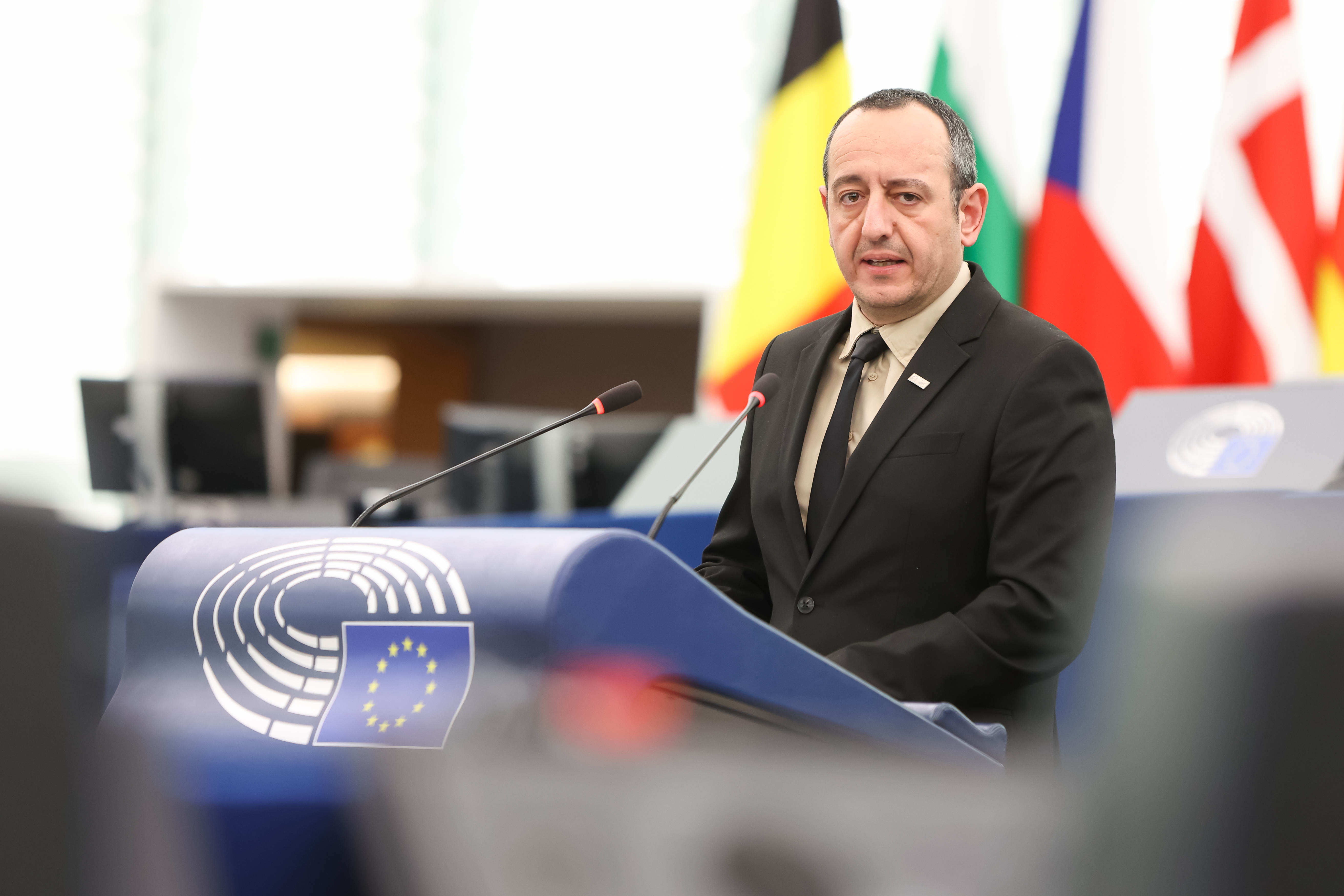
Elam member of the European Parliament Geadis Geadi on Tuesday called for the European Union to bolster its defences, saying that “Europe cannot sail into the future on a boat made out of hope and luck”.
He began his speech at the parliament’s plenary session in Strasbourg by saying that “the unstable international environment requires the construction of a stronger European defence”.
“The Russian invasion of Ukraine, Turkey’s aggression against Greece, the illegal Turkish occupation of Cyprus, the uncontrolled actions of Islamist terrorist organisations, mainly in the Middle East, illegal migration, hybrid threats, cyberattacks, and changing geopolitical developments require immediate action,” he said.
To this end, he said that the EU “must build strong military capabilities and invest in the European defence industry”.
This, he said, must be done to ensure the “effective implementation of article 42.7 of the Treaty of the European Union”, which is better known as the Lisbon Treaty.
That article is the EU’s mutual defence clause, which states that “if a member state is the victim of armed aggression on its territory, the other member states shall have towards it an obligation of aid and assistance by all the means in their power”.
It also states that “commitments and cooperation in this area shall be consistent” with countries’ Nato commitments, with 24 of the EU’s 27 member states – all except for Austria, Cyprus, and Ireland – as well sa Turkey all Nato member states.
Geadi on Tuesday closed his speech by saying that the EU must boost its defence capabilities “so that Europe can respond quickly and decisively to any threats or aggressive actions against it”.
“Only a common European defence framework can safeguard Europe’s freedom to protect European territories and international law,” he said.
His comments come after Cypriot Trade Minister Michael Damianos had last week called for a stronger European single market with the aim, among other things, of using its benefits to bolster the EU’s defence sector.
“A key priority is to bridge the gap between research and production on an industrial scale. The smooth functioning of the single market is essential in this regard, especially for small and medium-sized businesses in the defence sector,” he said.
To this end, he added, “particular attention has been paid to ensuring that small member states, including Cyprus, can benefit and contribute substantially”.
Geadi’s fellow Cypriot MEP Costas Mavrides had made similar statements at the European Parliament’s previous plenary session last month, calling for Europe to strengthen its defence industry and bolster its “independence from external factors”.
“European small and medium-sized businesses are already involved in this sector, and I know for sure that in my country, Cyprus, this is happening, but we need to strengthen it by simplifying processes, facilitating financing, and cooperation between large and small businesses from different member states,” he said.
One key element of the EU’s new defence architecture is its Security Action for Europe (Safe) programme, through which the Cypriot government secured over €1 billion of funding last year.
Defence Minister Vasilis Palmas had said at the time that the funding would see the National Guard acquire military hardware to “cover [its] priorities” until 2030.
He added that the Safe programme came about about “at a time when the European Union’s needs to cover shortcomings are significant”, and at a time “when the mobilisation of equipment programmes and joint procurement programmes is becoming urgent”.
“The €150bn which will be invested by member states in the joint procurement of high-tech weapons systems is expected to be the trigger for a new promising era for European defence, with the ultimate goal of autonomy, technological dominance, and resilience,” he said.





Click here to change your cookie preferences