
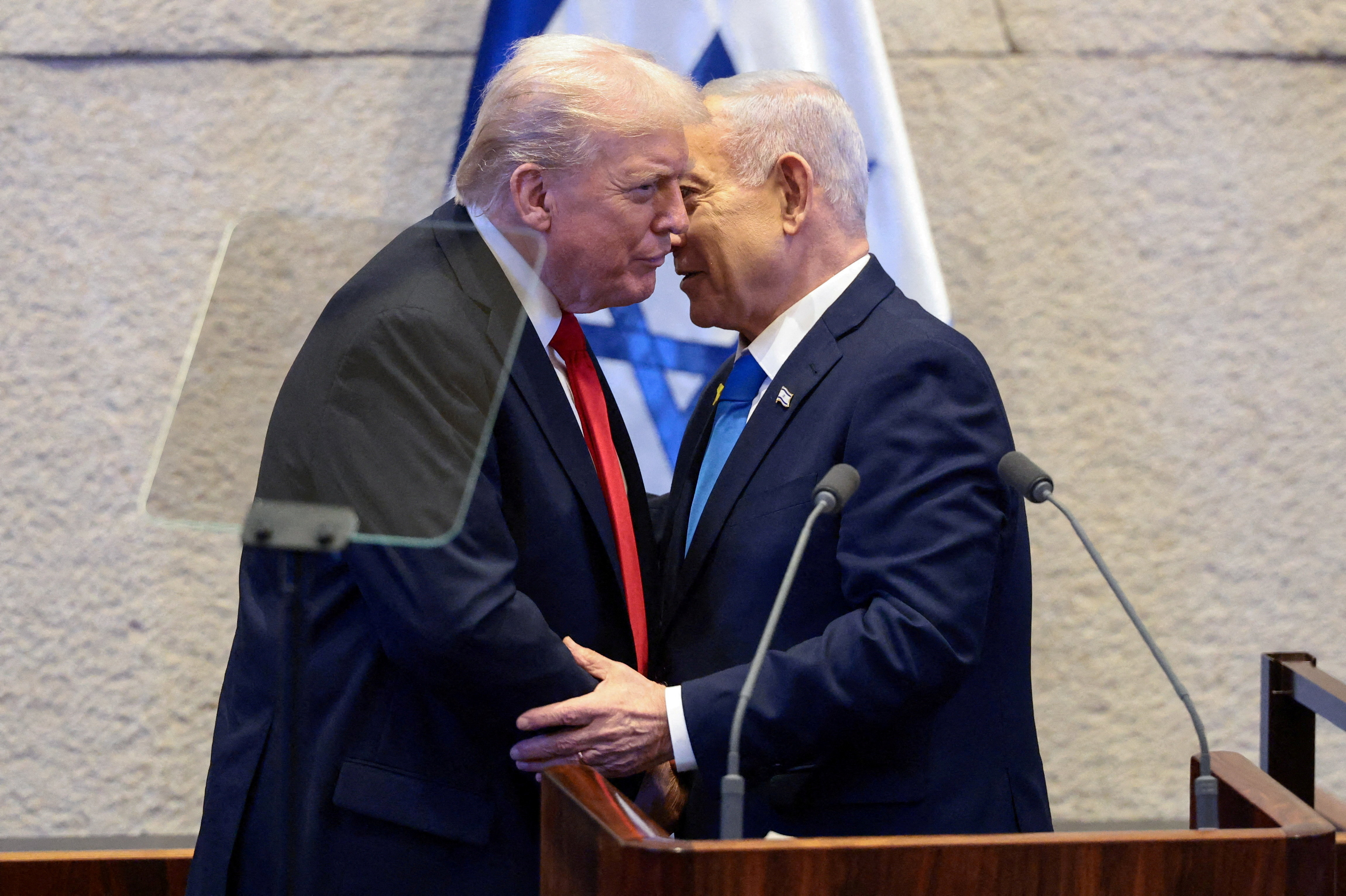
President Donald Trump said after talks with Israeli Prime Minister Benjamin Netanyahu on Wednesday they reached no “definitive” agreement on how to move forward with Iran but he insisted negotiations with Tehran would continue to see if a deal can be achieved.
Netanyahu, who had been expected to press Trump to widen diplomacy with Iran beyond its nuclear program to include limits on its missile arsenal, stressed that Israel’s security interests must be taken into account but offered no sign that the president made the commitments he sought.
In their seventh meeting since Trump returned to office last year, Netanyahu – whose visit was more muted than usual and closed to the press – was looking to influence the next round of U.S. discussions with Iran following nuclear negotiations held in Oman last Friday.
The two leaders spoke behind closed doors for more than two and a half hours in what Trump described as a “very good meeting” but said no major decisions were made and stopped short of publicly accepting Netanyahu’s entreaties.
Trump has threatened strikes on Iran if no agreement is reached, while Tehran has vowed to retaliate, stoking fears of a wider war as the U.S. amasses forces in the Middle East. He has repeatedly voiced support for a secure Israel, a longstanding U.S. ally and arch-foe of Iran.
In media interviews on Tuesday, Trump reiterated his blunt warning to Iran, while saying he believes Tehran wants a deal.
“There was nothing definitive reached other than I insisted that negotiations with Iran continue to see whether or not a Deal can be consummated,” Trump said in a social media post after the meeting with Netanyahu. “If it can, I let the Prime Minister know that will be a preference.”
“If it cannot, we will just have to see what the outcome will be,” Trump added, noting that the last time Iran decided against an agreement the U.S. struck its nuclear sites last June.
TRUMP SAYS NO TO IRANIAN NUCLEAR WEAPONS, MISSILES
Trump told Fox Business in an interview broadcast on Tuesday that a good deal with Iran would mean “no nuclear weapons, no missiles,” without elaborating. He also told Axios he was considering sending a second aircraft carrier strike group as part of a major U.S. buildup near Iran.
Israel fears that the U.S. might pursue a narrow nuclear deal that does not include restrictions on Iran’s ballistic missile program or an end to Iranian support for armed proxies such as Hamas and Hezbollah, according to people familiar with the matter. Israeli officials have urged the U.S. not to trust Iran’s promises.
Iran has rejected such demands and says the Oman talks focused only on nuclear issues.
“The Prime Minister emphasized the security needs of the State of Israel in the context of the negotiations, and the two agreed to continue their close coordination and tight contact,” Netanyahu’s office said in a statement after Wednesday’s talks.
The two leaders had also been expected to talk about potential military action if diplomacy with Iran fails, one source said.
Iran has said it is prepared to discuss curbs on its nuclear program in exchange for lifting sanctions but has ruled out linking the issue to missiles.
“The Islamic Republic’s missile capabilities are non-negotiable,” Ali Shamkhani, an adviser to Iran’s supreme leader, said on Wednesday.
Netanyahu’s arrival at the White House was lower-key than usual. The two leaders were shown shaking hands in a photo released by the Israeli Embassy. But unlike previous Netanyahu visits with Trump, a press pool was not allowed into the Oval Office. It was not immediately known why he received such low-profile treatment.
GAZA ON THE AGENDA
Also on the agenda was Gaza, with Trump looking to push ahead with a ceasefire agreement he helped to broker. Progress on his 20-point plan to end the war and rebuild the shattered Palestinian enclave has stalled, with major gaps over steps such as Hamas disarming as Israeli troops withdraw in phases.
“We discussed the tremendous progress being made in Gaza, and the Region in general,” Trump said after the meeting.
Netanyahu’s visit, originally scheduled for February 18, was brought forward amid renewed U.S. engagement with Iran. Both sides at last week’s Oman meeting said the negotiations were positive and further talks were expected soon.
Trump has been vague about broadening the negotiations. He was quoted as telling Axios on Tuesday that it was a “no-brainer” for any deal to cover Iran’s nuclear program, but that he also thought it possible to address its missile stockpiles.
Iran says its nuclear activities are for peaceful purposes, while the U.S. and Israel have accused it of past efforts to develop nuclear weapons.
During a 12-day war last June, Israel heavily damaged Iran’s air defenses and missile arsenal. Two Israeli officials say there are signs Iran is working to restore those capabilities.
Trump threatened last month to intervene militarily during a bloody crackdown on anti-government protests in Iran, but ultimately held off.
ISRAEL WARY OF A WEAKENED IRAN REBUILDING
Tehran’s regional influence has been weakened by Israel’s June attack, losses suffered by its proxies in Gaza, Lebanon, Yemen and Iraq, and the ousting of its ally, former Syrian President Bashar al‑Assad.
But Israel is wary of its adversaries rebuilding after the multifront war triggered by Hamas’ October 2023 assault on southern Israel.
While Trump and Netanyahu have mostly been in sync and the U.S. remains Israel’s main arms supplier, they appear to be at odds on another key issue.
Part of Trump’s Gaza plan holds out the prospect for eventual Palestinian statehood – which Netanyahu and his coalition, the most far-right in Israel’s history, have long resisted.
Netanyahu’s security cabinet on Sunday authorized steps that would make it easier for Israeli settlers in the occupied West Bank to buy land while granting Israel broader powers in what the Palestinians see as the heartland of a future state.
The decision drew international condemnation, and Trump on Tuesday reiterated his opposition to West Bank annexation.




Click here to change your cookie preferences