
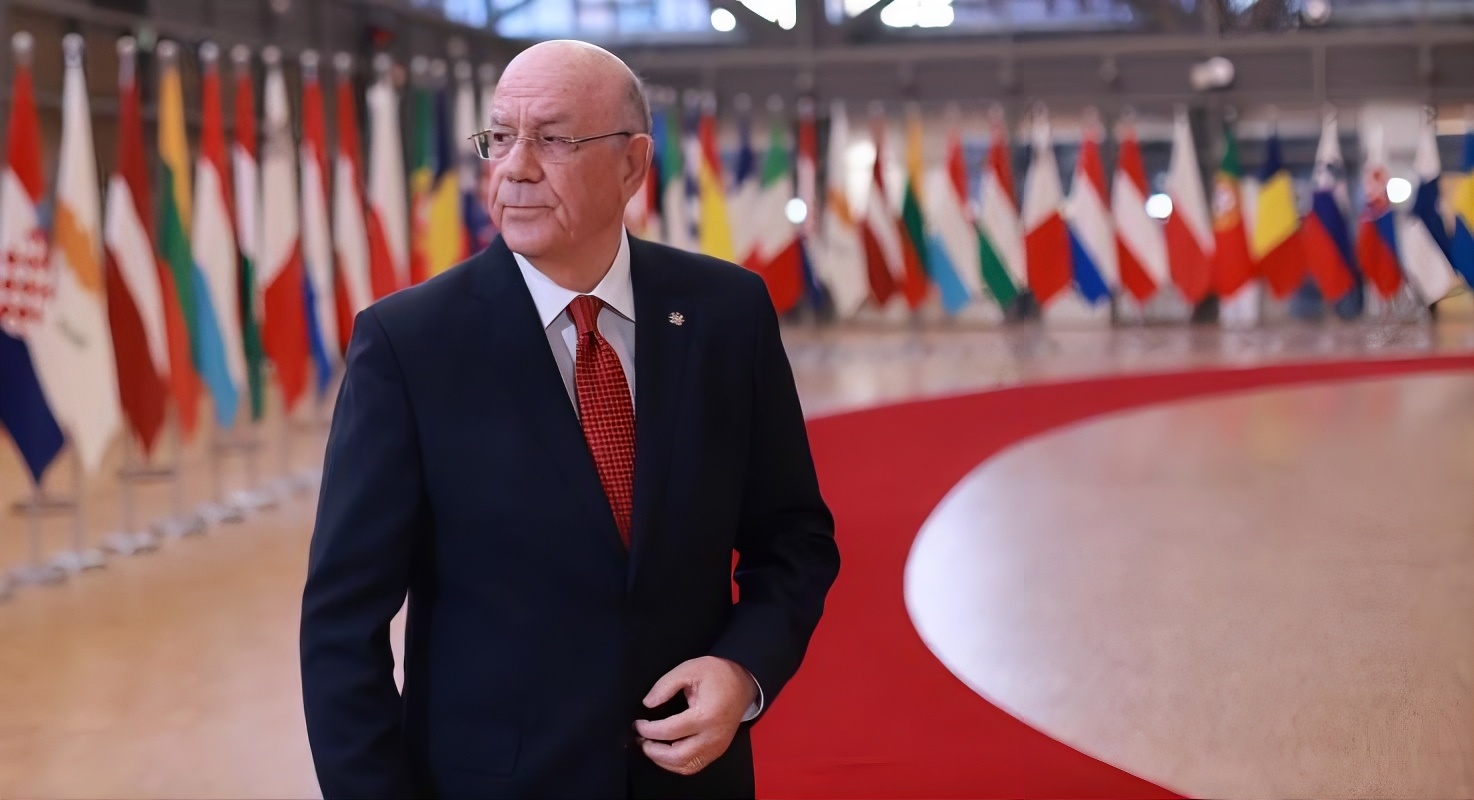
Finance minister to attend Eurogroup and chair Ecofin next week
Finance Minister Makis Keravnos on Friday said that Cyprus recorded economic growth of 4.5 per cent in the fourth quarter of 2025, confirming the resilience of the Cyprus economy despite external challenges.
“The data on the growth rate of Cyprus’ GDP in the fourth quarter of 2025 confirm once again the dynamism of the Cypriot economy despite the fact that the external environment is full of challenges and uncertainties,” Keravnos said.
“The policies of the Finance Ministry have shaped today an environment of stability and prospects, which is recognised both internally and by our international and European partners,” he added .
Referring to broader economic developments, he said that the government has “secured fiscal stability and sustainability”.
“Through prudent management, we manage to achieve surplus budgets, steadily reduce public debt and create the conditions for the long-term resilience of our economy,” he added.
He stressed that preserving strong liquidity buffers remains a standing priority for the ministry, alongside efforts to enhance the country’s standing in financial markets.
“The maintenance of high levels of available liquidity constitutes a constant goal and challenge of the Ministry,” Keravnos said.
“The strengthening of the creditworthiness of the state is among our high strategic objectives,” he added.
Turning to price developments, he indicated that inflationary pressures have subsided completely.
“Inflation has now reached zero levels,” he said.
“This strengthens the purchasing power of citizens, creates stability in the prices of products and services and provides a solid basis for planning by households and businesses,” Keravnos added.
He also linked the expansion in output to positive labour market conditions, pointing out that Cyprus continues to outperform the European Union average while unemployment remains contained.
“The Cypriot economy is growing at rates higher than the average of the European Union, while unemployment remains at low levels, creating opportunities for society and businesses,” Keravnos said.
Referring to figures released by the Cyprus Statistical Service and Eurostat, he said they validate what he described as a people-centred and disciplined economic strategy.
“The growth rate of Cyprus is in the order of 4.5 per cent for the fourth quarter of 2025 and is significantly higher than the European average,” Keravnos said.
“These data confirm once again the dynamism of the Cypriot economy,” he added.
“Despite a period of increased uncertainty and an external environment full of challenges and uncertainties, Cyprus continues to record relatively high growth rates especially compared with the EU in combination with low inflation and conditions of full employment,” Keravnos said.
Looking ahead, he maintained that adherence to cautious fiscal management will further reinforce the resilience of the Cypriot economy and support sustained expansion above 3 per cent over the medium term.
“The maintenance of prudent and disciplined fiscal and economic management by this government will contribute even more to the resilience of the Cypriot economy so that Cyprus can continue to record medium-term growth rates above 3 per cent,” Keravnos said.
He further stated that this trajectory enables the state to channel resources towards social priorities and business support.
“This course gives us the possibility to release economic forces and capabilities in order to further strengthen social policy and mitigate any problems facing our businesses and our society in general,” Keravnos said.
In a separate statement, the Finance Ministry said that for 2025 as a whole, economic growth is estimated at 3.75 per cent, exceeding earlier projections by the ministry and other domestic and international institutions, which had placed growth conservatively between 2.9 per cent and 3.5 per cent.
Meanwhile, the ministry also announced that Keravnos will travel to Brussels on February 16, to attend a meeting of the Eurogroup, a day before he chairs the Ecofin Council meeting.
At the Eurogroup meeting, ministers will exchange views on economic policy recommendations for the euro area issued by the European Commission in December as part of the European Semester process, with formal adoption expected at the Ecofin Council the following day.
They will also discuss steps aimed at strengthening the international role of the euro in line with efforts to enhance the European Union’s strategic autonomy.
The Eurogroup will then convene in an expanded format with all 27 member states to examine international macroeconomic imbalances in the context of ongoing geopolitical risks, in the presence of Canada’s finance minister.
On February 17, Keravnos will preside over the Ecofin Council, which will open with a working breakfast focused on current economic developments.
The main session will begin with a presentation of European Commission proposals designed to reinforce the framework for supplementary pensions, including measures to strengthen occupational pension provision and establish a pan-European personal pension product.
Ministers will then exchange views on the economic consequences of the Russian invasion of Ukraine.
The council is expected to approve guidelines for the European Union budget for 2027 and adopt the economic policy recommendation for the euro area.
It will also receive an update on the implementation of the Recovery and Resilience Facility and approve Lithuania’s amended Recovery and Resilience Plan.
Finance ministers are further expected to endorse Austria’s request to activate the national escape clause to increase defence spending and to be briefed on progress in implementing the SAFE loan instrument, which aims to strengthen the European Union’s defence capabilities and defence industry.
On Monday evening, ministers will attend an informal working dinner at the initiative of the Eurogroup president to discuss international economic relations in a period marked by asymmetric challenges.





Click here to change your cookie preferences