
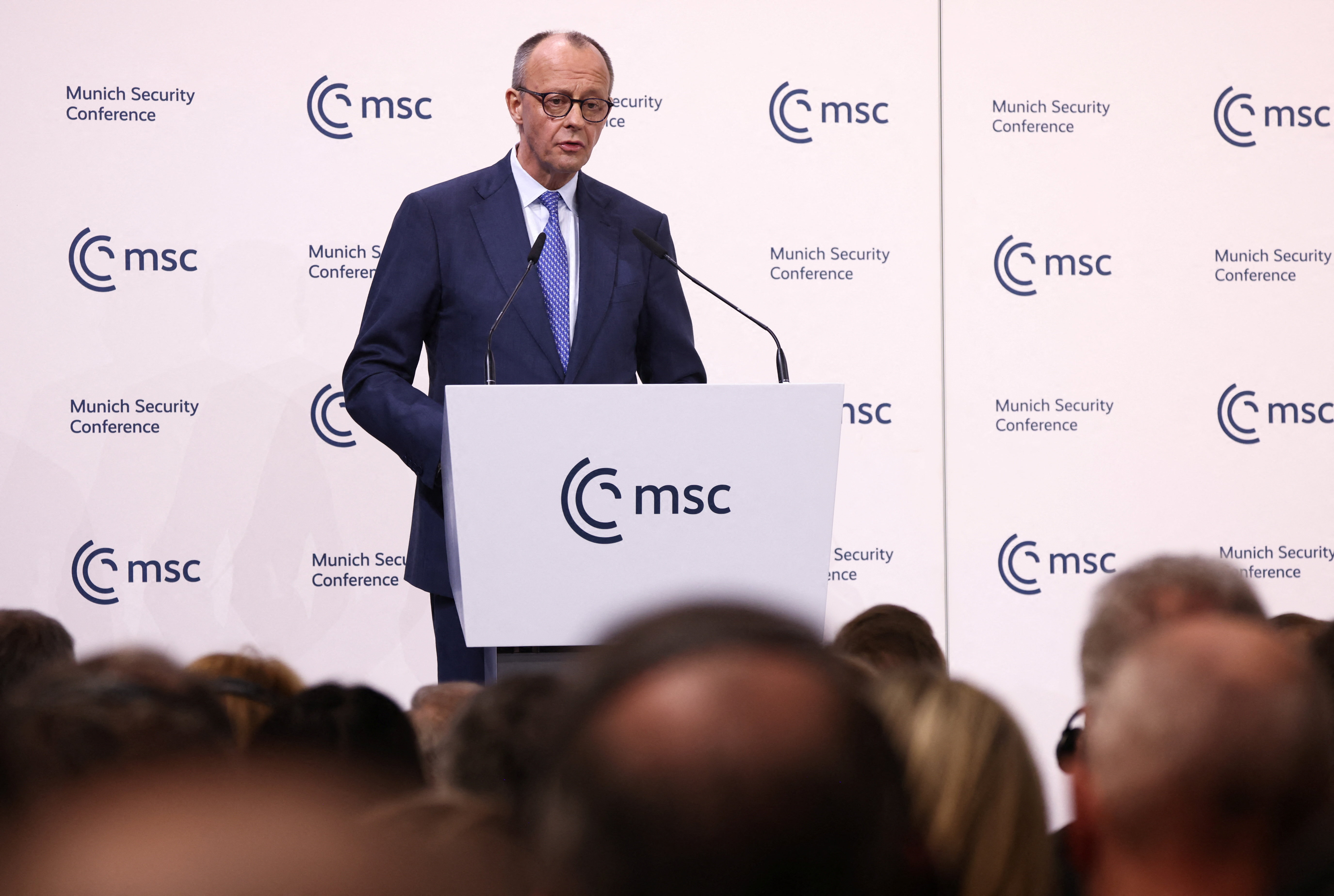
Every year at this time the North Atlantic Treaty Organisation (Nato), the world’s most powerful alliance for the past 77 years, holds a conference in Munich to examine its state of health.
The one just past was really a wake, but it played out more like the immortal Dead Parrot sketch from Monty Python, in which a customer (John Cleese) enters a pet shop with a cage containing a dead parrot (a Norwegian Blue) and says: “This parrot is definitely deceased, and when I purchased it not half an hour ago you assured me that it’s total lack of movement was due to it being tired and shagged out following a long squawk.”
Shopkeeper: “Well he’s…he’s, ah…probably pining for the fjords.”
Cleese: “He’s not pining. He’s passed on…He’s a stiff. This parrot is no more. If you hadn’t nailed him to the perch, he’d be pushing up the daisies. THIS IS AN EX-PARROT!!!”
And so too with Nato, though it is still nailed to its perch..
The psychodrama raging beneath the surface at the Munich conference was an argument among the European members of Nato about whether the United States could still be trusted. Some insisted that the old alliance could survive. More thought that it will have to be Nato 2.0 or no alliance at all.
Observers from the US Democratic Party promised the conference that Trump will be gone in three years and the old American security guarantees will be revived.
“I think the Europeans sighed with relief because it was saying that Europe is important, that Europe and America are very intertwined and good allies,” said Kaja Kallas, the European Union’s chief diplomat.
But most EU leaders have lost the faith. The German Chancellor, Friedrich Merz, said bluntly that “The United States’ claim to leadership has been challenged and possibly lost.”
Echoing Canada’s Prime Minister Mark Carney, he said that the “rules-based world order no longer exists,” and that “a deep divide has opened between Europe and the United States.”
France’s President Emmanuel Macron agreed: “Europe is rearming, but we must now go beyond” to become a unified major power. It can only achieve that if it can act like a single country, of course, but Trump is giving it a strong incentive to learn how.
Starting with US Vice-President JD Vance’s anti-European tirade at last year’s Munich conference, we have had US air strikes on Iran and five other countries, the subjugation of Venezuela, American complicity in the genocide in Gaza, and above all Trump’s threats to invade Greenland, which is part of the Kingdom of Denmark, a Nato member.
Curiously, Greenland was what tore it, and most Nato leaders now understand that Trump’s America is at best an unreliable ally and sometimes openly hostile. Nor are they confident that the United States will remain a country where governments change hands democratically, so they have to plan for the worst.
It’s not really a huge crisis. The existing Nato is an ideal template for a successor alliance that includes most or all of the existing members except the United States. If Canada dared to stay in, they wouldn’t even have to change the name. The new alliance would still have ample numbers, wealth and weapons to deter any Russian attack.
Filling the gaps that remain when American troops all leave Europe would take some years, but the risk is really quite small. Russian military resources are too heavily committed to conquering Ukraine at the moment to embark on a war with all of western and central Europe as well.
As hegemons go the United States was a relatively benevolent one (there has never been a truly benevolent one), and we will doubtless come to regret Donald Trump’s decision to dismantle it prematurely. But Nato 2.0 is probably the least bad alternative for the ‘West’.
The one real uncertainty is nuclear deterrence. Britain and France both have their own nuclear weapons, but Germany, the richest and most populous EU country, has none. There would also be huge pressure in Poland to get its own nukes if the US nuclear guarantee is void: Poles don’t trust Russia, for good historical reasons, and they are very exposed.
That’s why it was good news, in the context, when Chancellor Merz revealed at the conference that he is in “confidential talks” with the French president on creating a joint European nuclear deterrent. In terms of nuclear proliferation, that would be the least harmful outcome.
As for Nato 1.0, it is dead, although it may persist as a polite fiction for some time. It has “kicked the bucket, shuffled off the mortal coil, rung down the curtain and joined the choir invisible.” But its soul goes marching on.
Gwynne Dyer’s new book is ‘Intervention Earth: Life-Saving Ideas from the World’s Climate Engineers’. The previous book, ‘The Shortest History of War’, is also still available





Click here to change your cookie preferences