
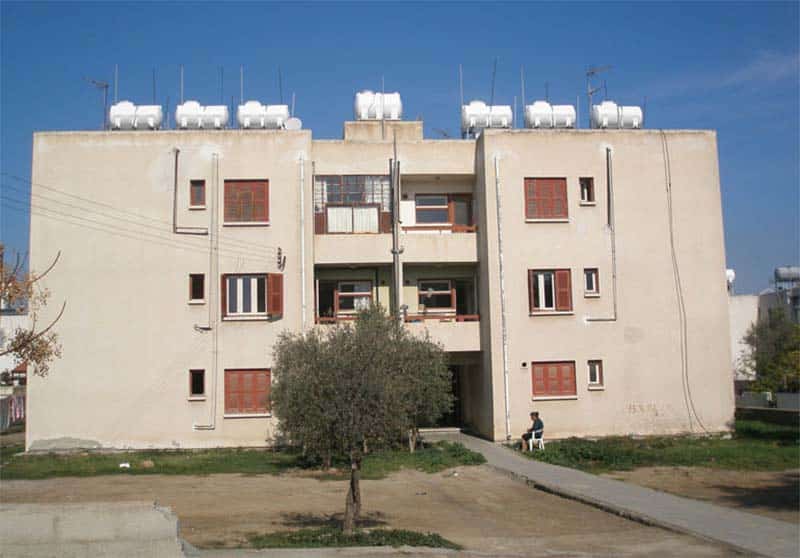
The House refugee committee confirmed on Tuesday that no foreclosures or evictions have taken place in refugee housing estates following its recent interventions.
Committee chair and Akel MP Nikos Kettiros said members were satisfied that credit acquisition companies had complied with parliamentary guidance and had not proceeded with any divestment of primary residences in refugee settlements.
“We have seen with satisfaction that all the recommendations and instructions of the refugee committee have been followed,” he said.
However, Kettiros admitted that “there is one issue still pending, which concerns residences located in self-housing settlements,” explaining that credit acquisition companies hold no clear data identifying such properties.
As such, borrowers in these schemes face uncertainty over their protection.
During the meeting, president of the Association of Credit Acquisition Companies and Credit Facility Managers Anthi Exadaktylou told MPs that only 14 properties in refugee settlements are currently held by credit acquisition companies, while a further 320 fall under the state-owned asset manager Kedipes.
Earlier figures suggesting far higher exposure were revised after cross-checks with the land registry.
Exadaktylou insisted that the companies had handled the cases “with particular sensitivity” while conceding that the absence of reliable data on properties in refugee estates has been a persistent problem.
Kettiros agreed that borrowers who receive letters regarding their loans should immediately contact the relevant credit acquisition company and declare that their home is located in a refugee settlement.
“This is necessary so that an arrangement can be made,” he said.
Disy MP Rita Theodorou Superman said parliament’s concern extends to all refugees at risk, rejecting any approach that would push them towards compensation mechanisms linked to properties in the north, such as the ‘immovable properties commission’ (IPC).
“We are opposed to policies that drive refugees in that direction,” she said, calling for an immediate review of the foreclosure framework and advising affected individuals to seek help from the financial ombudsman or their loan managers.
The human cost was emphasised by Akel MP Christos Christofides, who described foreclosures as “a huge social problem” that risks compounding historical trauma.
“For a refugee that has already lost everything once, foreclosures take on an additional tragic dimension,” he said.
“These people are at risk of becoming homeless and displaced for a second time.”
Financial commissioner Valentina Georgiadou told MPs that her office had already intervened in at least three relevant cases, requesting that proceedings be paused.
“There was de facto respect from the companies towards the committee,” she said, while urging similar sensitivity in other categories of borrowers.
Attention also turned to the rent-for-instalment scheme, which offers temporary protection while applications are under review.
A Central bank representative said more than 500 applications have been approved, with another 1,000 pending.
“For as long as an application is pending, companies will not proceed with auctions,” Georgiadou clarified, saying this commitment had been given in writing.
The borrower’s association president, Jenny Papacharalambous, welcomed the restraint shown so far but pressed for greater flexibility where negotiations stall.
Referring to Central Bank data, she said credit acquisition companies had already recovered almost double what they paid to acquire certain loan portfolios.
“In cases where no consensual solution has been found, there should be more sensitivity on write-offs,” she concluded.



Click here to change your cookie preferences