
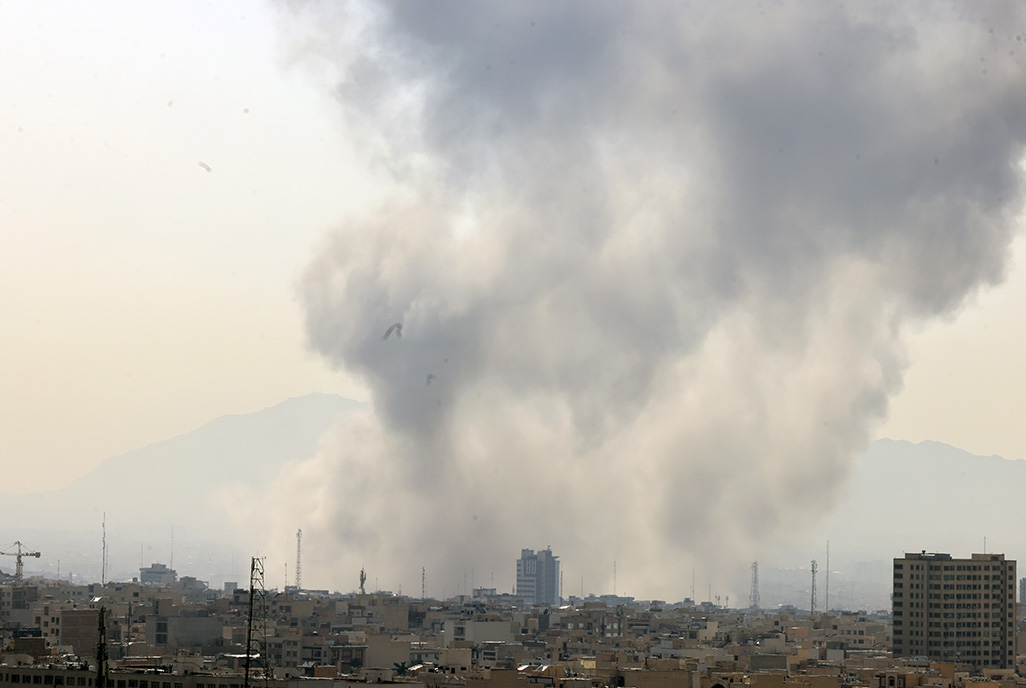
Although Saturday’s attack on Iran by the United States was expected seeing the massing of American forces in the region, it still came as a surprise with Israeli forces leading the way. Negotiations between the Iran and the US, aimed at resolving a decades-long dispute commenced in February, and the last meeting on Friday ended inconclusively with suggestions there would be more next week. President Donald Trump, however, had said that he was “not happy” with the way the discussions were going.
An Israeli defence official, quoted by Reuters, said the attack on Iran “had been planned for months in coordination with Washington, and the launch date was decided weeks ago”, which raises questions about the US-Iran talks in which Israel played a major part. Israel insisted that any deal with Iran should not be restricted to stopping the enrichment process but also ensure the dismantling of its nuclear infrastructure. In addition to this, reports suggested that Israel was demanding that the Americans included restrictions in Iran’s ballistic missile programme in the negotiations.
Tehran said it was prepared to discuss restrictions on its nuclear programme in exchange for lifting sanctions, but including its missile programme in any deal was out of the question. It has been said that Iran’s ballistic missile project threatened regional stability and could deliver nuclear weapons, but this threat would not exist if there was no nuclear capability. The positions taken at the talks by the US would ensure that the launch date of the attack, decided weeks ago – probably before the talks had begun – would not be missed. Nobody could have expected Tehran to give up its missile programme and render itself defenceless.
President Trump justified the attack on Iran, the second in less than a year, by saying on Truth Social that “Iran’s threatening activities put the US, its forces and bases abroad and our allies around the world at risk.” This argument to back the attack is not very convincing, but some threat had to be identified to justify America’s action which was not exactly compliant with international law.
The US was not threatened by Iran, but Israel was, and Trump in reality is fighting Israel’s war. Israel’s Prime Minister Benjamin Netanyahu said on Saturday that ‘Operation lion’s roar’ was launched “to remove the existential threat posed by the terror regime in Iran”. There is no “existential threat” to the US by any stretch of the imagination.
A broader regional conflict is now a possibility. Shortly after the US-Israel attack, Islamic Revolutionary Guard Corps (IRGC) hit US military bases in the Gulf with ballistic missiles. These, according to the IRGC, included air bases in Qatar, in Kuwait and UAE where explosions have been reported and the US Fifth Fleet headquarters in Bahrain, which confirmed the strike. Israel has also been targeted.
It is very early in the conflict, for anyone to make any predictions, although the US officials said it would be a “multi-day” operation, whatever that is supposed to mean. The air war between Iran and Israel in June, during which the US bombed Iran’s nuclear facilities, lasted 12 days, but does not appear to have achieved its objective as Tehran’s nuclear programme, according to the Americans, has not been terminated.
This time, Trump will help eliminate the “existential threat” to Israel, by “destroying Iran’s missiles and razing their missile industry to the ground” and “annihilating their navy”. He also wants to force regime change on the Islamic Republic, telling Iranians, “when we are finished, take over your government, it will be yours to take.” What if there is no desire among the Iranian to pursue regime change? What will Trump do then?
The danger is that this attack – operation epic fury – will not have the desired results and we end up with a repetition of the disasters in Iraq and Afghanistan. And that would benefit nobody in the region.





Click here to change your cookie preferences