
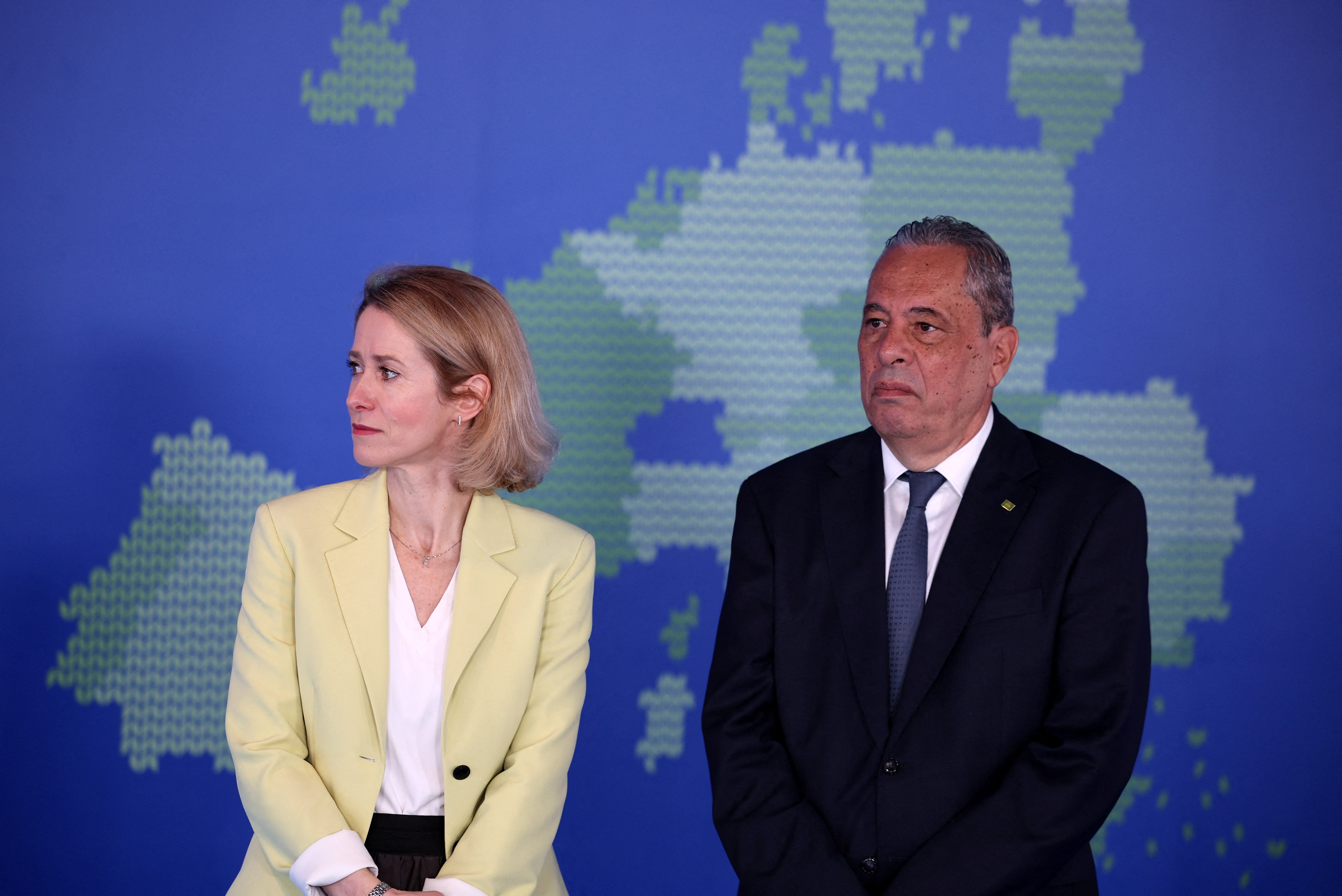
The ongoing war in Ukraine is set to dominate proceedings on Monday, with the European Union’s 27 defence ministers having descended on Nicosia for an informal meeting of the European foreign affairs council (Fac) in its defence configuration.
Kaja Kallas, the EU’s foreign policy chief, said upon her arrival in Cyprus’ capital that the three main topics of the day’s discussion would be maritime security, developments in the Middle East and continued support for Ukraine.
She said that attendees would also review the EU’s naval operations in the Middle East, and said that new sanctions linked to freedom of navigation and maritime security concerning Iran were being implemented for the first time.
On the matter of the war in Ukraine, she said that attendees would discuss efforts to tackle Russia’s “shadow fleet” – a flotilla of hundreds of oil and gas tankers used by Moscow to bypass western sanctions and export energy supplies.
To this end, she said that the EU’s naval operations had recently expanded their rules of engagement and begun boarding vessels.
“The idea is also to exchange best practices between member states and curb Russia’s activities,” she said.
Likewise, the matter of offering support for Russia is also expected to feature prominently during the day’s discussions, with attendees set to deliberate efforts to further mobilise funding through the European peace facility, an off-budget fund established by the EU to finance military and defence actions.
Asked about the prospects for negotiations to end the war, Kallas said that both Russia and Ukraine would eventually have to engage in talks, but stressed that pressure on Moscow must continue.
“We have to do everything so that Russia and Ukraine will talk to each other because eventually they have to agree,” she said. “At the same time, we need to keep our core European security interests in mind.”
She also highlighted cooperation between Ukraine’s defence industry and European manufacturers, particularly in drone technology, saying the bloc should build on Ukrainian expertise rather than “reinvent the wheel”.
Additionally, she made brief reference to Armenia, where pro-European Prime Minister Nikol Pashinyan has secured victory in the weekend’s parliamentary election, saying that those indications suggest strong public participation despite what she described as significant pressure from Russia.
“It looks like Armenia’s people, although under heavy Russian pressure, have made their choice,” she said, while noting that votes were still being counted.
Pashinyan’s Civil Contract party secured 49.8 per cent of votes nationwide and a majority of seats in the country’s parliament, winning more than twice as many votes as the pro-Russian opposition Strong Armenia party, which is let by Samvel Karapetyan.
Earlier, Cypriot Defence Minister Vasilis Palmas had said he was confident that the day’s discussions would be both substantive and constructive.
“As you understand, issues of defence and security are a first priority for the European Union,” he said, adding that ministers would seek practical ways to strengthen the bloc’s response to the challenges of the day.
European Defence Commissioner Andrius Kubilius, meanwhile, said that the bloc must accelerate its defence production, and warned that Russia is continuing to expand its military manufacturing capacity.
Asked about reports that the United States had delayed deliveries of some weapons systems to European countries, he said Washington’s stockpiles had come under pressure in recent months and that Europe needed to become more self-reliant.
“We are still relying on American weapons for around 40 per cent of our defence procurement,” he said, before adding that “we need to increase our own defence production.”
He said the EU is now introducing new initiatives to strengthen the continent’s defence industry but warned that fragmentation remained a major obstacle, and said that as such, Europe needs to learn how to develop joint defence projects more successfully, particularly in areas where it remains heavily dependent on non-European suppliers.
Asked about discussions in Lithuania on the possible deployment of nuclear weapons on its territory, he described the issue as a matter for individual member states, but said European countries needed to be prepared to strengthen their defence capabilities in the most effective way possible.
He added that the best way to avoid future security threats was to continue supporting efforts to achieve a “just and lasting peace” in Ukraine.
Irish minister of state for defence Thomas Byrne stressed the importance of maritime security, saying, “from one island on the west of Europe to another on the southeast of Europe, maritime security is vitally important”.
He stressed the importance of secure sea lanes, before moving on to the matter of Ukraine, saying that the EU needs to work together and “speak as commonly as we possibly can” on the matter.
Looking ahead to Ireland’s upcoming six-month term as the holder of the presidency of the Council of the EU, which begins next month, he thanked Cyprus for its stewardship over recent months and said Dublin would continue to prioritise security and defence issues.
Asked about reports concerning Irish exports which ultimately reach Russia, he said his country’s government has launched an investigation and would consider its findings in consultation with the European Commission.
He then stressed Ireland’s support for the EU’s sanctions against Moscow and its commitment to Ukraine.
Greek Defence Minister Nikos Dendias echoed the importance of maritime security, pointing to the EU’s Aspides naval mission in the Red Sea, which has recently seen its mandate expanded.
He said ministers would also discuss the future of European defence and efforts to “strengthen the bloc’s strategic autonomy through mechanisms complementary to Nato, while drawing on the mutual assistance provisions contained in Article 42.7 of the EU Treaty”.
Article 42.7 of the Treaty of the European Union, better known as the Lisbon Treaty, is the EU’s common defence clause.
“For a Greek minister, it is always moving to be here in Nicosia,” Dendias added.



Click here to change your cookie preferences