
Artificial intelligence makes some interesting points about loss, acceptance and resolution
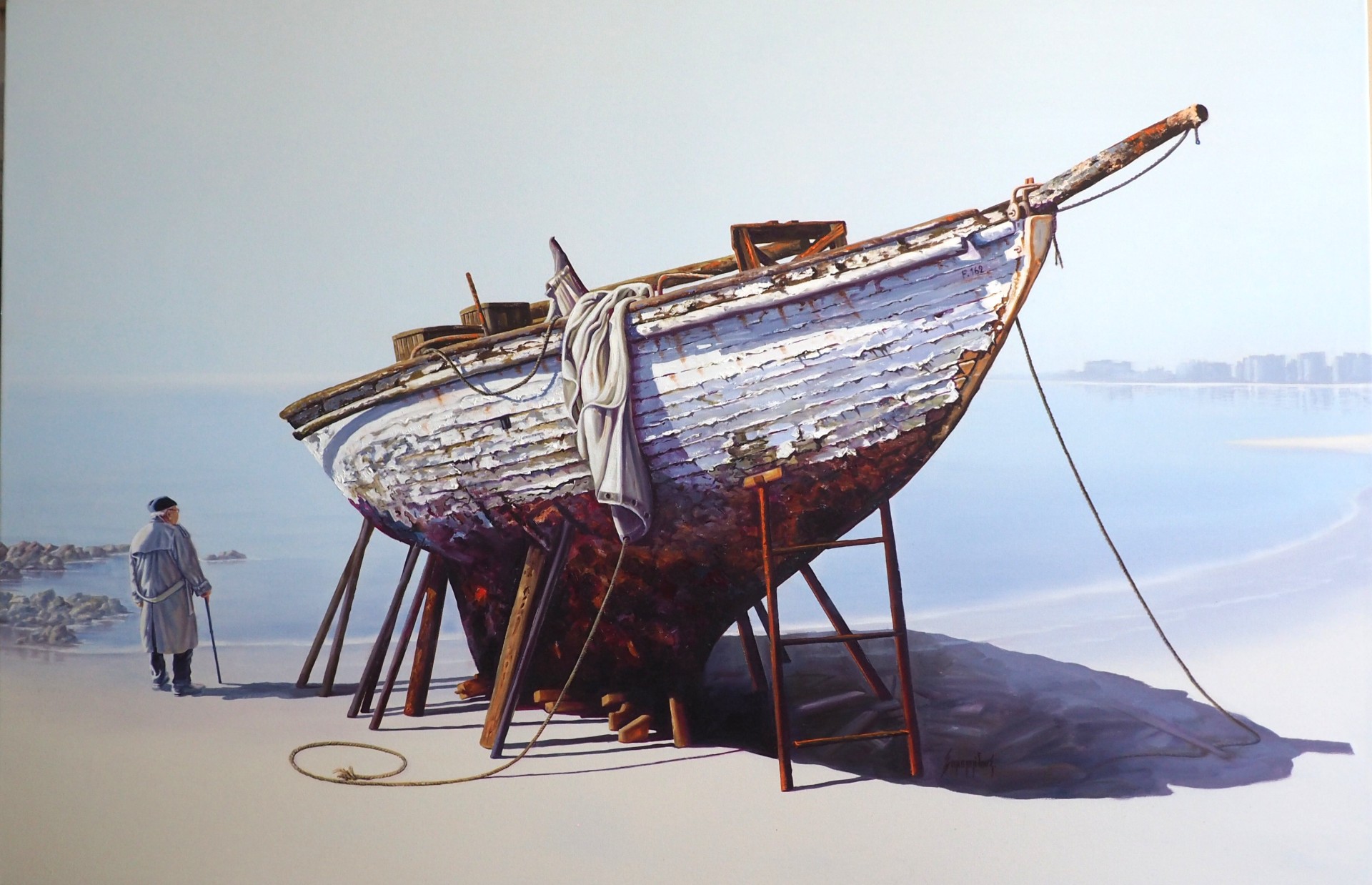
An acknowledged Greek painter and a good friend of mine, Sylvana Samartzidou, recently portrayed me gazing at the past, next to a classic Cyprus fishing boat grounded on the golden beach of Famagusta, while I was trying to understand how we managed to transform a vibrant, small Mediterranean town into a lifeless carcass, a prey to the elements of nature.
Over the last 50 years, I have made many unsuccessful attempts to formulate a satisfactory response to the question of how we managed to accomplish such an impossible task. Recently, I thought to seek the help of artificial intelligence. I admit that I was impressed by AI’s responses and the idea of sharing my impressions was born.
AI: Looking at the past can be a creative act, an act of self-knowledge, an act that can offer valuable lessons; experiences that should be imitated and experiences that should be avoided. he process should aim at self-knowledge but it should not lead to fatalism. Memories often act as a compass, helping us to understand both our correct and incorrect choices, helping us to bridge the past with the future. Depending on the character and personality of each one of us, looking back can have a different impact:
• Accepting the past – Recognising and accepting reality helps us leave behind our pain or regrets, focus our attention on the present and the future, and neutralise the consequences of our mistakes.
• Being trapped in nostalgia – Clinging to the past can sometimes fill us with bitterness or make us lose touch with the present, denying reality and thus perpetuating the problem.
• Creating a tool for managing the future – The past is the best teacher. By analysing our experiences, we can lay the foundations for a more conscious future.
If the past is Famagusta, how can one cope?
AI: When the past is identified with Famagusta, reconciliation is not a simple mental process, but a deep existential and collective struggle with the trauma of a huge loss. Famagusta is not just a city that was lost, but a symbol of an “open wound” that refuses to close. The acceptance of reality often leads to the following paths.
• The preservation of memory as a form of resistance: Many choose not to “forget”, transforming nostalgia into a living bond with the past. Memory here functions as a right and not as a burden, keeping the hope of return alive. However, the danger of “I do not forget” lies in the fact that it can lead to complacency of the type “at some time, in the years to come, the occupied land will revert to us”.
• The transformation of pain: Loss often leads to creative and/or socially favourable reactions (e.g. setting up and running of refugee associations, organising exhibitions, undertaking architectural revival studies and the like), which create the illusion of contributing to the healing of the wound, especially in the cases where the problem remains unresolved for a long time. The substitution of pain is also a way of absolving ourselves of the responsibilities we have for the harm caused by our mistakes of commission or omission.
• The ‘mourning of the loss’: Psychologically, the recognition of reality requires the admission that the environment we knew has substantially changed or even destroyed. This stage is the most difficult, as the city remains there – visible but inaccessible – preventing the completion of the mourning cycle. Unfortunately, in the case of Famagusta, the pressure caused by the “mourning of the loss” has not been transformed by politicians into a realistic action plan for resolving the problem. Political incompetence and the lack of political foresight must have played a significant role in this process.
• Connecting generations: For the younger generations, the acceptance of reality comes through the search for a “new language” of communication and understanding, trying to build a future that will not be solely determined by the destruction of the past. Thus, many young people (often the most capable) choose to emigrate to other countries (mainly the European Union) or to join far-right or far-left organisations, on the strength of the illusionary belief that such organisations have the ability to resolve the problem.
Without doubt, a compromise solution in the case of Famagusta (and of Cyprus, in general) should not result in merely accepting the loss. A solution that has long-term prospects of success must preserve the multicultural character of Cyprus while the political and economic “umbilical cord” that currently connects northern Cyprus with Turkey must be severed. Of course, the prospect of success of such a solution will primarily depend on the real intentions of the parties involved concerning their coexistence and their commitment to prosper peacefully.
Is this ‘compromise’ a form of peace or a form of renunciation of inalienable rights?
AI: What constitutes an “inalienable right” can easily be challenged. In any case, rights very often conflict with each other. Furthermore, these rights do not have any practical value, if there is no mechanism to ensure their enforcement, beyond the imposition of the views and choices of the most “powerful” or the victor, in a conflict situation. It is abundantly clear that provoking a conflict involves the risk of going for “gains” and ending up with “losses”, as happened in Asia Minor in 1922 and in Cyprus in 1974.
Can we then be led to the conclusion that prolonging the political status quo in Cyprus is an illogical and unjustified act?
AI: More than half a century has passed since the occupation. Throughout this period, the successive governments of Cyprus have limited themselves to rejecting the plans proposed from time to time to resolve the problem – mainly by the United Nations – with a “resounding no”. With the exception of the Vassiliou proposal of 1989, at no stage has a comprehensive and coherent plan been formulated with the required sensitivity towards the problems of all those involved in the process and with provisions that would maximise the prospects of the plan surviving in the long-run. In fact, in many cases, the stance of the political world of Cyprus was shaped within the framework of personal ambitions and personal financial interests. In this sense, the perpetuation of the status quo in Cyprus indeed constitutes an illogical and unjustified act, unless their goal is the partition of the island.
Christos Panayiotidesis a retired certified public accountant and a former columnist for the Cyprus Mail




Click here to change your cookie preferences