
How Palestine Action was proscribed as terrorist
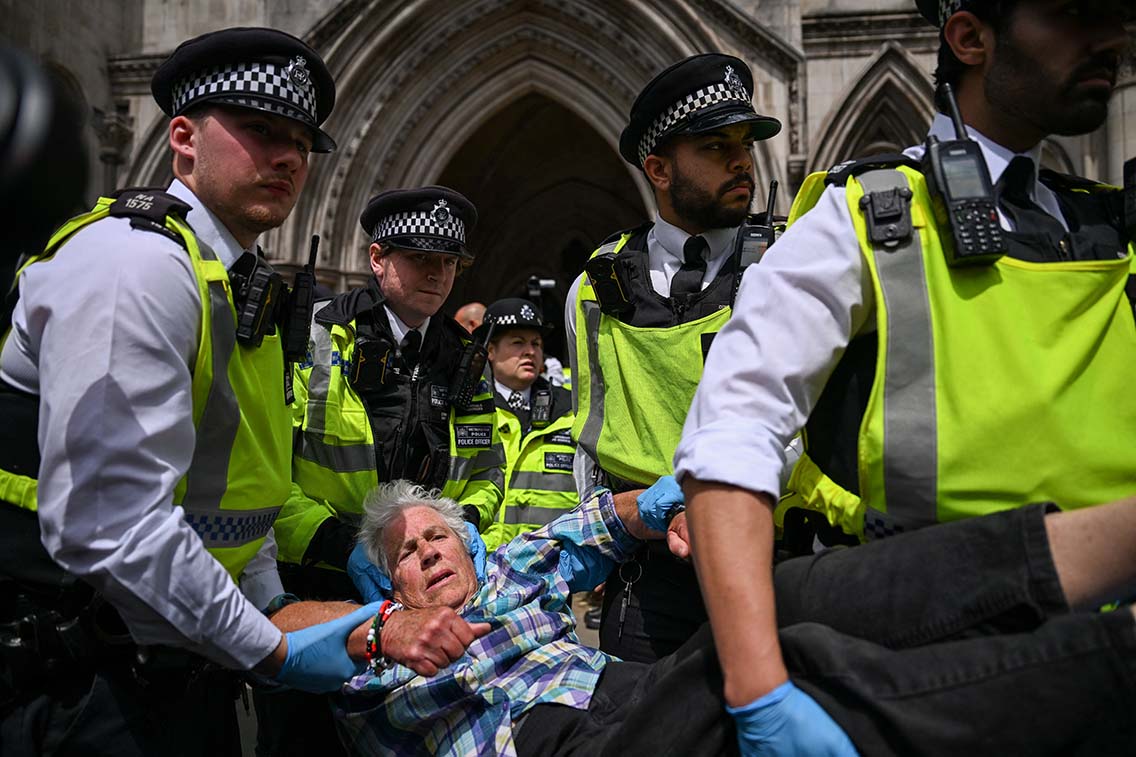
There were two judgments of general interest from the English courts two weeks ago about Palestine Action, a direct-action protest group based in UK that campaigned against the UK government’s arms trade with Israel.
The first was a judgment of five of the top judges of the civil court of appeal in England that unanimously decided that a government decision to include Palestine Action in a list of terrorist organisations was lawful.
A lower court held the government’s decision to be unlawful but granted permission to appeal and suspended giving effect to its decision as it had little confidence in its own judgment whose reasoning was indeed incoherent.
There was also a decision by a sentencing judge in a criminal case in which he held that offences of criminal damage by four members of Palestine Action convicted after a retrial were connected with terrorism and were therefore aggravated for the purpose of the sentences he imposed on the defendants, even though they were neither charged nor convicted by the jury of terrorist offences.
Terrorism is defined as committing crimes of serious violence against persons and property for political reasons to influence government policy. It is a form of asymmetrical warfare that was skated over during decolonisation when terrorist leaders became freedom fighters in pursuit of independence and afterwards became heads of state and government: Menachem Begin of Israel, Yasser Arafat of Palestine and Nelson Mandela of South Africa were all branded as terrorists, though it is fair to point out that all three were also awarded the Nobel peace prize in later life.
Terrorism is no longer tolerated or excused – if it ever was on home territory – after the attack on America of 9/11. In the UK the government has had the power to proscribe organisations that it considers terrorist since 2000, and when it does, it is a criminal offence to belong or support a terrorist organisation.
Palestine Action purports to be a direct-action protest group and the decision to proscribe it engaged the qualified rights of freedom of expression and association in human rights law. Both rights are qualified and governments can and do curtail them in many cases provided it is proportionate to do so.
The court of appeal assessed the proportionality of listing Palestine Action as a terrorist organisation and decided that, although its rights of freedom of expression and association were breached, it was a proportionate response for the protection of national security and the rights of others.
The reason why proportionality arose as an issue at all was because branding Palestine Action as terrorist criminalised the conduct of a lot of ordinary decent people who went on demonstrations holding placards saying “I am against genocide. I support Palestine Action.” The court’s answer to that problem was that the ban did not impede anyone’s freedom to support Palestine independently of Palestine Action.
Proportionality is easy to understand but difficult to assess. It is easy to understand because everyone knows that you do not use a hammer to crack a nut. Or as President Trump pithily put it the other day about Israel’s recent attacks on Beirut: “You don’t have to knock down an apartment house every time you’re looking for somebody because there’s a lot of people in those apartment houses and they’re not all Hezbollah.”
But banning a protest group like Palestine Action owing to its protest methods, which involved causing criminal damage to property, was not straightforward even though causing serious criminal damage to property for a political purpose can be terrorist. It is one thing to spray premises with red paint, but there was evidence that on a few occasions Palestine Action went beyond that and engaged in more serious damage and an issue in the appeal was if that was enough to attract proscription.
Proportionality as applied by judges across Europe is a four-stage process that addresses the importance of a measure; its effectiveness; whether there are alternative less intrusive measures; and whether the need for proscription is more important than the violation of the rights involved.
In assessing the necessity of the government’s decision to proscribe Palestine Action, the court of appeal held that it was not prepared to substitute its own judgment for that of the government on matters of national security in which it was not in as good a position to judge as the government that had more access to secret intelligence and was answerable to parliament and the electorate.
The court of appeal also said that even if Palestine Action was not terrorist at present, it was on a terrorist trajectory and that the government was entitled to make that judgment in the proportionality exercise.
Palestine Action will seek permission to appeal to the Supreme Court and to do so it would have to show the case raises a point of law of general public importance. It would be interesting to see what point of law on proportionality they put forward as arguable.
The criminal judge’s decision after the conviction of the four members of Palestine Action to treat their offences as aggravated by terrorism was mandatory once he was satisfied there was a terrorist connection.
The problem the defendants faced was that they gave evidence in their defence at trial that the criminal damage they caused was motivated by their wish to stop the UK government’s arms trade with Israel that in any case was not serious enough to be treated as terrorist.
The judge held that the criminal damage the jury convicted them of was serious and their motivation was for the political purpose of influencing the UK government and consequently within the definition of terrorist connection.
An interesting question in this case is whether the jury would have convicted the defendants if the offences were charged as terrorist offences rather than simple criminal damage. It could be argued that the prosecution had it both ways: the jury decided the defendants were guilty of criminal damage and the judge that they were terrorist offences.
In principle defendants should be sentenced for offences they have been convicted by a jury and not for more serious terrorist offences camouflaged as aggravating features.




Click here to change your cookie preferences