
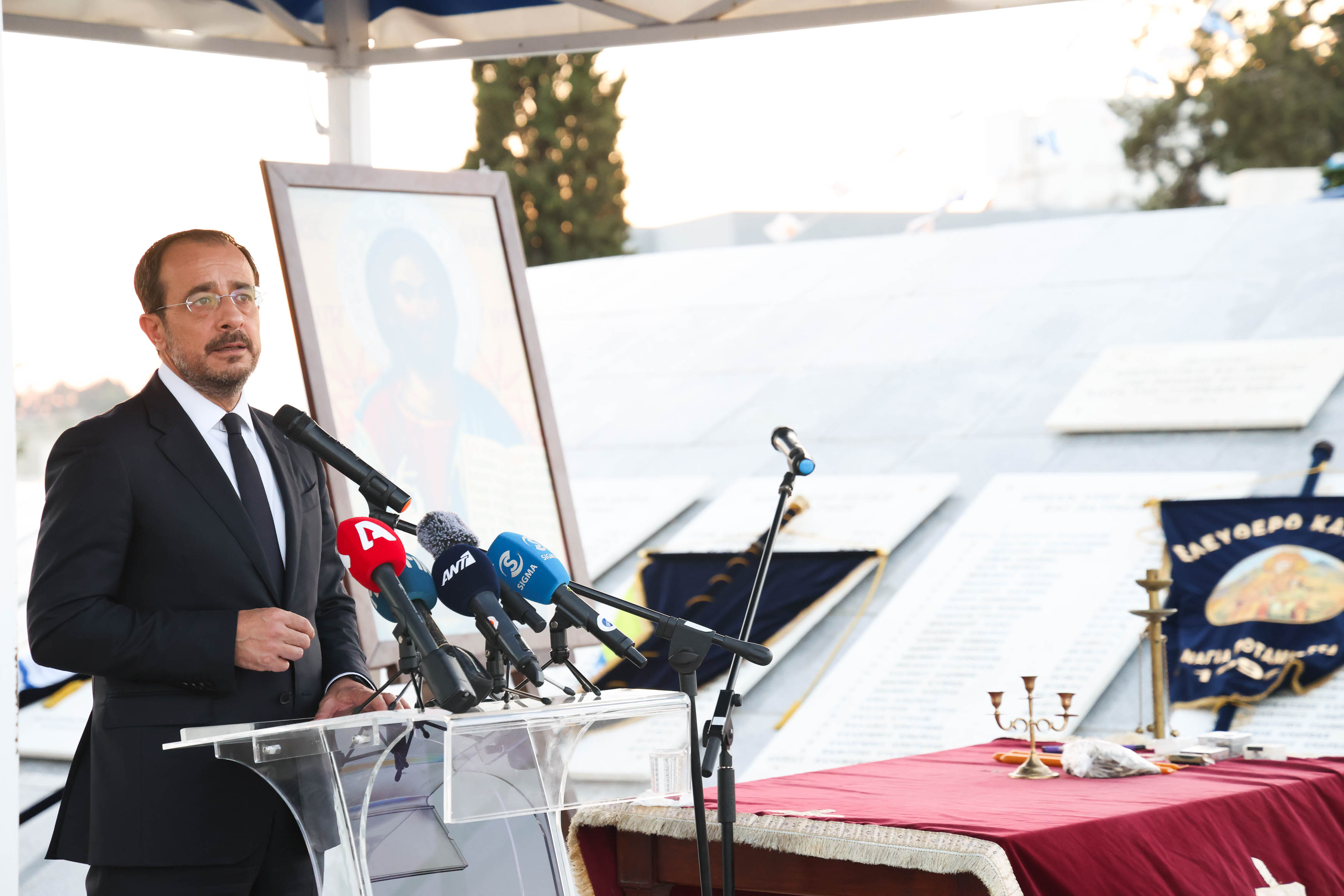
President Nikos Christodoulides said on Wednesday that the European Union’s involvement in efforts to resolve the Cyprus problem was now substantive rather than symbolic, as he reiterated that progress in EU-Turkey relations must be directly linked to developments on Cyprus.
Speaking at an event organised by Kyrenia municipalities, communities, refugee associations and organisations at the Makedonitissa Tomb, Christodoulides said the government remained committed to a settlement that would end the occupation and reunite the island.
Referring to Kyrenia, Lapithos, Karavas and other towns and villages in the north, Christodoulides said Kyrenia had paid and continued to pay an especially heavy price following the Turkish invasion and 52 years of occupation.
“On this day 52 years ago, the Turkish army entered the town of Kyrenia, occupied it and forcibly expelled all its indigenous Greek residents,” he said.
He praised displaced Kyrenians for rebuilding their lives, while maintaining their connection to their towns and villages through the work of refugee municipalities, communities and associations.
Christodoulides said Turkey continued to violate international law and the fundamental rights of the lawful residents of Cyprus, while seeking to legitimise the consequences of the invasion.
Addressing those who argue that the government should take existing realities into account, he said “the occupation itself was the reality that must be confronted”.
He referred to the case of Titina Loizidou, whose successful application before the European Court of Human Rights established Turkey’s responsibility for denying her access to her property in Kyrenia.
The ruling, he said, confirmed the principle that illegality cannot create legal rights, regardless of the passage of time or Turkey’s attempts to impose its position through military force.
Christodoulides acknowledged that the Cyprus problem would not be resolved in courtrooms but through political negotiations. However, he said its legal dimension could not be erased and the rights of citizens of an EU member state could not be surrendered.
The government’s policy, he added, sought a settlement that would end the existing state of affairs and establish a modern, functional and European state.
“We are not asking for anything more than what every person and every people deserves and is entitled to,” he said.
The president said the government was working towards a viable, functional and resilient settlement that would allow all lawful residents of Cyprus to live, work and create wherever they chose in conditions of peace, security and prosperity.
He said securing a leading role for the EU in the Cyprus negotiations had been one of his central goals even before his election, despite criticism from those who initially described it as unrealistic.
According to Christodoulides, it had now become clear that the Cyprus problem was also a European issue and that the EU therefore had both a right and an obligation to play a decisive role.
He cited the conclusions of the European Council in April 2024 and a joint letter sent by the presidents of the European Commission and European Council to UN Secretary-General Antonio Guterres in March 2025.
He also referred to the recent appointment of European Commission Executive Vice-President Raffaele Fitto as the EU’s special representative for Cyprus.
Christodoulides said the appointment had upgraded the EU’s involvement at a time when Guterres was pursuing a new initiative and was due to visit Cyprus between July 27 and 29.
“The European Union is present, not formally, but in a leading role,” he said.
He added that the government’s strategy rested on two pillars. The first concerned ensuring that any settlement was compatible with EU principles, values and law, while the second involved linking any progress in EU-Turkey relations directly to substantive developments in the Cyprus problem.
“This is a development which is the result of the strategy we are implementing,” he said.
Christodoulides said “the message to the Turkish government, the Turkish Cypriot leader and all interested parties was that a settlement benefiting everyone remained possible, provided there was political will”.
Any agreement, he said, must be “compatible with Cyprus’ status as an EU member state, a status the Republic would retain after a settlement, together with all the rights and obligations that membership entails”.
He said the state also had a duty to strengthen itself internally, warning that a country weakened at home would have fewer prospects of securing a positive outcome in negotiations on major national issues.
Christodoulides pledged to continue working under the mandate he had received from the electorate for a settlement that would free Cyprus from occupation and reunify the country.
“Our borders are in Kyrenia is not a slogan,” he said. “It is our objective for a settlement that will ensure the genuine reunification of the country in its territory, institutions, economy and every aspect of daily life.”
He said it was unacceptable for hundreds of millions of EU citizens to enjoy rights across the Union while Cypriot EU citizens were denied the same rights in their own country.
Christodoulides also paid tribute to refugees, relatives of the fallen and missing, resistance fighters and those who fought in 1974, saying their endurance continued to give strength to the government’s efforts.
He thanked Greece and the Greek people for their continued support, making particular reference to Greek officers and soldiers who fought in Cyprus, some of whom are buried at the Makedonitissa Tomb.
Addressing Kyrenia refugees at the close of his speech, Christodoulides said it was unthinkable to envisage a reunited Cyprus in which they could not walk, live and act freely in Kyrenia.





Click here to change your cookie preferences