
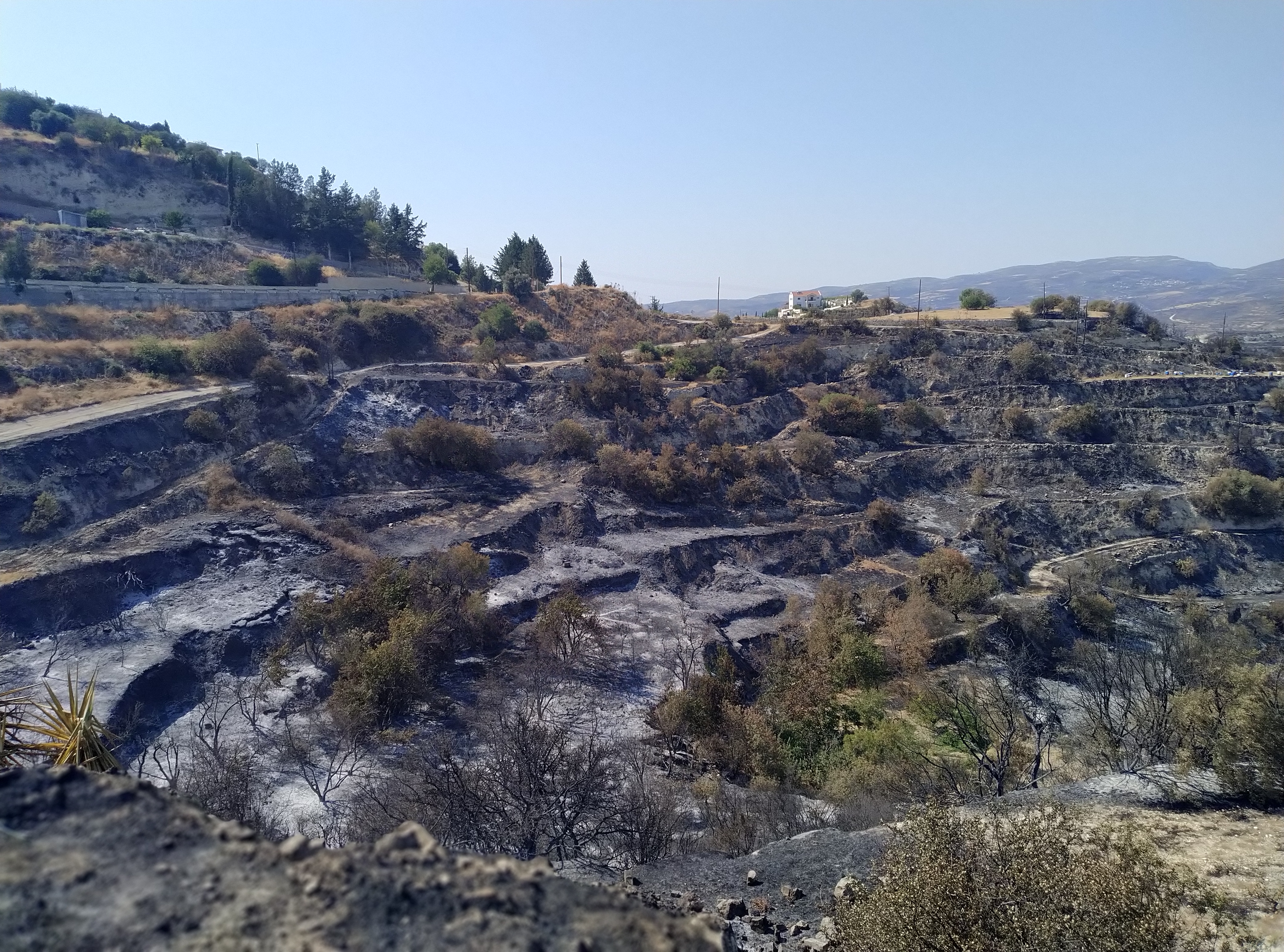
One year has passed since the deadly wildfire that claimed two lives, scorched more than 100 square kilometres of land and caused extensive damage across 15 communities in the western Limassol mountains.
The fire of July 23, 2025 also exposed, in the most painful way, the challenges Cyprus faces in preventing and managing natural disasters, as well as the need for greater public awareness over the protection of the island’s natural environment. The blaze was attributed to the careless disposal of a cigarette.
Mountain Communities Development Commissioner Charalambos Christofinas and Limassol Communities Union president Lefteris Periklis described the anniversary as a sombre reminder of an unprecedented and devastating event that left traumatic memories for all those who experienced it.
Christofinas said the fire spread at extraordinary speed, as also recorded in a report by American experts.
According to the report, the area’s topography played a decisive role, allowing the fire to spread in every direction, regardless of the prevailing strong winds, at a rate of between 60 and 63 metres per minute.
“Our appeal to the public is to protect Cyprus’ ‘green lungs’, and we must be particularly careful to preserve them,” Christofinas said.
“Without our countryside and the beauty of our land, we have no future.”
He said the Limassol mountain region had returned to a degree of normality, but added that recovery would not be complete until every affected resident had rebuilt and returned home.
“For us, the area will fully return to normality when the last of our fellow citizens rebuilds and returns to the home they lost,” he said, adding that 91 families were still living away from their homes with subsidised rent.
Christofinas said the state had responded as it was obliged to do, with an overall budget of €63 million allocated for recovery measures following the fire.
“According to our updated figures, we have a budget of €63 million for all restoration measures arising from the deadly fire, and so far we have spent €28 million,” he said.
A number of measures had already been completed, including the rapid restoration of electricity and water supplies, immediate assistance to those affected and a one-year tax exemption scheme for permanent residents, worth almost €670,000.
Work is continuing on the full restoration of damaged properties, with 931 applications examined for partially or completely destroyed homes and other premises.
“One year later, almost all those affected have been informed and most have signed,” Christofinas said.
“Around 13 cases remain pending because they require special treatment and are still being assessed, as they were not covered by the decisions initially taken.”
In cases involving underinsured properties, he said additional assistance had been approved where justified.
Those affected had been informed, while some had already signed agreements with the interior ministry so that the payment of additional sums, beyond their insurance coverage, could begin.
Christofinas also said an extension had been granted to owners of unlicensed premises, allowing them time to secure the necessary permits and qualify for full compensation.
Those unable to obtain the required permits would receive 25 per cent compensation, he added.
He said there was full cooperation with the Limassol district government organisation, which had established a dedicated unit to process applications from fire victims, while expressing hope that procedures would move more quickly.
The cabinet had also decided to include young couples in a scheme through which available plots could be provided, either in the same community or another area, under conditions allowing them to secure financing and build homes legally.
Christofinas also referred to additional incentives worth about €23 million introduced by the agriculture ministry to revitalise the area and restore vineyards.
The aim, he said, was to encourage the cultivation of vineyards that could also contribute to the creation of firebreaks.
He maintained that Cyprus was now in a much better position in terms of fire prevention measures, while both the public and local communities had become more aware of the risks.
Communities had also received additional funding for clearing vegetation and purchasing firefighting vehicles.
A further €1 million had been spent on establishing permanent rapid-response stations across Cyprus, equipped with tracked vehicles and water tankers.
“The least we can do as a state in such circumstances is stand beside our fellow citizens,” Christofinas said.
“I believe that, for the first time, there is a common acknowledgement that the state responded immediately. Today, we are in a position to say that everything has been set in motion, and we are monitoring its progress.”
Periklis said the events of a year ago had been deeply traumatic and that the affected communities were still “picking up the pieces”.
“The recovery of the communities has begun with the assistance of the state, as a large part of the measures announced has been implemented,” he said.
He added that steps had also been taken towards improving the response to emergencies, in cooperation with the fire service, police, district administration, forestry department and other authorities.
“This year, preventive measures are more coordinated, with technological equipment, patrols and the deployment of water tankers,” he said.
“We hope the public will be extremely careful in the way they behave in the countryside.”
Although restoring everything would be difficult, Periklis said residents would continue working to preserve their communities and look towards the future.
On compensation, he said several exceptional cases involving unlicensed premises remained unresolved and should be examined sensitively by the state.
“We are satisfied with the way the state, and the president personally, respond to issues of a humanitarian nature,” he said.
“We hope that, when we raise these cases with him, there will be a positive outcome.”





Click here to change your cookie preferences