
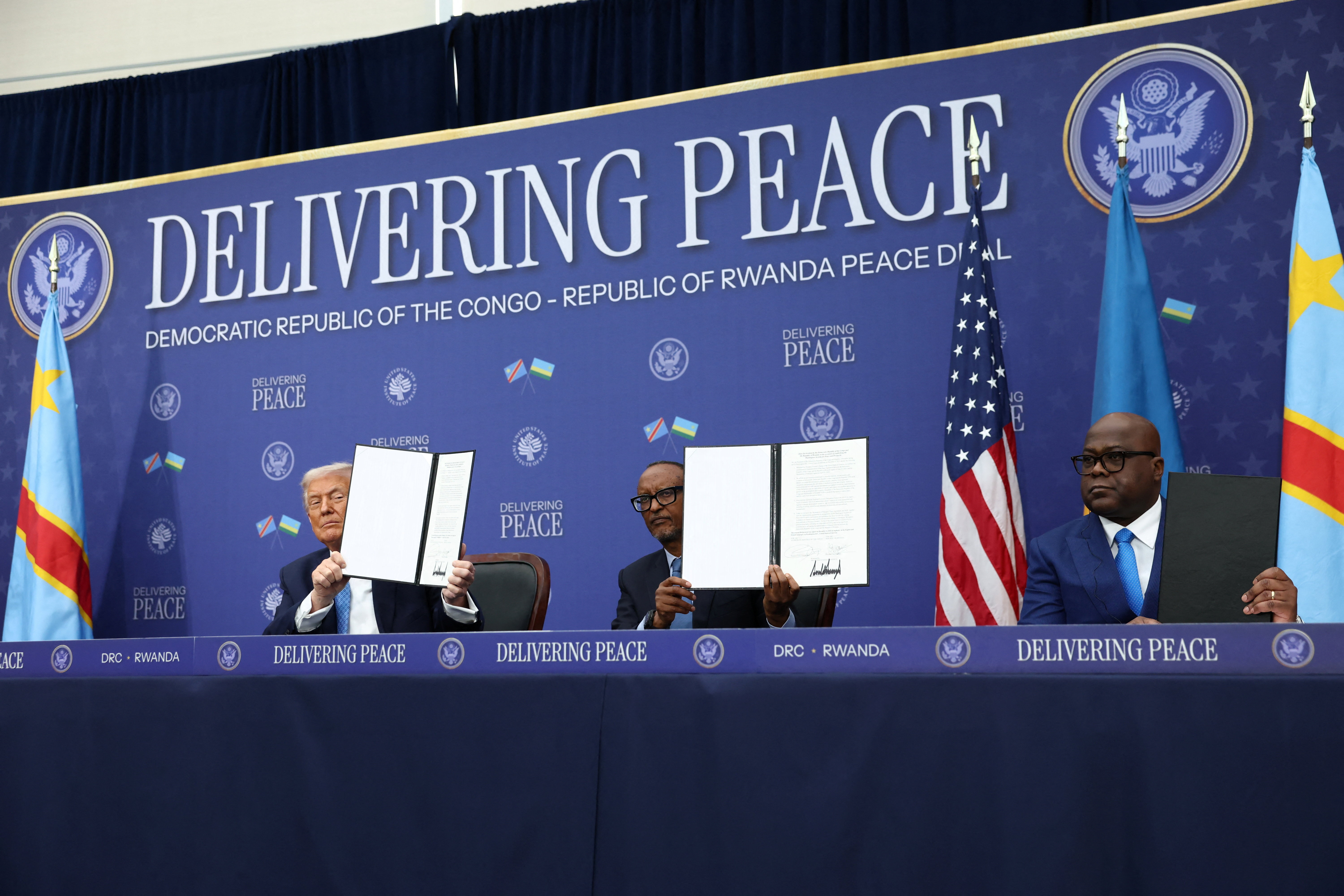
U.S. President Donald Trump gathered the leaders of the Democratic Republic of Congo and Rwanda to sign a peace deal in Washington on Thursday even as fighting continued in their war-scarred region.
Rwandan President Paul Kagame and Democratic Republic of Congo President Felix Tshisekedi affirmed commitments to an economic integration compact agreed last month,and to a U.S.-brokered peace deal reached in June. They were also due to sign an agreement on critical minerals.
The signing handed Trump the latest in a series of made-for-television diplomatic victories, in this case one at odds with the bloody situation on the ground. Washington wants access to a spectrum of natural resources in Congo and is scrambling globally to counter China’s dominance in critical minerals.
“We’re settling a war that’s been going on for decades,” Trump said. “They spent a lot of time killing each other, and now they’re going to spend a lot of time hugging, holding hands, and taking advantage of the United States of America economically – like every other country does.”
Sitting before a “Delivering Peace” backdrop at a peace institute that his administration unofficially renamed after Trump, the African leaders signed and exchanged documents with the U.S. president.
“Thank you for putting a certain name on that building,” Trump told Secretary of State Marco Rubio, adding that it was a “great honor.”
As the leaders signed, clashes between Rwanda-backed M23 rebels and the Congolese army were reported throughout South Kivu province. A spokesperson for M23 accused government troops of bombing several civilian areas.
M23 seized the two largest cities in eastern Congo earlier this year, raising fears of a wider war. Analysts say U.S. diplomacy has paused the escalation of fighting but has failed to resolve core issues.
A White House official said the deal signing “recommits the parties to the peace process” and reflected “months of intensive diplomacy led by President Trump, who made it clear to both the DRC and Rwanda that the status quo was unacceptable.”
CLASHES IN CONGO CONTINUE
The Republican U.S. president has been eager to burnish his diplomatic credentials. Since he returned to office in January, Trump has intervened in conflicts from the Middle East to Ukraine and beyond. He’s also presided over splashy deal-signing ceremonies from Kuala Lumpur to Sharm el-Sheikh.
Those efforts have brought mixed results: a long-sought Gaza deal, but also criticism that he should focus on domestic, cost-of-living concerns instead. Voters give Trump low marks on his handling of the economy.
Ahead of the signing on Thursday, the president’s name was added to a sign outside the United States Institute of Peace in Washington, a Congress-founded nonprofit his administration tried to seize control of earlier this year. Who controls the institute is now the subject of a legal battle.
The peace agreement may not change the humanitarian crisis on the ground. Congo’s army and M23accuse each other of violating existing ceasefire agreements. At a news conference in Washington on Wednesday, Congolese official Patrick Muyaya blamed M23 for recent fighting and said it was “proof that Rwanda doesn’t want peace.”
M23 did not attend the meetings in Washington. It is not bound by the terms of the Congo-Rwanda agreement and is participating in separate, Qatar-mediated talks with Congo.
Denis Mukwege, who won the Nobel Peace Prize in 2018 for helping Congolese sexual-violence victims, said the deals were driven more by the scramble for minerals than by a genuine effort to end bloodshed.
“For me, it is clear that this is not a peace agreement,” he said in Paris. “The proof: this morning, in my native village, people were burying the dead while a peace agreement was being signed. The M23 continues to seize territory.”
Rwanda denies backing M23. Kigali has said its own forces have acted in self-defense against ethnic Hutu militiamen linked to the 1994 Rwandan genocide, when more than 1 million people were killed. United Nations experts said in July that Rwanda exercises command-and-control over the rebels.
M23 says it is fighting to protect ethnic Tutsi communities in eastern Congo. The rebel group’s advances mark the latest episode in ethnic rivalry in Congo’s eastern borderlands with Rwanda, the source of conflict for three decades.
Two devastating wars in the African Great Lakes region between 1996 and 2003 cost millions of lives. The latest cycle of fighting has killed thousands of people and displaced hundreds of thousands more.
A REGION RICH IN MINERALS
Trump aides are looking to facilitate billions of dollars of Western investment in a region rich in tantalum, tin, tungsten, gold, cobalt, copper, lithium and other minerals.
Under the Trump-backed agreement, Congo would need to crack down on an armed group opposed to M23, the Democratic Forces for the Liberation of Rwanda. Rwanda would need to withdraw its forces from Congo. Little apparent progress has been made toward either pledge since June.
“We have seen countless mediations and efforts, but none has succeeded in resolving the underlying issues,” said Kagame. “President Trump introduced a new and effective dynamism that created the space for breakthroughs.” Tshisekedi called the deal a “turning point.”

Click here to change your cookie preferences