
The choice between Trumpian and European versions of civilisation now lies before us
The above headline was the subtitle of my column of December 1, 2024. In it, I argued that Donald Trump was unfit for the role of President of the United States. Events over the past week, both at home and abroad, have brought that argument back to mind and prompted further reflection on the role social media plays in bringing out both the best – and the very worst – of human character.
I begin with the United States. Last week saw the murder of celebrated film director Rob Reiner and his wife in their home, with their younger son charged with the crime.
Reiner rose to international fame through a string of hugely successful films. In Cyprus, many would recognise When Harry Met Sally, A Few Good Men, and The Shawshank Redemption among them. Reiner was also a vocal critic of Donald Trump, something that clearly infuriated the President. Few, however, could have anticipated the vile reaction Trump displayed in response to a tragic murder and an unfolding family drama.
For those who may not have seen it, I quote Trump’s Truth Social post in full:
“A very sad thing happened last night in Hollywood. Rob Reiner, a tortured and struggling, but once very talented movie director and comedy star, has passed away, together with his wife, Michele, reportedly due to the anger he caused others through his massive, unyielding, and incurable affliction with a mind crippling disease known as TRUMP DERANGEMENT SYNDROME, sometimes referred to as TDS.
He was known to have driven people CRAZY by his raging obsession of President Donald J. Trump, with his obvious paranoia reaching new heights as the Trump Administration surpassed all goals and expectations of greatness, and with the Golden Age of America upon us, perhaps like never before. May Rob and Michele rest in peace!”
Many people – including numerous Trump supporters – expressed shock at this post. Only a week earlier, I had warned Trump sympathisers to be cautious about who they align themselves with. The lack of character displayed in the above statement is, I hope, self-evident.
For me personally, as a self-confessed sufferer of ‘TDS’, it is particularly disturbing that the President could allude to such a “condition” as something that might get you killed – almost as if the act were being excused or condoned.
In the past, I took some comfort in believing that, as a Trump critic, I was too insignificant and too far removed from Washington to be directly affected. Yet the events of the past week have demonstrated – at least to me – that the tentacles of Trumpism and the MAGA movement are extending far beyond US borders, even reaching here in Cyprus. As I mentioned in last Sunday’s column, Trump is attempting to export his worldview to the rest of Europe.
This is well captured by Gideon Rachman of the Financial Times, who contrasts the competing visions of Western democracy: “The Trump administration view of ‘western civilisation’ is based on race, Christianity and nationalism. The European version is a liberal view founded on democracy, human rights and the rule of law, including international law.”
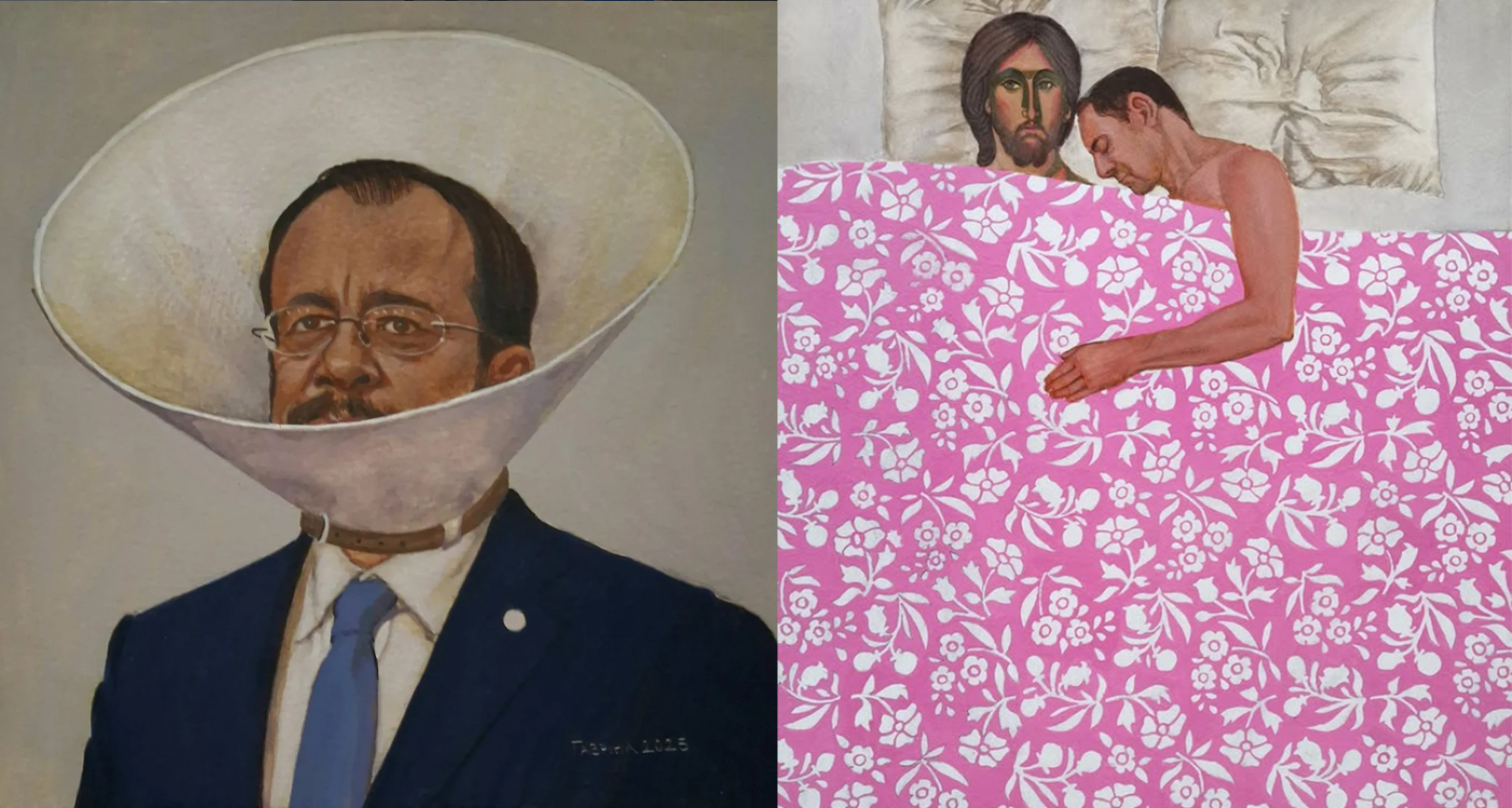
Recent events in Cyprus relating to the painter Giorgos Gavriel aptly demonstrate how this Trumpian worldview is being promoted by aligned political forces. Elam, it should be recalled, was the only Cypriot political party to attend Trump’s inauguration in January. The reproduction and circulation on social media of a manipulated collage of Gavriel’s paintings deliberately misrepresented and distorted his work. There can be little doubt about the intent behind this act, or about the attempt to profit politically from the outrage it provoked.
I admit that when I was first shown the so-called “painting” by friends last Sunday, I too was shocked and wondered whether the artist had crossed a line. The visceral reaction it produced was undeniable. However, upon calmer reflection – and after viewing the individual paintings themselves – I concluded that while the works are provocative and not to my taste, they are no more offensive than many other controversial artworks I have encountered over the years.
But the issue is not whether we like a particular piece of art. The issue is that artistic expression is a fundamental human right, grounded in the rule of law. Once we abandon that principle, we begin going along dangerous paths – issuing fatwas, as Ayatollah Khomeini did against Salman Rushdie over The Satanic Verses, or witnessing terrorist attacks such as those carried out against the satirical magazine Charlie Hebdo in response to controversial cartoons depicting the Prophet Muhammad.
The choice between the Trumpian and the European visions of Western civilisation is now clearly before us. For me, that choice is obvious – and I suspect it is equally clear for Elam. For Efthimios Diplaros, Deputy President of the Democratic Rally, the Gavriel controversy revealed something else entirely. After claiming that the collage was not his own creation – that he merely found it and reposted it – he was given the opportunity to acknowledge that, had he known it was fabricated, he might not have shared it. Instead, he doubled down, arguing that the original paintings were just as offensive and should be banned.
In much the same way, Trump doubled down when questioned about his own controversial post, refusing to show regret – perhaps believing that contrition signals weakness rather than strength. Maybe that is also what Diplaros sought to project. What both men ultimately revealed, however, was not strength, but a profound lack of character.





Click here to change your cookie preferences