
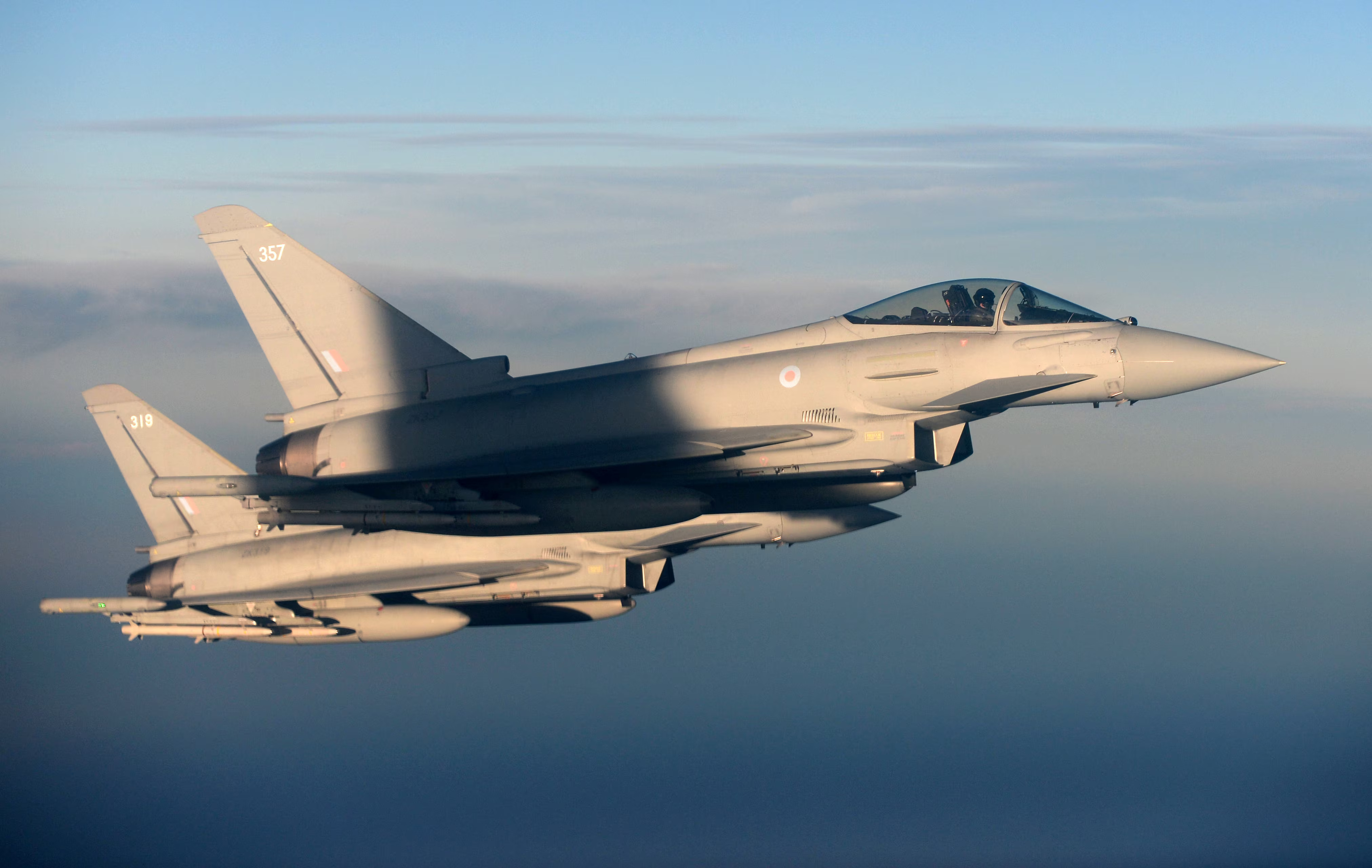
Cyprus was the likely launchpad for strikes conducted by the United Kingdom’s Royal Air Force against Islamic State targets in Syria on Saturday night.
The British government announced late on Saturday that four Typhoon fighter jets, supported by a Voyager air-to-air refuelling tanker, “joined French aircraft in a joint strike” on an underground facility, which it said was located “in the mountains some miles north of the ancient site of Palmyra” in central Syria.
“Our aircraft used Paveway IV guided bombs to target a number of access tunnels down to the facility,” it said, before adding that a “detailed assessment is now underway” and that “initial indications are that the target was engaged successfully”.
“There is no indication of any risk having been posed to civilians by the strike, and all our aircraft returned successfully,” it said.
It said the RAF has been conducting patrols over Syria “to help prevent any resurgence” of the Islamic State since 2019, and that “careful intelligence analysis” had led them to identify the facility.
The facility, it said, had “most likely” been used to “store weapons and explosives”, while it stressed that “the area around the facility is devoid of any civilian habitation”.
British Defence Secretary John Healey was glowing about the strikes, saying that “this action shows our UK leadership, and determination to stand shoulder to shoulder with our allies, to stamp out any resurgence of [the Islamic State] and their dangerous and violent ideologies in the Middle East”.
“I want to thank all the members of our armed forces involved in this operation for their professionalism and their courage,” he said.
The Cyprus Mail contacted the British defence ministry and was told that it could not confirm or deny whether bases in Cyprus were used “for operational reasons”.
The salience of the UK’s bases in Cyprus has grown in recent years as tensions in the region have heightened, with the UK having bolstered its military presence on the island last summer in response to a back-and-forth of missiles fired by Iran and the State of Israel at one another.
At the time, the country’s parliamentary under-secretary of state for the armed forces Luke Pollard having said earlier in the week that there were “about 14” British Typhoon fighter jets stationed at the RAF’s Akrotiri base.
However, he did stress that the UK was not involved in bombing raids carried out by the United States on Iranian nuclear facilitiesat the time.
Earlier last year, it had been reported that the US may ask the UK for permission to station aircraft in Cyprus for future attacks on Iran, with those reports coming after Iran had warned the US, the UK, and France that their bases and ships in the region will be targeted if they help to stop its missile strikes on Israel.
At the same time, the UK’s foreign secretary of the day David Lammy, who is now the country’s deputy prime minister, had said the country’s bases in Cyprus are “hugely important at this time”.
Previously, Cyprus had been the likely launchpad for the military support offered by the United Kingdom to defend Israel from a volley of Iranian missiles launched at the start of October 2024.
The British defence ministry had at the time announced that two RAF Typhoon fighter jets and one Voyager air-to-air refuelling tanker “played their part in attempts to prevent further escalation in the Middle East”.
This, they said, demonstrated “the UK’s unwavering commitment to Israel’s security”.





Click here to change your cookie preferences