
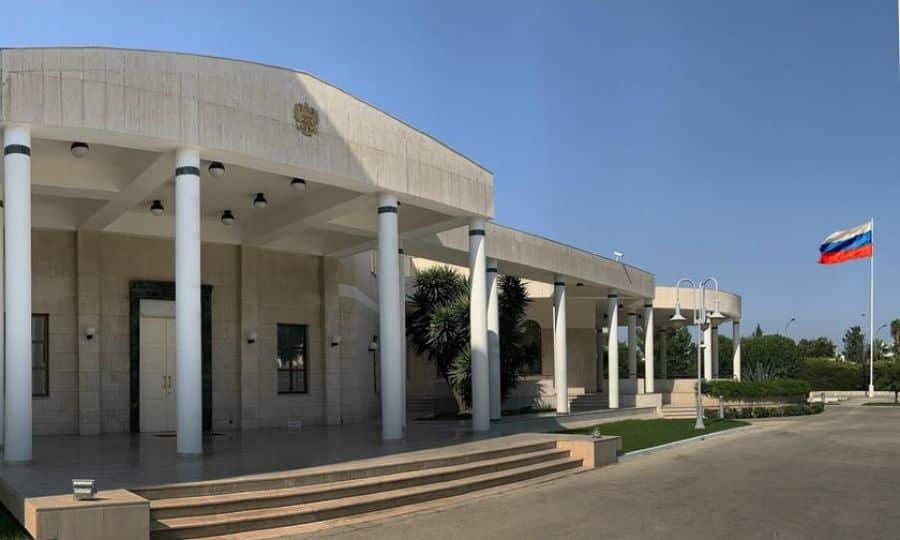
The death of a Russian embassy employee found hanged in his office in Nicosia on Monday has intensified international scrutiny, as investigative outlets and foreign media publish extensive links to Russian intelligence services.
Anton Panov, also identified in some reports as Alexei Panov, was found dead last Thursday inside the Russian embassy compound.
Cypriot police classified the case as an unnatural death but said initial findings ruled out criminal activity.
Authorities were denied access to the embassy building and were handed the body hours later in the courtyard.
A suicide note, cited by embassy officials, was not shared with Cypriot investigators and was reportedly sent to Moscow.
A postmortem conducted by the Republic’s state pathologist found death by asphyxia caused by hanging, with no signs of injury or struggle.
Police said any further evidence would depend on toxicology results, which may take months.
“We requested permission to enter the embassy, but it was denied,” police spokesperson Vyron Vyronas said, citing the compound’s extraterritorial status.
While the Russian embassy described Panov as an employee whose death was “a deeply personal tragedy for his family and friends”, a growing body of reporting suggests he held a far more sensitive role.
According to investigative outlet The Insider, Panov was trained as a cryptographer at a federal security academy and later served at a scientific and technical centre developing secure government communications.
He was allegedly in operational contact with officers of the foreign intelligence service and had previously worked on cyber and information security projects.
Phone records cited by The Insider indicate that shortly before his posting to Cyprus, Panov communicated with senior figures including foreign minister Sergei Lavrov, deputy ministers and officials linked to departments known for placing intelligence officers under diplomatic cover.
British newspapers The Sun and The Guardian said that he was a GRU spy and was possibly intending to defect.
Other contacts reportedly included a serving foreign intelligence lieutenant colonel and figures associated with Russian operations in occupied Ukrainian territories.
Separate reporting by Russian and European media suggests Panov may also have been under financial and personal strain.
The anonymous Telegram channel, known for publishing alleged data breaches from Russian intelligence and security agencies, VChK-OGPU claimed he and his wife lost a large down payment in a failed real estate project in Crimea, later investigated as alleged fraud.
Panov had reportedly written online that “they have stolen from us” and called for public exposure of the case.
Other outlets reported heavy gambling debts, details later echoed by independent journalists.
Western diplomats based in Nicosia have privately expressed concern over the circumstances.
One ambassador told The Guardian that while “conspiracy theories may abound”, a link to wider developments could not be ruled out.
Another described the situation as “mysterious and sinister”.
The death came within 24 hours of the disappearance in Cyprus of Russian businessman and former Uralkali executive Vladislav Baumgartner, prompting speculation of a possible connection, though Cypriot police say there is “no indication so far” linking the cases.
The incident has unfolded as Cyprus assumes the rotating presidency of the EU and amid heightened tensions with Moscow following the government’s pro Ukraine stance.
Panov’s death remains formally classified as a suicide.





Click here to change your cookie preferences