
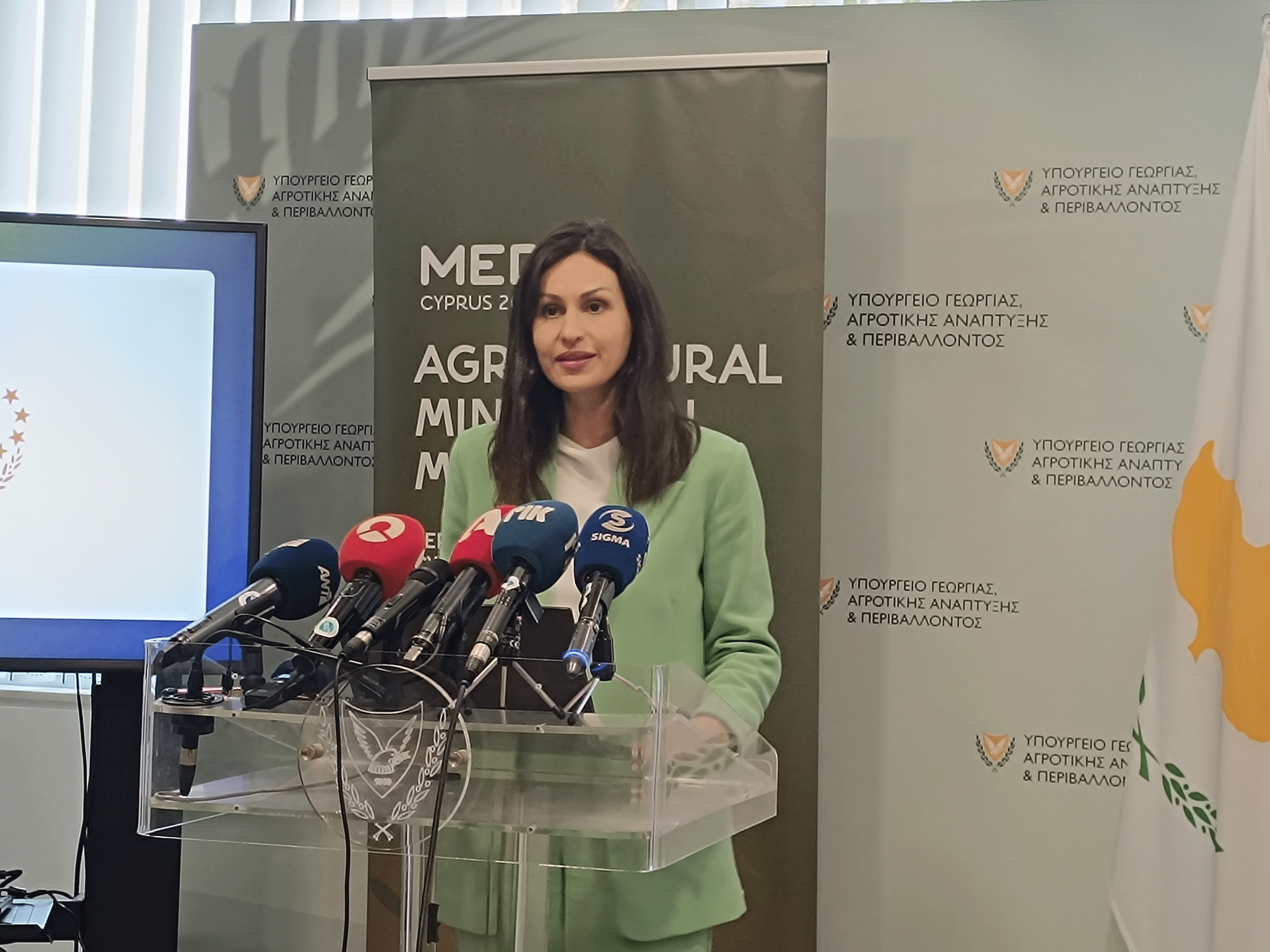
Agriculture Minister Maria Panayiotou on Friday said the government will bolster the island’s capacity to desalinate water, as Cyprus battles an ongoing water shortage.
She said that two new mobile desalination units, which are set to be installed in February and March, are to be placed in Limassol, with one set to be located near the Garyllis river and the other near the city’s port.
The addition of these two units, she said, will bring the total number of desalination units operational on the island to nine, with five – in Paphos, the Limassol district village of Episkopi, Vasiliko, Larnaca and Dhekelia – permanent, and four – in the Paphos district village of Kissonerga, the Limassol district village of Moni, and the two new additions – mobile.
She said the nine units will produce 282,000 cubic metres of water per day and thus cover 80 per cent of Cyprus’ water supply needs.
Additionally, she said, tenders have been put out for the installation of three more mobile desalination units, which will have a combined capacity of 30,000 cubic metres of water per day.
Those new units are to be placed in Episkopi, in Ayia Napa and in Vasiliko.
She also made reference to the planned desalination unit in the Larnaca district village of Mazotos, saying that the water development department is “moving forward” with the project despite the village council calling for it to be suspended immediately.
That unit, she said, will produce 20,000 cubic metres of water per day.
At the same time, however, she said that other measures are also being taken to help stave off a potential crisis in Cyprus’ water supply, with golf course owners in Paphos having been given a matter of months to stop using mains water to water their greens.
“After contacts with the owners of the golf courses, they have been given a specific timetable to proceed with the necessary infrastructure to end their use of water from the Paphos irrigation system before the summer,” she said.
She said that at present, two of the five golf courses in the Paphos district are still using mains water and thus “affecting the quantities provided” to farmers.
Later, she said that the government aims to reduce the island’s water consumption by “at least 10 per cent”, but that thus far, “unfortunately, we have not come close to this target”, before warning that if the island does not reduce its consumption by this much, water cuts may be necessary during the summer.
As such, she called on the public to run their taps for two minutes fewer per day each and complained that some individuals are using far more water than is necessary.
“I have seen individual water consumption exceeding 500 litres of water per person [in a day], while the average is between 120 and 140 litres per person,” she said, before adding that the government has “a plan” to combat this.
“A plan is currently underway to procure the appropriate equipment which consumers will put on their taps to save 10 per cent of water,” she said.
Her comments come with the levels of water in Cyprus’ reservoirs at extremely low levels.
The islands’ according to the water development department’s latest statistics, which were released on Friday, only 11.1 per cent full, with only 32 million cubic metres of water in the reservoirs. That figure is less than half of the number recorded a year ago, when the reservoirs were 26.6 per cent full.
A little over a year prior, in December 2023, there were 133 million cubic metres of water in the reservoirs, meaning they were 45.5 per cent full at the time.
Broken down by area, those near Paphos are now just 11.1 per cent full – in line with the national average – compared to a figure of 27.9 per cent recorded a year ago.
Reservoirs in the Polis Chrysochous area are faring better, though they are 15.5 per cent full, having been 25.1 per cent full this time last year, while the smallest drop compared to last year has been recorded in the Nicosia district, where reservoirs are 15.7 per cent full, having been 16.8 per cent full a year ago.
The southern converyor is facing the biggest shortage, however, with its reservoirs just 10.3 per cent full, having been 25.7 per cent full a year ago.
In particular, the Limassol’s Yermasoyia reservoir, one of the eight which feed the island’s southern coast, is just 0.9 per cent full. This time last year, there was more than 30 times more water in that reservoir alone.





Click here to change your cookie preferences