
By George Neokleous
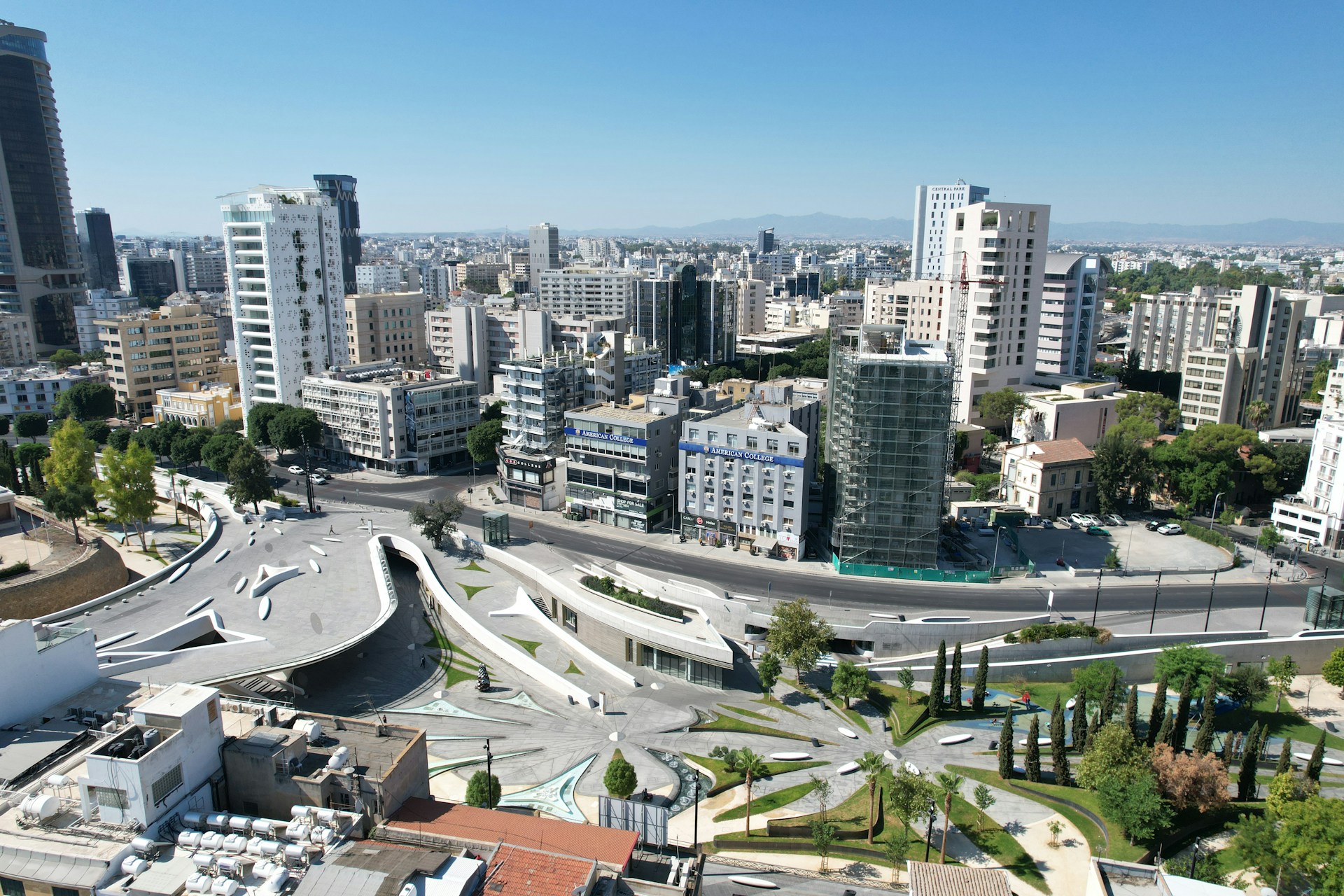
The Cypriot capital is undoubtedly in a period of transition. Nicosia is currently re-defining itself, aiming to align with its European counterparts through a construction boom and large-scale revitalisation in the old town. The city is emerging in global ranks as an attractive place to visit, work and live yet some things have not changed: the notorious congestion and the city’s status as the last divided European capital. Nonetheless, the Nicosia of 2026 is a vastly different experience than that of 2016.
A decade ago, Nicosia was struggling with uncertainty and a notorious lack of hope. The banking sector was in shambles and citizen confidence was at a critical low as the country navigated the aftermath of the catastrophic financial crisis.
In 2016, Wargaming’s 75m tall HQ dominated the skyline. Today, the city has an expanding high-rise corridor centered around the 135m 360 Nicosia. While 2016 lacked today’s sea of cranes and scaffoldings, it felt like an endless construction site. Eleftheria Square was a seemingly eternal project, and major avenues were perpetually a ‘work in progress’. Now, the capital is reaping the rewards of last decade’s endurance.
Malls dominated social life in 2010s Nicosia, functioning as a safer, more convenient alternative to the run-down old town. Today, once dilapidated townhouses covered with safety tape and graffiti are thriving and the old town is once again becoming Nicosia’s vibrant, beating heart where restored facades serve as a photogenic backdrop for tourists.
Ermou, once a crumbling street adjacent to the Green Line, has transformed dramatically. The revamped street now features retail and trendy wine bars. This energy has spilled toward the new Town Hall, creating a nightlife axis.
This wave of change has of course positively affected the ‘traditional’ entertainment core of the old town as well. Faneromeni Square attracts so many visitors that finding a vacant bar/café table on weekends is a feat, while walking along the area’s streets almost guarantees an encounter with an acquaintance. In 2016 though, a night at Faneromeni was different. The area was quieter, less commercial, and belonged to a different world.
As urban spaces changed, so did the faces. Paparazzi’s street art, The World of Cyprus (2017) was perhaps the finest archive of this vanishing era. Paparazzi’s modern, urban re-interpretation of A. Diamantis’ iconic 1967 painting served the same vital function: capturing the essence of a generation. While Diamantis immortalised the village priest and the veiled yiayia of the Cypriot countryside, Paparazzi archived the gritty urban icons of 2010s Nicosia. These were the real people of 2016. As the neighborhood “upgraded” and “refined”, these once familiar faces vanished. So did Paparazzi’s monumental mural, whitewashed as the building was repurposed into a luxury boutique hotel.
Overall, between 2016 and 2026, Nicosia’s image has been meticulously curated. Whether this is true evolution or merely an expensive facelift is up to interpretation. In urban planning, change for improvement is often an elusive concept. Polishing a city is easy, fixing the systems that let it decay in the first place is not. Without structural change, today’s ‘revitalisation’ is just a temporary bandage over deep, old scars. Such surface-level ‘bandages’ are a familiar trope in our society; OSEL’s ageing blue buses were swapped for CPT’s new ‘smarter’ fleet, yet if you didn’t take a bus in 2016, you likely aren’t taking one in 2026 either.
New developments may glisten momentarily, but if they ignore the people, history and culture they were meant to serve, the city hasn’t improved, it has simply replaced its soul with performative superficiality. True evolution requires more than a coat of paint, it requires respecting the urban fabric that made the city worthy of saving and improving in the first place.





Click here to change your cookie preferences