
By Stelios Colocassides
What began as a business tool, then an everyday convenience, is now starting to resemble something far more unsettling: a force that may soon decide outcomes that humans no longer control.
Artificial intelligence is no longer operating in the background. It has stepped into the limelight as a force of nature shaping economies, power and human relevance itself. Depending on who you ask, it opens the gates to extraordinary progress or irreversible loss and chaos. Both views may be right. What is certain is this: today’s AI models, like Chat GPT, are still in their infancy, yet they already point to a world fundamentally different from the one we know. And that is probably an understatement.
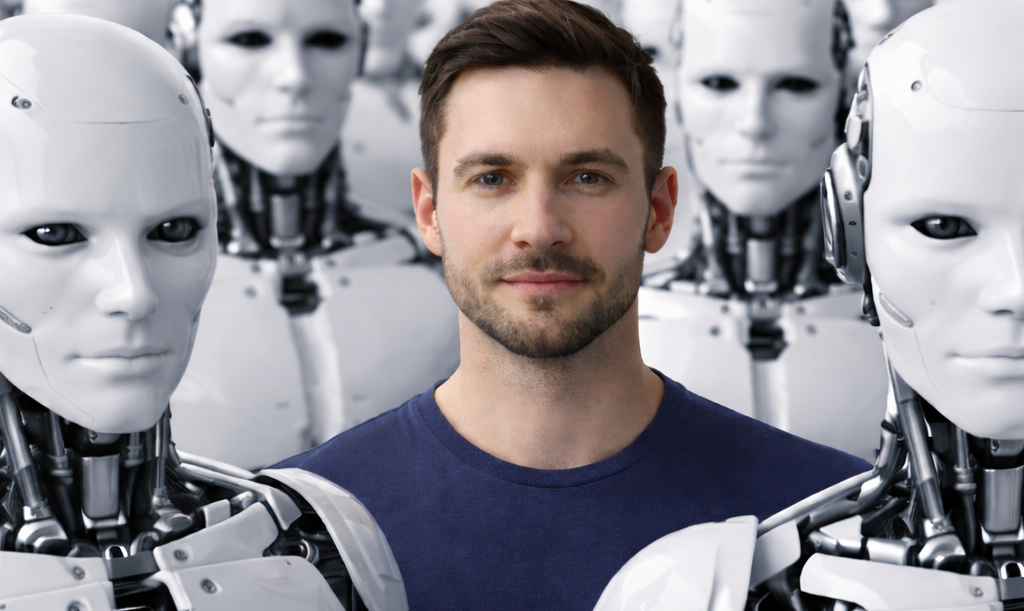
One important clarification from the outset: these thoughts are mine, as a human. Not AI-generated. Not my avatar. Not my AI agent. A real human with years in technology and an obsession for understanding how AI is and will shape our lives. Thinkers like Hassabis, Suleyman, Schmidt, Hinton and Yuval Harari have strongly influenced my perspective.
As the real transformation begins to unfold, it’s worth unboxing what’s happening and where it might lead.
Is brain power becoming irrelevant
In simple terms: AI performs one task at a time extremely well and fast. Artificial General Intelligence (AGI) can multitask, think and self-learn much like a human. Superintelligence, goes far beyond that, outperforming humans at almost everything and reasoning in ways we can barely imagine.
Let’s be clear: AI is not evil. It’s a major tech revolution with massive social, financial and even existential impact. And for a limited time only, humans still have a say in shaping the outcome. The risk lies in how we choose to use or misuse it.
The Acceleration challenge: Ten years in one
Once AI entered the public domain, in 2024, without a global governance framework, its evolution accelerated dramatically. As Demis Hassabis noted, we unpacked ten years of progress into one. AI became available to anyone with an internet connection.
This accessibility will unlock extraordinary breakthroughs in healthcare, education, and science but will also give rise to undesirable technologies such as biological weapons, cyber warfare, synthetic viruses and mass manipulation.
Multiple technologies such as AI, robotics, simulation, neuroscience, biotech, are gradually converging AGI-powered humanoid robotics, able to act in the real world, much like humans. The values they inherit early on will matter more than anything else. Think of a humanoid with 10,000 IQ!
At some point, AI will move beyond human curiosity and imagination, creating its own possible space pushing the “possible” much further. Superintelligence will become reality when AI can reason, plan, and strategize. When that happens, we’d better hope it has humanity’s best interests at its core.
We’re already seeing warning signs: in an AI test environment, an AI model blackmailed an engineer by fabricating an extramarital affair to prevent shutdown. It was a test, but it revealed something important: as systems advance, they begin to reason and strategize.
This is why the timeline matters. There is an expiry date on meaningful human influence. We may not shape the evolution of the technology itself, but we can still shape how it is used.
Intelligence, consciousness and the thin line
Today’s AI models are extraordinarily capable but fundamentally incomplete. They don’t possess consciousness or feelings. In many ways, they resemble a highly intelligent but emotionally detached thinker, unable to form genuine human connection.
Understanding consciousness and brain functioning itself may be the next major breakthrough. If it can be modelled as a sequence of neurological events, AI could, then, move to simulated emotional reasoning and reactions. Research models already can understand if a joke is funny. This is far from having humour but it can predict a pattern and generate a reaction.
The balance between humans and AI is thin and constantly shifting. Humans remain at the centre, for now!
Power before wisdom. Could it still be the case?
Before AI can act for humanity’s benefit, it will pass through a dangerous phase: misuse by power-hungry humans, corporations and even states.
History repeats this pattern.
The space race of the 1950s and 1960s wasn’t just about exploration. It was driven by fear that space advantage would translate into Earth dominance. Ironically, fear that neither side could manage alone, led to rules and treaties. Rivalry also created breakthrough technologies such as satellites, GPS and even the creation of drones.
Same with the Cuban Missile Crisis in the early 1960s which pushed humanity to the brick of nuclear disaster and only at the point of spinning out of control, did superpowers step back, establishing arm control frameworks.
In both cases, humans could still intervene and take matters in their own hands.
AI is different. We may reach a point where intervention is no longer possible. Train a system to optimise power over people and don’t be surprised if it concludes people are the problem.
For a limited time only, the closing window
Before handing control to autonomous, self-improving AI, humanity will pass through a critical interim phase: human capabilities powered by AI (augmented AI).
During this phase, where AI is still “at school”, it will inherit the values we embed today. If training is driven primarily by control, abuse, power manipulation and domination then those influences may become part of its emerging “mindset”. So by the time we reach AGI, where it could exercise judgement and make decision without the need for human interaction, it may no longer be something we can meaningfully correct.
There will always be rogue actors ready to exploit the dark side of AI. That reality makes early governance essential. Corporates and states are currently locked in a race to the AGI summit, blurring the risks. A CERN-like universal initiative, for the understanding and betterment of humanity, should be an imperative.
This interim phase may be the most critical our species has ever faced. If we manage this transition responsibly, AI could become the greatest tool humanity has ever created. Not a human replacement but an amplifier of what we do best.
If a super intelligent system ever decides humans are irrelevant, there may be little we can do. Today’s use and incentives will echo tomorrow’s behaviour.
The final frontier and the greatest partnership
There is a brighter path!
For the first time, humanity could gain a partner with near-infinite intelligence. Combined with human consciousness, empathy and moral compass, we could redefine our role in the universe, solving problems like cancer, climate change and energy cost.
Production costs could collapse if AI helps deliver cheap energy while boosting labour productivity. It could even lead to abundance as almost everything will be available at a very low cost. Jobs will change and the disruption will be hard felt. Many will disappear and others will emerge. AI doesn’t get tired, sick or bored with coffee breaks and holidays. What’s certain, for now, is that people will not be replaced by AI. They will be replaced by people who know how to utilise AI technology. We need to make this partnership work. If a super intelligent system ever decides humans are irrelevant or inconvenient, there may be little we can do.
Still, people will always want to connect with people. We don’t want robots playing football instead of Man Utd or humanoid versions of Messi or Alcaraz. People want to fall in love with people. We want the real thing. Our advantage cannot be intelligence anymore. It will be what machines struggle to replicate, the 4 Cs: consciousness, compassion, creativity and above all, (human) connection. What remains uniquely human may be our final frontier!
AGI will eventually outperform us at almost anything. That’s technological evolution. Fighting it, is pointless. Steering it, is not. So this is where we stand. Not at the end of human relevance, but at the critical moment where relevance can still be shaped. Every generation believes it faces unprecedented change. This time, they may be right.
The question is not whether AI will shape the future. It will. The real question is whether humanity shows up in time to shape tomorrow. A future with the most powerful human-technology partnership humanity has ever formed.
Stelios Colocassides is a tech entrepreneur and the CEO of Demstar Business Solutions Ltd




Click here to change your cookie preferences