
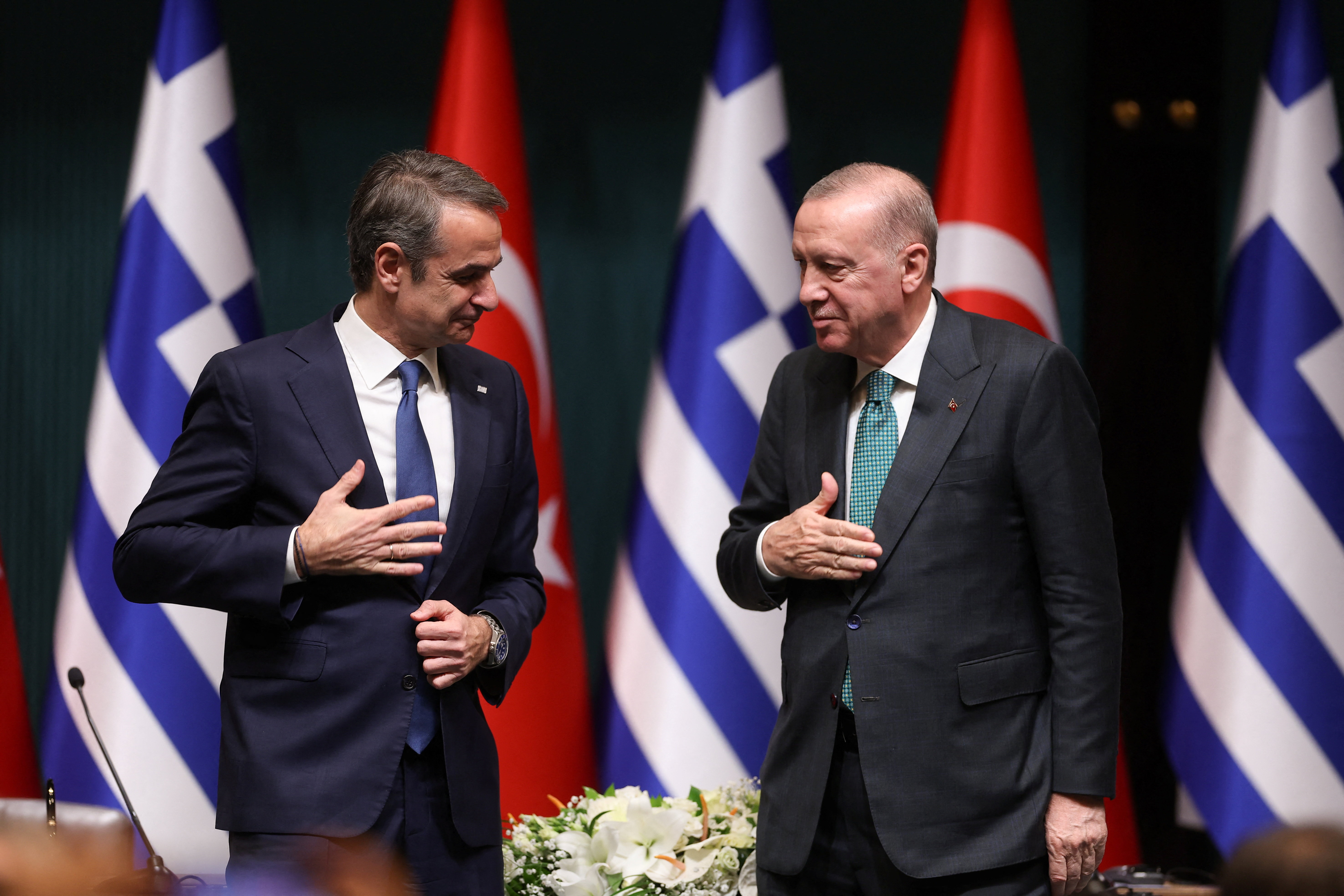
Greek Prime Minister Kyriakos Mitsotakis on Wednesday told Turkish President Recep Tayyip Erdogan that there now exists a “window of opportunity” for a solution to the Cyprus problem to be found.
“We discussed with the president the latest developments on the Cyprus problem, on which the Greek position remains clear. United Nations Secretary-General Antonio Guterres’ initiatives are creating a window of opportunity for the restart of a substantive dialogue from where it left off in 2017,” he said at a joint press conference in Ankara.
He then added that any process towards a solution on the Cyprus problem “must always move within the bounds of the UN security council’s resolutions”.
While Erdogan did not make a direct reference to Cyprus in his statements, he said that he and Mitsotakis had “openly discussed our positions on the Aegean and the eastern Mediterranean”.
“While these issues are complex, they are not insurmountable under international law. All that is needed is good faith. I saw that my friend Kyriakos and I agree on this. The issues must be resolved on the basis of the law. I believe that our relations will make progress towards a solution,” he said.
The meeting of Erdogan and Mitsotakis came a couple of hours in advance of a meeting of Guterres and Turkish Cypriot leader Tufan Erhurman in New York – the pair’s first since Erhurman was elected to the office in October last year.
Greek Foreign Minister Giorgos Gerapetritis, who travelled to Ankara with Mitsotakis on Wednesday, had earlier said that Erhurman’s election “opens a new chapter of hope and expectations for the island’s reunification”.
More recently, European Enlargement Commissioner Marta Kos had last week said she welcomes Turkey’s “engagement” in talks regarding the Cyprus problem following a meeting with Turkish Foreign Minister Hakan Fidan in Ankara, with Fidan and Guterres having held a telephone call to discuss the Cyprus problem on Wednesday morning.
Kos had earlier spoken of an “opportunity” for Turkey to progress its process towards EU accession through Cyprus problem talks.
“We know that any progress is connected to bilateral relations, not just Cyprus, but also with the … new Cyprus settlement talks. It is now a big opportunity to continue,” Kos said, before adding that “there really is more that connects the EU and Turkey than what is dividing us”.
She later said that Turkey’s aim to be more deeply involved in Europe’s defence architecture would depend on the stances of the EU’s member states, and to this end said that “the new Cyprus settlement talks are a great opportunity for improvements in this area”.
Greece and Turkey’s next direct involvement in the Cyprus problem will likely come at an enlarged meeting, involving the island’s two sides, the UN, and both countries, as well as the island’s third guarantor power, the United Kingdom.
However, a date for such a meeting has not yet been set, with a tripartite meeting involving President Nikos Christodoulides, Erhurman. and UN envoy Maria Angela Holguin held last month having ended without any agreements been reached.
Holguin had said after that meeting that no enlarged meeting could be held before “results on the confidence-building measures” between the island’s two sides are achieved.
Mitsotakis said he hoped circumstances would allow the sides to solve a dispute on the demarcation of maritime and exclusive economic zones in the Aegean and eastern Mediterranean.
“It is time to remove any substantial and formal threats to our relations, if not now, when?” Mitsotakis said.
“Destiny has appointed us to live in the same neighbourhood. We cannot change geography, but we can make it an ally, choosing convergence, dialogue and trust in international law… to build a future of peace, progress and prosperity for our people.”
Despite the positive tone, Greece’s foreign minister earlier said Athens planned to extend its territorial waters further, including potentially in the Aegean.
Shortly after, Ankara said it had issued a maritime notice urging Greece to coordinate research activities in areas of the Aegean that Turkey considers part of its continental shelf.
In 1995, Turkey’s parliament declared a casus belli – a cause for war – should Greece unilaterally extend its territorial waters beyond six nautical miles in the Aegean, a stance Athens says violates international maritime law. Greece says it wants only to discuss demarcation of maritime zones.
Mitsotakis also said the flows of migrants in the Aegean Sea had decreased by almost 60 per cent last year due to cooperation between the two countries, adding this should be strengthened.




Click here to change your cookie preferences