
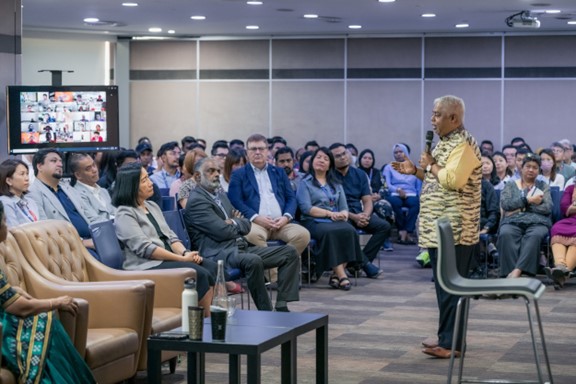
Business leader and QI Group executive chairman Vijay Eswaran is calling for a fundamental rethinking of how prosperity is measured, arguing that economic success defined solely by GDP fails to capture whether growth actually improves human lives.
Writing ahead of the World Economic Forum’s 2026 meeting in Davos, themed “A Spirit of Dialogue,” Eswaran challenges development models that prioritize output and expansion while overlooking social cohesion, fairness, and well-being. His proposal reframes progress around what he calls a “Growth Quotient,” an assessment of whether economic activity uplifts people alongside profits.
“We need a new measure of prosperity,” Eswaran wrote. “Instead of GDP, perhaps we should be looking at Growth Quotient, the extent to which our growth uplifts people, not just profits.”
The argument arrives amid growing debate over the limitations of traditional economic indicators. GDP can rise even as inequality deepens, environmental conditions deteriorate, and trust in institutions erodes. For Eswaran, these contradictions expose a deeper misalignment between what economies measure and what societies actually need.
Rethinking prosperity metrics
Traditional indicators track production, consumption, and efficiency, but they rarely assess whether economic systems foster dignity, inclusion, or opportunity. Eswaran argues that this gap reflects a failure of intent rather than measurement.
His Growth Quotient framework evaluates whether development produces fairness alongside efficiency and whether productivity gains translate into shared progress. It challenges the assumption that faster growth necessarily leads to better outcomes, especially when gains are concentrated rather than distributed.
“A nation’s true wealth lies not in what it builds, but in what it believes,” Eswaran writes, emphasizing values as the foundation of durable prosperity.
While the idea overlaps with conversations around stakeholder capitalism and alternative well-being indices, Eswaran positions his case as more fundamental than corporate governance reform. In his view, the issue is not how companies report performance, but how societies define success in the first place.
Vijay Eswaran on the leadership deficit
Eswaran extends his critique to leadership culture, arguing that modern institutions suffer from an excess of authority and a shortage of understanding. Decisions are made quickly, yet often without sufficient attention to context or consequence.
“We are not suffering from a shortage of leaders,” Eswaran observes. “We are suffering from a shortage of listeners. Dialogue is not weakness. It is strength in its highest form.”
His perspective is informed by more than two decades leading QI Group across diverse Southeast Asian markets. Operating across regulatory, cultural, and political boundaries, he argues, has reinforced the importance of cooperation over command.
“When dialogue becomes a habit, cooperation follows,” Eswaran notes. “Companies innovate better, nations negotiate better, and societies heal faster.”
This view challenges leadership models that reward decisiveness and hierarchy above all else. Eswaran instead identifies the ability to facilitate constructive disagreement as the defining skill for leaders navigating economic uncertainty and social change.
Aligning technology with human values
Emerging technologies such as artificial intelligence, biotechnology, and quantum computing promise efficiency and scale, but Eswaran warns they will inevitably reflect the values embedded in their design. Systems optimized solely for speed and output risk amplifying inequality and eroding trust.
“If we lack empathy, our algorithms will amplify that lack,” he cautions. “If we value only efficiency, we risk engineering empathy out of existence.”
Rather than relying exclusively on regulation after deployment, Eswaran advocates embedding human values at the design stage. He refers to this approach as “authentic intelligence,” meaning technology shaped by ethical judgment, emotional awareness, and social responsibility from inception.
“The real question is not how intelligent our machines become,” he writes, “but how conscious we remain as humans.”
This distinction matters, he argues, because systems built without regard for human impact require constant correction. Technologies designed with those considerations integrated are more likely to scale responsibly.
From philosophy to practice
Eswaran grounds his ideas in operational experience rather than abstract theory. Within QI Group, he says a sustained emphasis on dialogue has reduced internal silos and improved collaboration across teams and regions.
“It allows people to see one another not as rivals in a race, but as partners in a journey,” he explains.
He applies the same logic to global cooperation. As nations confront trade disruptions, climate pressures, and rapid technological change, Eswaran argues that dialogue offers a strategic advantage over confrontation.
“Global cooperation is not an agenda item,” he concludes. “It is a human instinct that needs to be reawakened.”
Whether policymakers and business leaders adopt this framework remains uncertain. Yet as economic systems face mounting pressure to address inequality, environmental strain, and social fragmentation, Eswaran’s call for dialogue-centered growth presents an alternative to metric-driven orthodoxy.
The 2026 Davos meeting will serve as an early test of whether human-centered economic thinking can move from commentary into policy.
DISCLAIMER – “Views Expressed Disclaimer – The information provided in this content is intended for general informational purposes only and should not be considered financial, investment, legal, tax, or health advice, nor relied upon as a substitute for professional guidance tailored to your personal circumstances. The opinions expressed are solely those of the author and do not necessarily represent the views of any other individual, organization, agency, employer, or company, including NEO CYMED PUBLISHING LIMITED (operating under the name Cyprus-Mail).



Click here to change your cookie preferences