
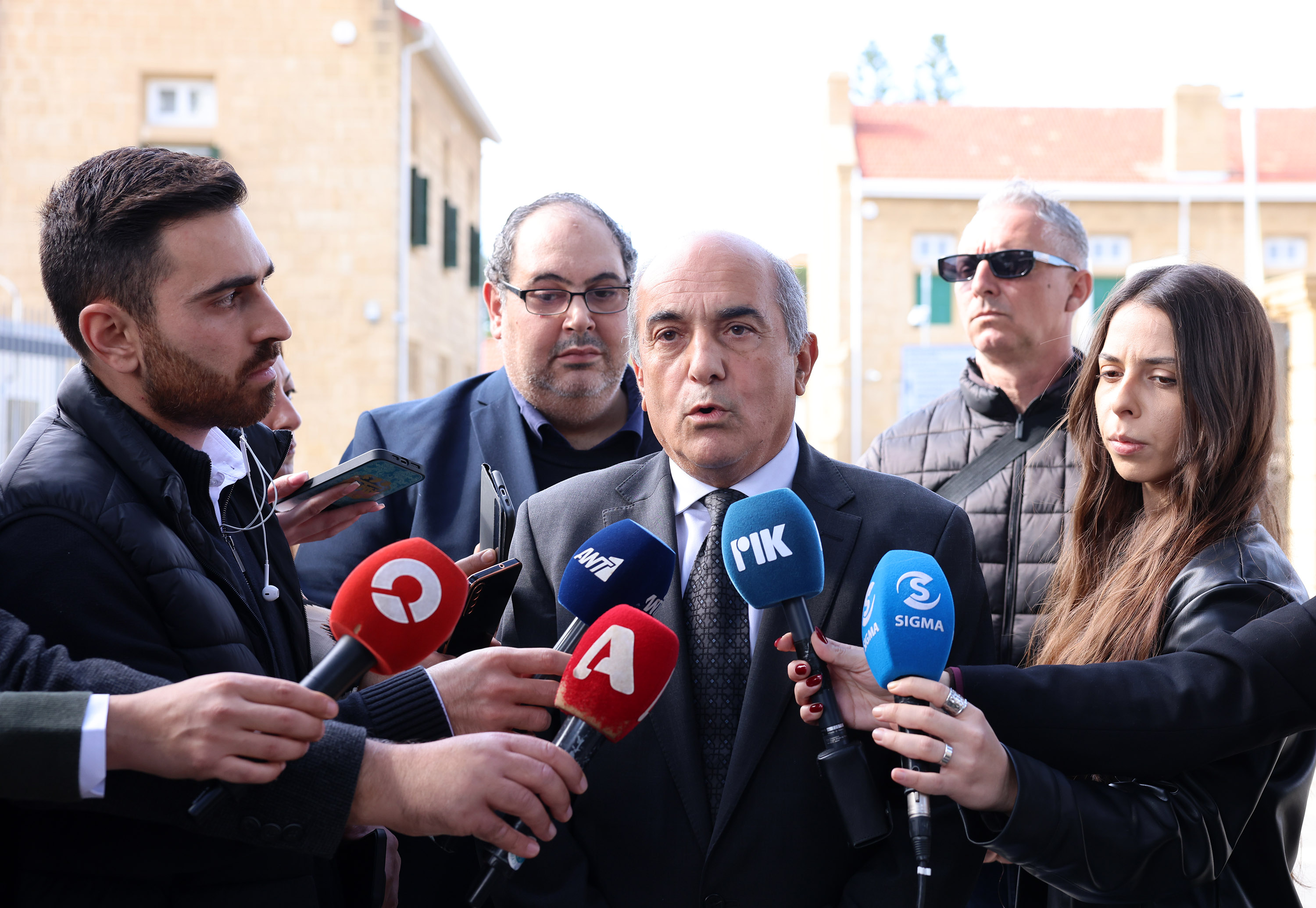
Former House President Demetris Syllouris and former Akel MP Christakis Giovanis were found not guilty on Tuesday by the Nicosia criminal court regarding their alleged involvement in the ‘golden passports’ scandal.
Five years after Al Jazeera broadcast a video in which high profile officials appeared to be assisting the proxy of a pretend Chinese investor – with a supposed criminal record – secure a Cypriot passport under the citizenship-by-investment scheme, the two remaining defendants – Syllouris and Giovanis – were acquitted.
On hearing the verdict, Syllouris and Giovanis were clearly emotional. Their supporters, family and associates in the full courtroom cried for joy, embracing each other and applauding. The judges reacted, saying this was “unacceptable” as the proceedings had not finished.
The verdict, spread over 170 pages, was not unanimous.
The three-member court ruled by majority that the charges of conspiracy to defraud the Republic, abuse of power, bribing a public official and unlawful interference in naturalisation procedures could not be proved.
During the trial, the Al Jazeera video was not accepted as evidence and certain prosecution witnesses were not called to testify.
Presiding judge Nicholas Georgiades said from the beginning that the video was not part of the evidence and that the final charges were not linked to its contents.
The criminal court ruled that it had not been proved that there had been an acceptance of irregular exchange, inappropriate influence or an agreement for a fraudulent act.
The court identified “substantive gaps” in the evidence presented by the prosecution.

The defendants were thus acquitted of all three charges they were facing, concerning influence in naturalisations and conspiracy to defraud.
The minority of the court believed the evidence presented could suffice for the conviction of the defendants on at least one of the charges.
The criminal court listed what should have been proved for a conviction and had not.
It said the prosecution should have proved that the defendants had received financial gains for themselves or their companies in order to influence a civil servant.
Telephone calls to be updated on the course of applications did not constitute corruption, the court said.
Regarding the third charge on which unanimity had not been reached among the judges, the prosecution failed to prove corruption and bribery, since the money in question had never been paid. The court also said a reservation agreement raised concern but again did not prove corruption.
Furthermore, no civil servant had reported being under pressure, nor had an exchange been proved.
The court said an agreement for a legitimate purpose with legal means did not constitute conspiracy.
It added that the defendants had not been questioned about the reservation agreement or emails, and that there had been a gap in evidence, which put the defence at a disadvantage.
In its ruling, the court said the defendants had initially faced five charges, two of which – in relation to the Al Jazeera broadcast – had later been retracted by the legal service.
The court also referred to the charges being lifted in full for lawyer Andreas Pittadjis who appeared to be assisting the proxy of a pretend Chinese investor – with a supposed criminal record – secure a Cypriot passport under the citizenship-by-investment scheme, and officer of the Giovanis Group Antonis Antoniou.
It added that the attorney-general held the constitutional power to proceed with nolle prosequi, which was not subject to judicial review.
The main charges examined concerned influence of civil servants and bribery with the aim of misleading the Republic into approving irregular naturalisations, which the court said the prosecution did not prove.
The court pointed out that the responsibility to prove a charge lies with the prosecution, that the level of proof should be beyond reasonable doubt and that doubt alone did not lead to a conviction.
Furthermore, the court said no finance ministry officer had testified, despite the fact that the ministry was responsible for evaluating the financial criteria for naturalisations.
The court dismissed emails as insufficient to support a charge, as none of the senders or recipients had testified in court, their authenticity had not been proved and they could not be used against any of the defendants.





Click here to change your cookie preferences