
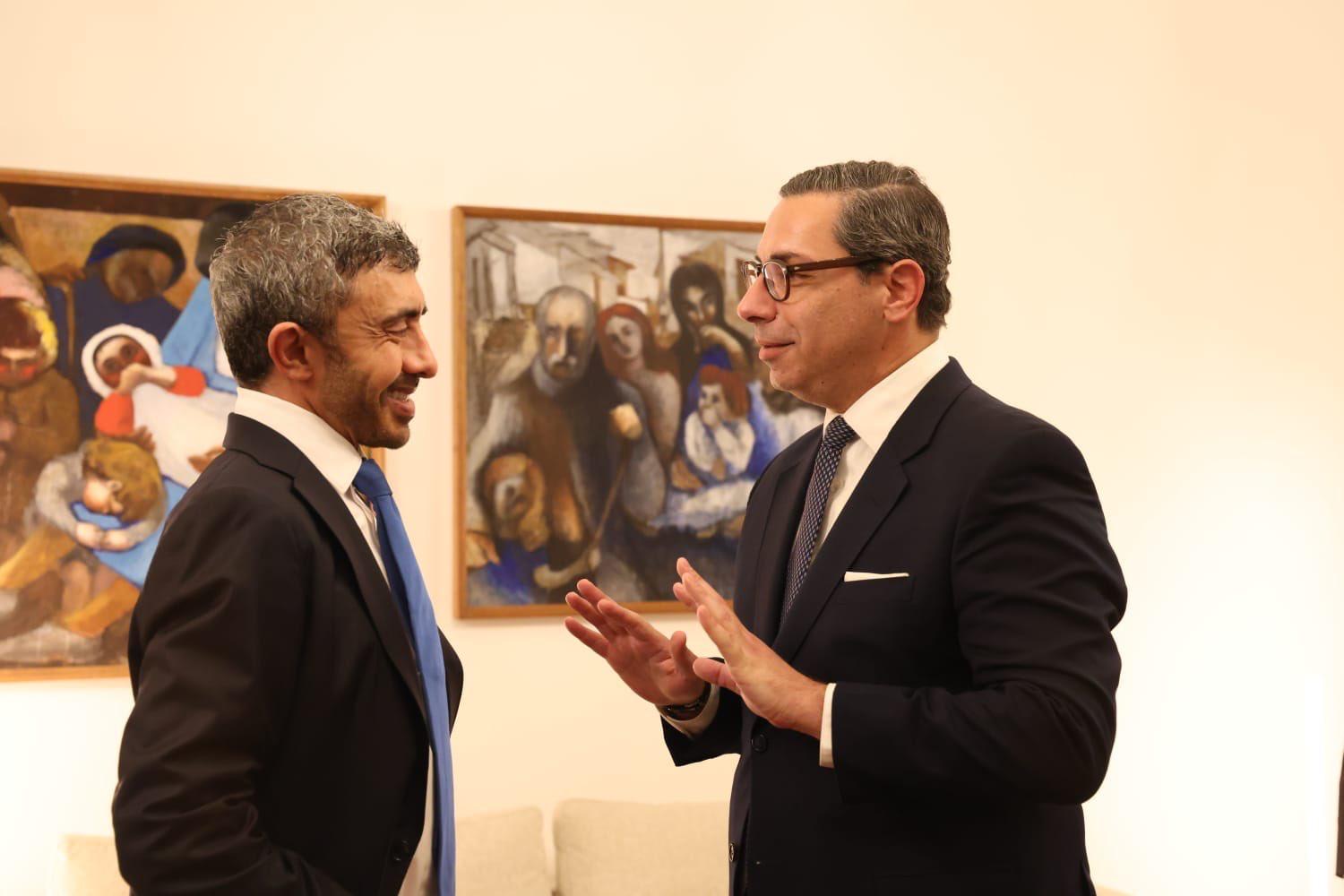
President Nikos Christodoulides and Foreign Minister Constantinos Kombos met the United Arab Emirates’ Foreign Minister Abdullah bin Zayed Al Nahyan on Monday, with the country finding itself at the centre of the ongoing conflict between the United States, Israel, and Iran.
Kombos wrote in a post on social media that the trio had held a “substantive discussion” on “the profoundly concerning developments in the region”.
“Cyprus’ solidarity, in the face of the indiscriminate and unjustifiable attacks against the United Arab Emirates, was once again underscored. We reaffirmed that diplomacy and dialogue is the only sustainable path to de-escalation and stability,” he added.
Major cities in the UAE, including Dubai and Abu Dhabi, have been the target of Iranian bombardment in recent days, with the country having declared that it is in a “state of defence on Sunday after having been on the receiving end of more than 1,000 ballistic missiles since the start of the month.
The country’s foreign ministry had described the strikes as a “direct threat” to its internal security, while stressing that it does not wish to be drawn into the conflict as a party to it.
However, it nonetheless said that it “reaffirms its full right to take all necessary measures to safeguard its sovereignty, national security, and territorial integrity, and to ensure the safety of its citizens and residents”.
The Cypriot government has already sided with the UAE over Iran in a more minor dispute, drawing the wrath of the Iranian government last year when it signed a joint declaration stressing its “principled support for the sovereignty of the United Arab Emirates, especially as regards its three islands, Greater Tunb, Lesser Tunb and Abu Musa”.
Abu Musa, Greater Tunb and Lesser Tunb are islands located in the Persian Gulf, with Abu Musa, the largest of the three, situated roughly at the midpoint between Dubai and the Iranian coastal town of Bandar Lengeh. It has a commercial airport, which is served by flights to mainland Iran.
Greater Tunb and Lesser Tunb are located further northeast, close to the undisputed Iranian island of Qeshm. They have a combined population of around 300.
In the modern era, the dispute over the islands’ ownership is sourced from when the British ruled over the Trucial States, the predecessor to the modern UAE.
Shortly before the end of the British protectorate and the formation of the UAE in 1971, Iran, ruled at the time by Mohammad Reza Pahlavi, and the ruler of the Emirate of Sharjah – one of the UAE’s emirates – Khalid bn Mohammed Al Qasimi, signed a memorandum of understanding stipulating joint administration of the island of Abu Musa.
The memorandum, signed on November 30, 1971, provided for the establishment of a police station by Sharjah and the stationing of Iranian troops on the island.
Iran took Greater Tunb and Lesser Tunb on the day the memorandum was signed, and seized Abu Musa the following day.
Two months later, in January 1972, Al Qasimi was killed in an attempted coup, while Pahlavi was toppled in the Islamic Revolution in Iran in 1979, but the Islamic Republic formed out of the revolution retained the islands.
The UAE took its claim over the islands to the United Nations in 1980, but the claim was deferred by the security council at the time and the matter has not been revisited.
Since then, the Iranian government has since established naval bases on the islands, which it uses to patrol the Strait of Hormuz, a choke point between the most northerly point of Oman and Iran’s southern coast.
The strait provides the only seaborne access between the Persian Gulf and the open ocean, with 20 per cent of global oil passing through it. It has returned to the headlines in recent days with Iran threatening to close it in response to the joint American and Israeli bombing campaign.





Click here to change your cookie preferences