
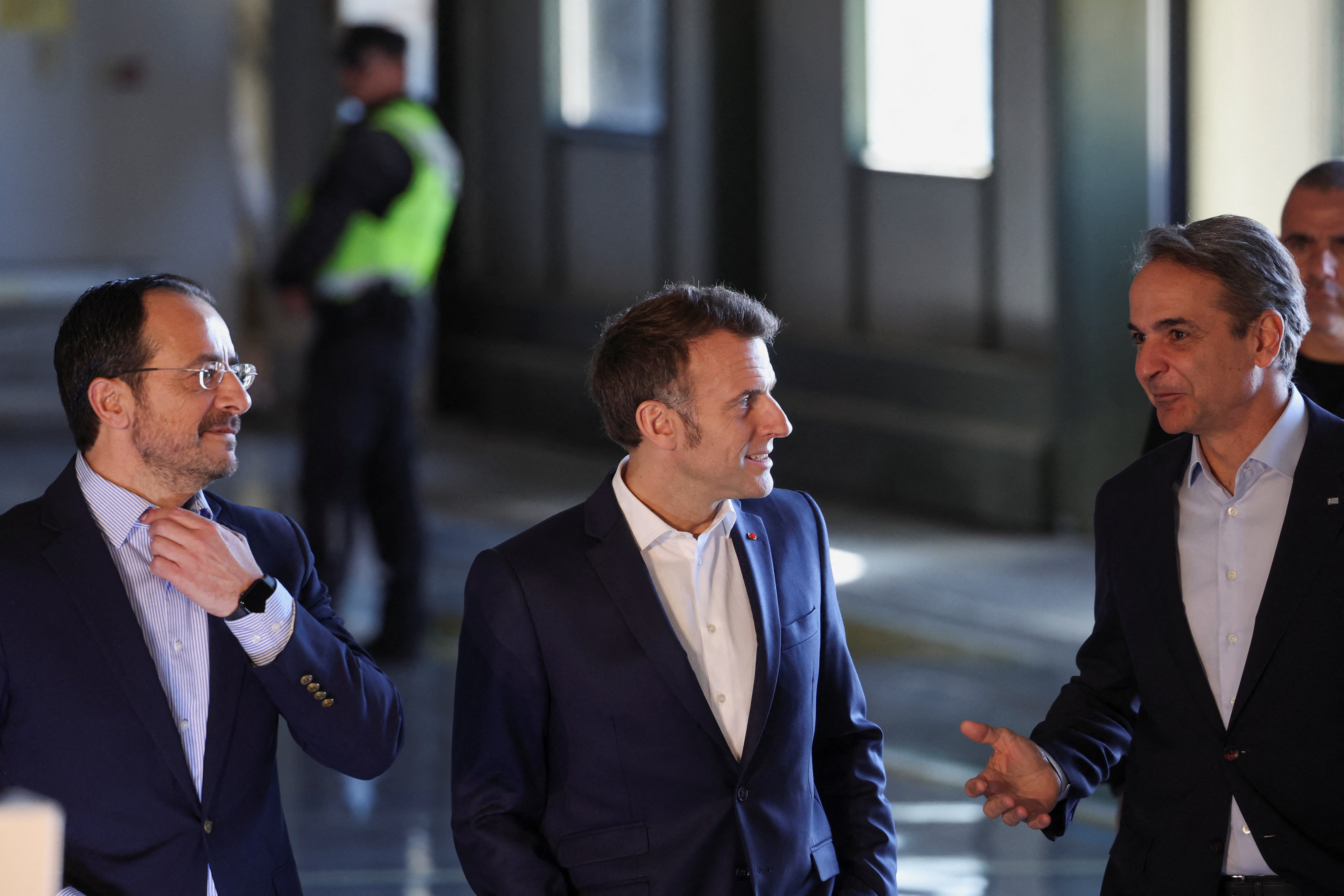
French President Emmanuel Macron on Monday said of last week’s drone strike that “when Cyprus was attacked, all of Europe was attacked”, as he visited Paphos’ Andreas Papandreou airbase alongside Greek Prime Minister Kyriakos Mitsotakis and Cypriot President Emmanuel Macron.
He stressed the importance of the strategic partnership signed by the governments of Cyprus and France last December, as well as a prior such agreement signed between France and Greece.
“The presence of all three of us side by side today indicates the strength of these partnership, their robustness, and that your compatriots can really believe in them,” he told Christodoulides.
He added that beyond the strategic partnership, “there exists a solidarity of nations and their armed commitment”.
“As such, the first objective of this trip to your side is to show full solidarity with Cyprus, which was the target last week of several drones and missile fire. This is what led us to deploy an anti-aircraft unit of Mistral [missiles] and to immediately deploy the Languedoc frigate, both of which were able to be deployed during hte past week,” he said.
He also pointed out the arrival of the aircraft carrier the Charles de Gaulle, saying that it is “now close to Cyprus to contribute to the overall defence picture, and to ensure it in the long term”.
Then, he made reference to efforts to ensure the safe removal of European Union citizens from countries more directly impacted by the conflict.
On this front, he then stressed that “I want to reiterate here our support for the United Arab Emirates, Qatar, Kuwait, with which we are bound by defence agreements, but also for Jordan, Saudi Arabia, and Iraq, which have been destabilised, struck, and to which we have provided elements of support”.
He said that France wishes to “ensure the freedom of navigation and maritime safety in the eastern Mediterranean, where we are, and in the Red Sea”, and that to this end, “the French presence which will unfold from the eastern Mediterranean into the Red Sea and precisely off Hormuz will mobilise eight frigates, two amphibious helicopter carriers, and our aircraft carrier”.
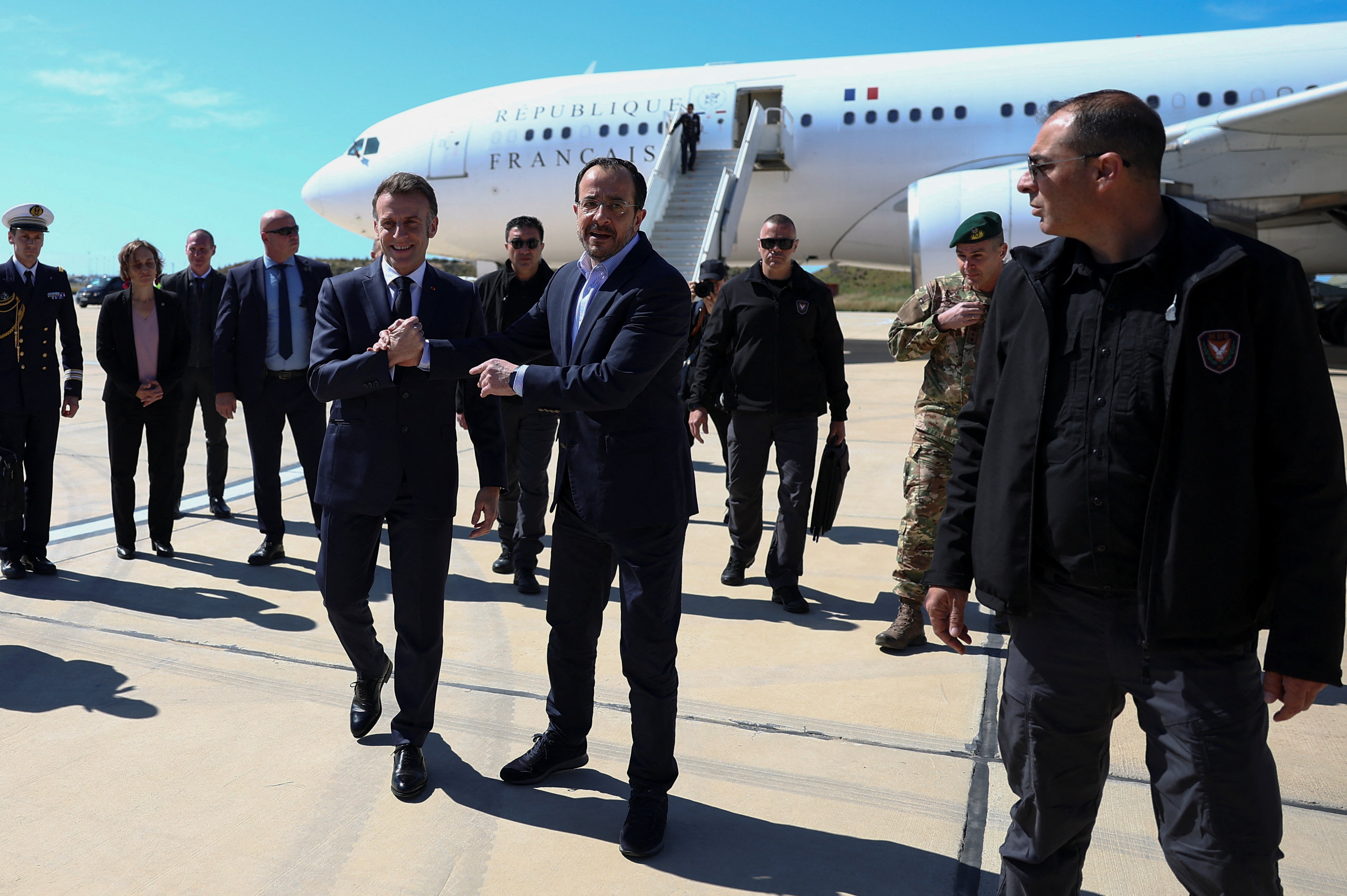
The deployment of French naval assets, he said, will take place “with the contribution of several other European countries”.
He made reference to the striking group of the Charles de Gaulle, which includes frigates from other EU member states including Spain and the Netherlands, saying that “several European colleagues have chosen to continue to accompany us”.
“The mobilisation of our navy is unprecedented,” he concluded.
Mitsotakis, meanwhile, stressed that Greece “would be by your side, even if we were alone”, but that “we are not alone”.
“Greece and Europe are expressing their solidarity with deeds, and not just with words,” he said, before making reference to the sending of four Greek F-16 fighter jets to Paphos last Monday and the ensuing deployment of two frigates, including the Kimon, to which he once again referred as the “pride of the Greek fleet”.
“As far as Greece is concerned, from the beginning of this crisis, I set as a basic national priority the security of [Cyprus], a place which is connected to us by the strongest national, historical, and cultural ties,” he said.
To this end, he said that “the security of Cyprus is an integral part of European security and most certainly a factor of stability for the entire eastern Mediterranean”, before expressing pride in the swift nature of Greece’s response to last Monday’s drone strike.
“The Greek armed forces were the first to move, to provide the presence of peace and security to these sacred lands,” he said.
He also stressed the need to protect Lebanon, across the Levantine Sea from Cyprus, and to give the country and its people “the future they deserve”.
“In a world experiencing unprecedented turmoil, Europe must remain a responsible force capable of shaping global developments, ensuring stability in the eastern Mediterranean,” he said.
In his own statements, Christodoulides said that France “has proven to be a strong strategic partner of Cyprus”, while also thanking Greece, as well as Spain and Italy, for deploying naval assets to the island’s vicinity.
“These development s remind us that everything which happens in the Middle East has an impact on Europe,” he said, adding that developments such as those seen in recent weeks “impact the collective European future, the security, and the stability of Europe”.
As such, he said, “Europe must become more actively and more coherently involved in the region, with an approach which aims to strengthen security, stability, and cooperation”.
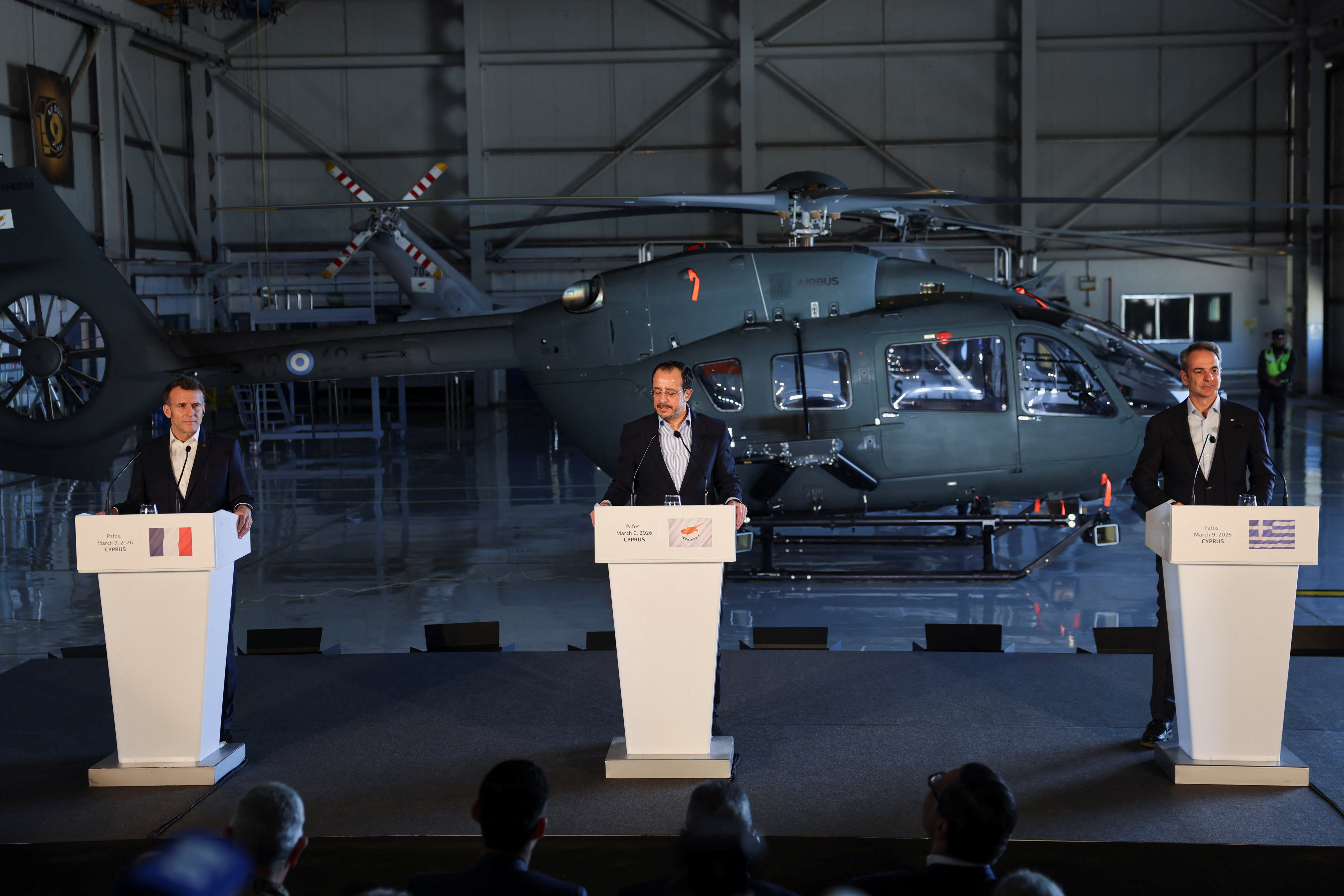
Of Cyprus’ own role in the conflict, he stressed that the island’s “position is clear”.
“We are not involved in military operations. We remain committed to the humanitarian role which we have served all this time, responsibly, as part of the solution, and not as part of the problem,” he said, before referring to Cyprus as “a bridge of cooperation” between Europe and the Middle East.
Returning to the matter of the ongoing conflict, he said that Cyprus “knows very well what war means”, saying that the island “has, for 52 years, been paying the price of war”, and that “we are, as a country, a victim of illegal invasion”.
“That is why every step we take is aimed at security, peace, and prosperity,” he said.
The meeting lasted a little over an hour and a half, with both Mitsotakis and Macron having arrived at the airbase earlier in the afternoon.
Mitsotakis arrived first, and is joined in Cyprus by his Foreign Minister Giorgos Gerapetritis, with Macron’s presidential jet touching down in Paphos while the Greek prime minister and the Cypriot president were exchanging pleasantries on the tarmac.
Christodoulides, meanwhile, was accompanied to Paphos by his own Foreign Minister Constantinos Kombos and Defence Minister Vasilis Palmas.




Click here to change your cookie preferences