
Hungary looked set on Monday to block further EU sanctions on Moscow and a 90-billion-euro loan for Kyiv, as attacks on Ukraine’s southern Odesa region killed two people ahead of the fourth anniversary of Russia’s full-scale invasion.
Hungary and Slovakia blame Ukraine for delays in restarting the flow of Russian oil via the Druzhba pipeline. The two countries have the only remaining refineries in the European Union using Russian oil shipped via Druzhba.
As Kyiv and its allies prepared for Tuesday’s anniversary, Ukraine’s President Volodymyr Zelenskiy told the BBC that Russian leader Vladimir Putin had “already started” World War Three, and that the world must respond with intense pressure.
“The question is how much territory he (Putin) will be able to seize and how to stop him… Russia wants to impose on the world a different way of life and change the lives people have chosen for themselves.”
Russia has repeatedly denied claims that it wants a broader conflict with the West and says its “special military operation” in Ukraine is aimed at protecting its own security against what it casts as a hostile and aggressive West. Kyiv and its Western allies say Putin is bent on an imperial-style land grab.
The U.S. has been trying to broker a peace deal between Russia and Ukraine, but progress has proved elusive. Their most recent talks, in Geneva on February 17 and 18, did not produce a breakthrough.
Russia says Ukraine must withdraw from the roughly 20% of the eastern Donetsk region it still controls, a demand Zelenskiy again rejected in his BBC interview, saying it would mean “abandoning hundreds of thousands of our people who live there”.
SANCTIONS AND LOAN ON HOLD
Zelenskiy’s comments came as Hungary vowed to block the European Union’s 20th package of sanctions against Russia and a 90-billion-euro ($106 billion) loan for Ukraine because of the Druzhba pipeline outage.
EU foreign ministers were gathering in Brussels after a row between Hungary, Slovakia and Ukraine over the outage in the Druzhba pipeline boiled over at the weekend, threatening to derail the bloc’s latest plans to help Kyiv.
Shipments of Russian oil to Hungary and Slovakia via Druzhba have been severed since January 27, when Kyiv said a Russian drone hit pipeline equipment in Ukraine. Slovakia and Hungary say Ukraine is to blame for the prolonged outage.
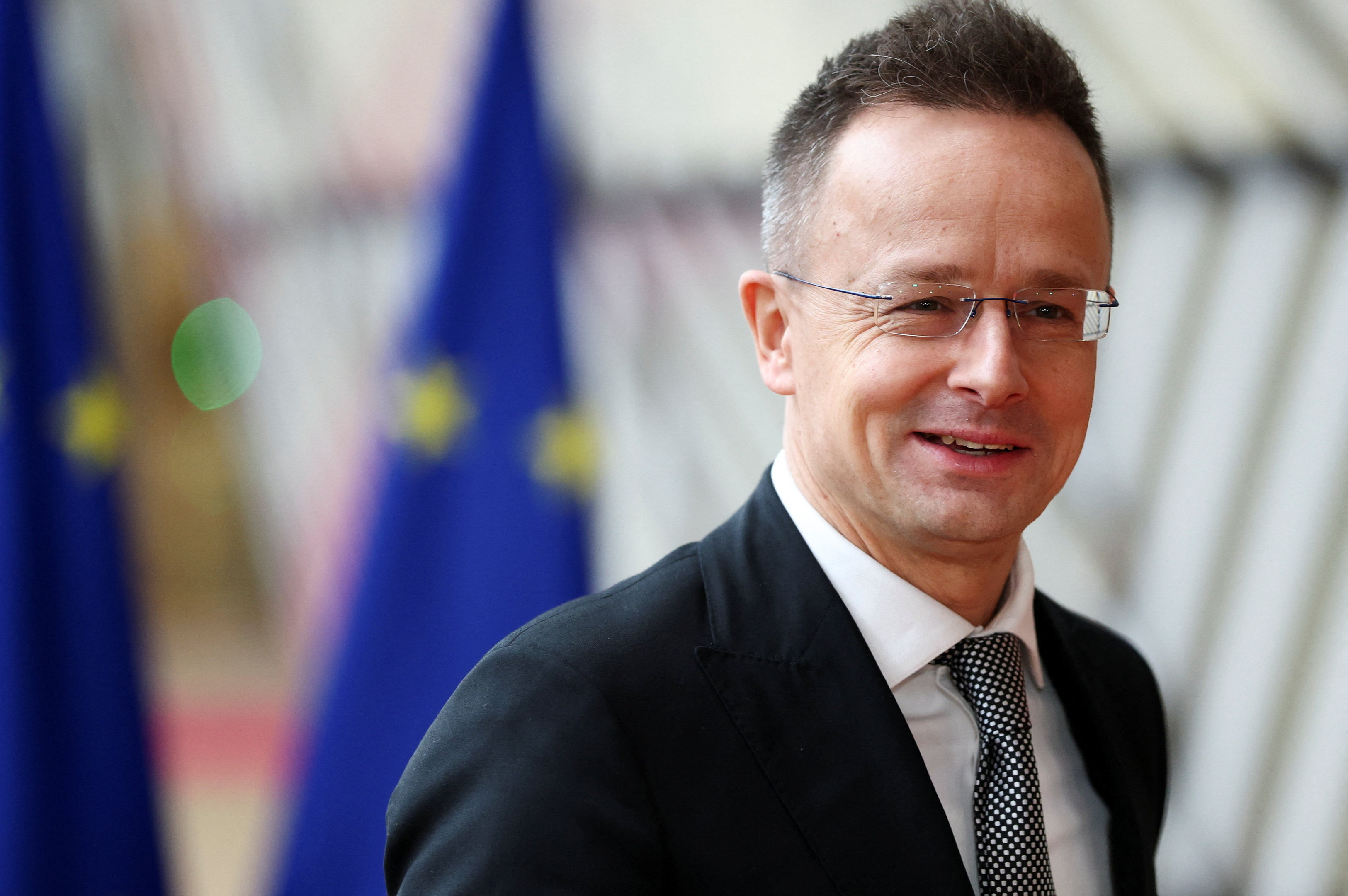
“We do not hate Ukraine… but the Ukrainian state behaves in a hostile manner towards Hungary,” Hungarian Foreign Minister Peter Szijjarto said. “The ball is in Ukraine’s court.”
In a letter seen by Reuters, Hungarian Prime Minister Viktor Orban told European Council chief Antonio Costa the Druzhba outage was an “unprovoked act of hostility that undermines the energy security of Hungary” and vowed to block the loan until it was solved.
Orban, who has maintained warm relations with Russia, has sought to cast Hungary’s April 12 election as a stark choice between “war or peace”, accusing his opponents of wanting to drag the country into the conflict, which they strongly deny.
MINISTERS ASK HUNGARY TO RETHINK POSITION
EU foreign policy chief Kaja Kallas said EU countries were unlikely to reach agreement on the proposed new package of sanctions against Russia at Monday’s meeting, though they are expected to continue negotiating until a deal is reached.
Hungary and Slovakia have also vowed to stop emergency power exports to Ukraine if oil shipments failed to resume.
Exports of electricity to Ukraine from Slovakia continued on Monday, according to operational data on Slovakia’s electricity transmission system operator SEPS.
The foreign ministers of Germany and Poland both urged Hungary to reconsider its position.
“I would have expected a much greater feeling of solidarity from Hungary for Ukraine,” Polish Foreign Minister Radoslaw Sikorski told reporters in Brussels, referring to the Soviet invasion of Hungary in 1956.
“And instead, with the help of state propaganda… the ruling party managed to create a climate of hostility towards the victim of aggression. And now it’s trying to exploit that in the general election. It’s quite shocking.”
STRIKES ON ODESA REGION
The conflict has killed tens of thousands of people, driven more than five million people to seek refuge across Europe and devastated Ukrainian cities, towns and villages. It has long become a grinding war of attrition in the east, where Russian forces have made slow but steady territorial gains.
However, the commander-in-chief of Ukraine’s armed forces, Oleksandr Syrskyi, said on Monday his forces had “restored control” over 400 square km of territory along a stretch of the southern frontline.
Meanwhile, Russia kept up its drone attacks overnight, killing two people and injuring three others in Ukraine’s southern Odesa region, emergency services said on Monday.
Ukraine’s Infrastructure Minister Oleksiy Kuleba said Russia had attacked port infrastructure in the Odesa region.
Russian state news agency RIA, citing the country’s Defence Ministry, said Moscow’s forces had carried out successful strikes on Ukrainian transport, energy and fuel infrastructure.




Click here to change your cookie preferences