
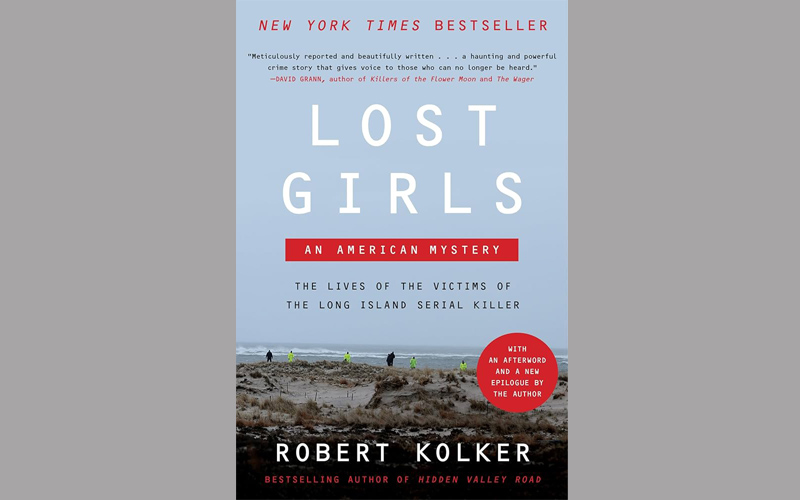
Lost Girls: An American Mystery by Robert Kolker
In December 2010, after seven months searching for missing woman Shannon Gilbert, the remains of four other women were found on Gilgo Beach, Long Island. Each was wrapped in burlap and hidden in the bramble beside the motorway. Melissa Barthelemy, Maureen Brainard-Barnes, Megan Waterman and Amber Overstreet Costello became known as the Gilgo Four. Suffolk Country police were still searching for missing 24-year-old Shannon, whose disappearance in May 2010 was now part of the same investigation. Police were on the hunt for a serial killer.
Using personal accounts, from many hours of interviews and published reports, this is a work of non-fiction focused on these five women and their families. All of them, in their 20s, advertised online as escorts, using Craigslist. When Kolker’s book was first published in 2013 the case of the so-called ‘Gilgo Beach serial killer’ was unsolved. The book was updated with an epilogue after former Manhattan architect Rex Heuermann was arrested in 2023. He has since been charged with killing seven women, over more than 15 years, including the Gilgo Four. Heuermann, who has pleaded not guilty to all seven, is due to stand trial in early September 2026, in New York.
Kolker’s narrative weaves a number of themes around the story of these women’s lives. He highlights our attitudes to missing sex workers, and how these overlap with failings in the investigation and the impact of the media response. He asks if the response from the police would have been different if the victims were from middle-class homes. Each of these working-class girls had a personal reason for choosing to have sex for money; Kolker speculates about what that might have been “acceptance, adventure, success, love, power.” The women chose to advertise online without the need for a pimp. In a declining job market where there may have been few other prospects, the women knew there was still a cost. “Every time you met a client was another roll of the dice.”
It is a story about addiction, abuse, poverty and neglect. It is also about the impact of the search for these women, and their loss, on their families. It is a compelling read. Kolker captures the “modern age of prostitution in which clients are lured with the simple tap of a computer keyboard rather than the exhausting, demeaning ritual of walking the streets.” He asks why these women were invisible for such a long time, despite the efforts of their families to search for them. Is it because of who these women were and the choices they made? The book highlights how shocking it is that a killer was able to commit these crimes with impunity for so many years, crimes that went unsolved for so long.
The book has also been adapted into a film, Lost Girls, released by Netflix in 2020 and a documentary series called Gone Girls released on Netflix in 2025.





Click here to change your cookie preferences