
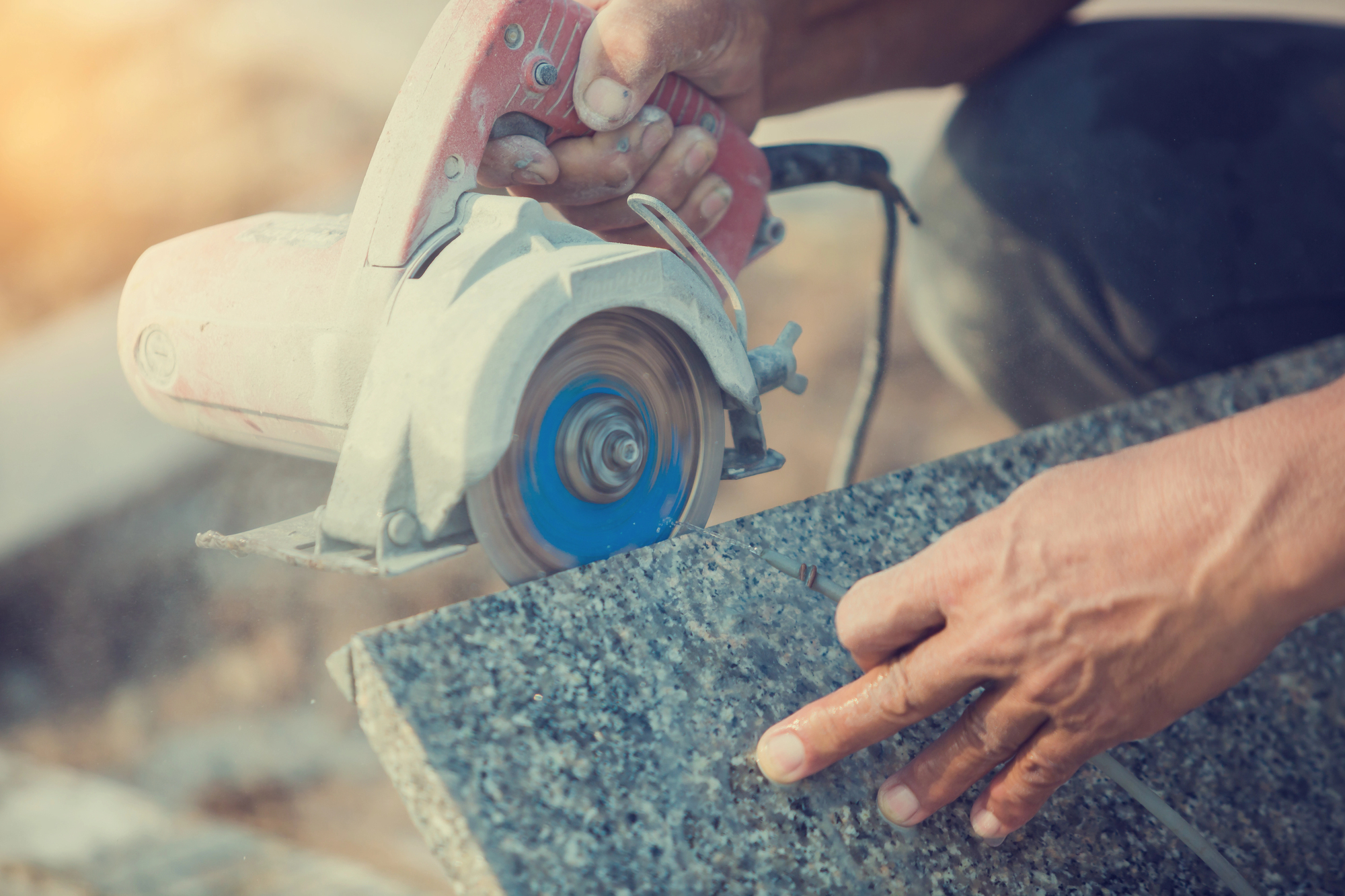
Affordable countertops are safe for those who use them, not for those who make them
Workers cutting engineered stone have increasingly been taking sick leave for skin disease and respiratory problems, however there is not enough data in Cyprus to link inhaling the fine dust to incidences of cancer.
Even so the affordable alternative to granite kitchen countertops have been banned in some countries because of deaths linked to the cutting process.
Quartz or engineered stone worktops have been growing in popularity over the past decade as they provide a hard and durable kitchen worktop – for a fraction of the cost of marble or granite – that can be easily cleaned without leaving residues that encourage germs. At the same time, they are nice to look at, with their shiny surfaces in infinite sparkly variations.
The artificial stone is made by mixing crushed stone with resins, which allows for any colour or pattern to suit personal tastes.
But before these slabs of engineered stone arrive in a kitchen to serve as an affordable glamorous countertop, they have to be ground, polished and custom cut to fit, a process banned in some countries as the fine dust produced during processing is considered to be responsible for the rising number of silicosis cases.
According to a recent report on Sky News dubbed ‘Killer Kitchens’, the UK has recorded more than 50 confirmed cases and four deaths from silicosis. California with 31 recorded deaths from silicosis is promoting a ban of engineered stone, potentially becoming the first US state to outlaw its use. Australia has already imposed a ban.
Silicosis is an occupational lung disease caused by the inhalation of respirable crystalline silica dust. It is a form of pneumoconiosis for which the Amiantos asbestos mine which operated between 1904 to 1988 was notorious.
It causes chronic lung inflammation and fibrosis, and can be moderate to acute depending on the intensity and duration of exposure.
People suffering from silicosis mainly experience shortness of breath, coughing and fatigue. In severe cases, cyanosis also occurs. Silicosis can also lead to other infections, such as tuberculosis, bronchitis, emphysema, nephritis, lung cancer and a host of autoimmune diseases.
Silicosis is incurable.
But it can be prevented.

Trade unions SEK and PEO told the Cyprus Mail that workplace prevention measures include the use of special protective masks, cutting the slabs with water to minimise dust and good ventilation and extraction systems.
However, they said exposure to dust particles was not the only danger from cutting these slabs, as they were large and heavy enough to crush a worker to death.
Due to the dangers, Australia has banned quartz slates, while calls are increasing in the UK and US for a ban that would potentially save lives.
Head of the industrial workers’ union of SEK George Kashiouris told the Cyprus Mail that workers at stone factories “do a very difficult job, as they have to deal with dust, water, the weight and cutting and polishing machinery, and everything this means in terms of risk of accident or disease”.
“Regarding the engineered stone imported over the past few years, apart from the difficulties of the job, given that the cutting machine makes a lot of noise and the polishing of these materials – usually by hand with a grinder – that produces dust and fumes that the worker comes into contact with, it is also very dangerous for their health as it contains high percentages of crystalline pyrite,” Kashiouris explained.
PEO’s builders’ union head Adamos Katalanos listed the same dangers from inhaling fumes and dust particles, as well as myoskeletal disorders and crushing from the sheer weight of the slabs.
“The danger from the fumes arises due to the materials used by the workers during the processing and manufacturing stage, when they bind various marble-granite slabs. They use strong glues with a suffocating smell. They also use thinner and acetone to clean the glue residues,” Katalanos said.
He said water is used during processing, which minimises the dust particles released into the workspace. The worst stage, Katalanos pointed out, was the grinding and polishing of the slabs, which produced a lot of fine dust.
“A serious danger for myoskeletal disorders is moving the slabs by hand during processing and cutting, as well as being crushed by large slabs of stone. This danger is also present during unloading and moving the slabs from the warehouse to the cutting machine,” Katalanos added.
Both trade unionists said that there have been cases of cancer among workers but so far there is little or no evidence to support it was caused by exposure to dangers in the workplace.
“In recent years, there have been cases of workers who presented various forms of cancer. However, it has not been scientifically verified that these diseases are related directly to cutting or processing marble, granite and engineered stone, as many of the workers were smokers or faced other health issues, which makes it difficult to safely draw conclusions about the exact causes,” Kashiouris said.
Katalanos said the trade unions did not have access to data regarding pneumoconiosis or other cases.
“However, what we can say is that there are cases of workers who were absent from work for a number of days due to back pain, skin disease and respiratory problems,” he added.
As for many problems, health or other, preventative measures are called for.
Both Kashiouris and Katalanos said such measures were wet stone cutting to prevent the release of dust into the workplace, ventilation and extraction systems, dust meters, cranes to move the slabs, and personal safety gear, such as steel toecap boots, masks with special filters, goggles, earplugs, gloves and waterproof overalls.
Every factory should have a risk assessment in writing so that all protective measures can be taken.
Kashiouris and Katalanos agreed that in most factories, particularly those where the trade unions are present, there was “a good level of observing these measures”.
Nevertheless, the danger still exists and “we have quite a few cases of hand injuries” on cutting machines, as well as workers being crushed by slabs, Kashiouris said.
“Workers and employers alike must place more attention to properly observing the measures,” he added.
Katalanos pointed out that “in many cases health and safety measures at workplaces are not taken, as they constitute an extra cost for the employer”.
SEK and PEO regularly visit workplaces to make sure that all measures are in place and to educate workers and employers about the risks and what they can do to prevent diseases and accidents.
Many measures have also been included in collective agreements.
Kashiouris pointed out that the trade unions were in contact with the Labour Inspection Department, demanding more onsite inspections.
Katalanos added to this, saying that workplaces also have their own health and safety committees, so that all employees can have a role and say in the matter.
The Labour Inspection Department were not available to comment.




Click here to change your cookie preferences