
Cyprus and the tragedy of nationalism when it becomes total
Lawrence Durrell begins his book Bitter Lemons with one of the most memorable reflections on travel ever written: “Journeys, like artists, are born and not made.” The best journeys, he suggests, do not merely carry us outward; they carry us inward as well. “Travel can be one of the most rewarding forms of introspection.”
That line has stayed with me for much of my life, perhaps because Cyprus itself has always been such a journey: beautiful, wounded, hospitable, suspicious, lyrical, divided. To travel across Cyprus, or even to remember Cyprus, is never simply to move across geography. It is to move across memory, grievance, longing and the unfinished question of who we are.
I was reminded of this recently, in an unexpected place: Harvard Yard in Cambridge, Massachusetts.
I had just listened to Ronny Chieng’s Class Day speech to Harvard’s Class of 2026. It was hilarious, irreverent, profane in places, and unmistakably serious beneath the laughter. I shared it with my sons, one of whom attended Harvard and the other Oxford. As a professor at Harvard, and as someone formed by Cyprus, Britain, America and the wider world, I found myself thinking about what these ancient institutions mean to us.
Why do we hold Harvard, Oxford and other great universities dear? Why do we revere them as homes of the mind, while so often giving our deepest loyalties to identities – nation, tribe, religion, grievance, flag? Whether one is English, French, American, Greek, Turkish or Cypriot, why do national identities so often command more passion than the values that might save us: truth, humility, compassion, cooperation and the recognition of our shared humanity?
Ronny Chieng’s speech was framed as a warning about artificial intelligence. But its deeper message was about the human mind. He warned graduates not to allow AI to rob them of the difficult, creative, pleasurable part of their work.
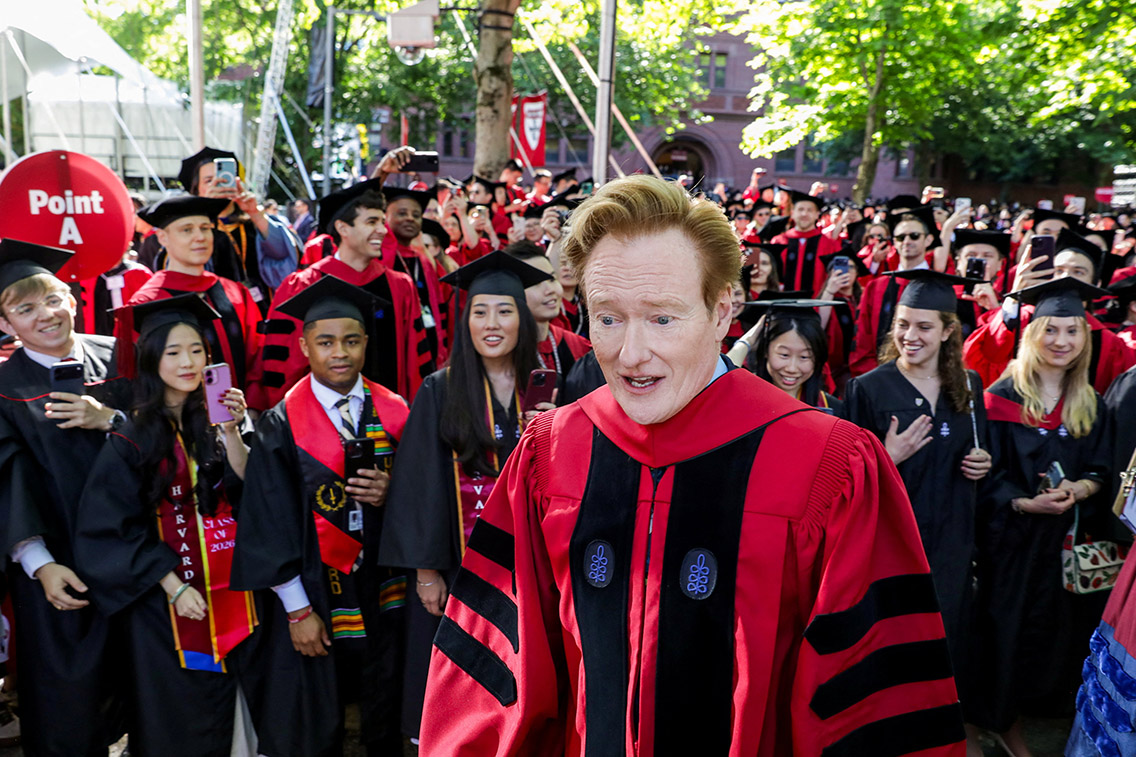
The following day, Conan O’Brien – Harvard graduate, former president of the Harvard Lampoon, and one of the great comic voices of our time – delivered the Commencement address. Again, beneath the comedy was a moral argument. His central word was humility. He urged graduates not to make Harvard the most important thing about themselves. He spoke of luck, friendship, failure, community and the danger of mistaking a fortunate hand for personal gain.
What is striking is that two comedians – two men professionally devoted to absurdity, timing, satire and laughter – emerged as among the clearest moral voices of our public life. At a moment when many political leaders speak the language of grievance, domination and self-advertisement, these comedians spoke of humility, cooperation, kindness and human connection.
Perhaps that should not surprise us. Comedy, at its best, is an ethical art. It exposes vanity. It punctures pomposity. It reveals contradiction. It reminds us that no person, no tribe, no government and no nation should take itself so seriously that it loses the capacity for self-criticism.
Cyprus needs that lesson.
For too long, our island has lived inside competing certainties. Greek Cypriots and Turkish Cypriots have each preserved real memories of suffering. Each community has its martyrs, its losses, its silences, its betrayals. But memory, when sealed inside nationalism, becomes dangerous. It ceases to be a source of wisdom and becomes a weapon.
Durrell’s book is also often comic: the house-buying and his efforts to restore it in the village of Bellapais which he called Bellapaix, to draw out the French word paix (peace), linked to the Abbaye de la Paix. The village bargaining gave way slowly to the bitterness of politics. He saw beauty and bitterness together.
The lemons were bitter because love of place had become entangled with history’s poison. The failure of Cyprus was not only constitutional or diplomatic. People who shared villages, weather, food, music, markets, childhood landscapes, and everyday courtesies came to inhabit mutually exclusive histories.
That is the tragedy of nationalism when it becomes total. A humane identity says: this is where I come from. A destructive identity says: this is all I am, and the other must disappear, or remain permanently outside my moral compass.
This is not unique to Cyprus. It is visible across the world – in Europe, the Middle East, America and beyond. Nations are not inherently evil. They can protect language, memory, culture and dignity. I was reminded of this in a recent conversation with a Swiss friend, incidentally from the very country where Cyprus Republic was born – that historical identities can coexist within a shared civic framework which can protect difference without division.
The irony is that universities such as Harvard and Oxford are cherished precisely because, at their best, they offer a larger form of belonging. They invite us into a “republic of learning” that crosses borders, languages, religions and generations. They teach us that no inherited identity is sufficient on its own. To be educated is not merely to be credentialed. It is to be enlarged.
Yet even elite education, as Socrates argued, does not guarantee moral wisdom. The educated can be tribal. The cultured can be cruel. The brilliant can be vain. Advances in AI cannot mourn for us. It cannot forgive for us. It cannot reconcile our histories. It cannot love a divided island back into wholeness.
That remains human work – our work, each one of us.
This is why the speeches by Ronny Chieng and Conan O’Brien mattered. They were reminding graduates of something more basic: do not surrender your mind; do not mistake prestige for virtue; do not confuse success with goodness; do not allow technology, ambition, or identity to replace human connection.
For Cyprus, the lesson is urgent. We do not need less identity. We need more spacious identity. We need Greek and Turkish Cypriots, who can love their community without making another community’s dignity conditional.
The journey Durrell described is still before us. It is not only outward across checkpoints, negotiations, property claims, security arrangements and constitutional formulas. It is inward, into the stories we inherited, the resentments we cherish and the myths we repeat.
The new frontier may indeed be AI and machines. But the older frontier remains harder: the line between self and other, memory and mercy, justice and revenge, identity and humanity.
Are we doomed by our history? I do not believe so. But we are not saved by intelligence alone, nor by universities, nor by machines, nor by clever speeches by politicians. We are saved, when we are saved, by humility, courage, compassion and the willingness to cross the line toward the person we were taught to fear.
Perhaps that is why two comedians spoke so powerfully to this moment. Laughter, when honest, is not an escape. It is a way back to reality – to remind us that we are all absurd, dependent and in need of one another.
Cyprus has had enough bitter lemons. The journey now must lead not only outward, but inward toward the better selves we have postponed for too long.




Click here to change your cookie preferences