
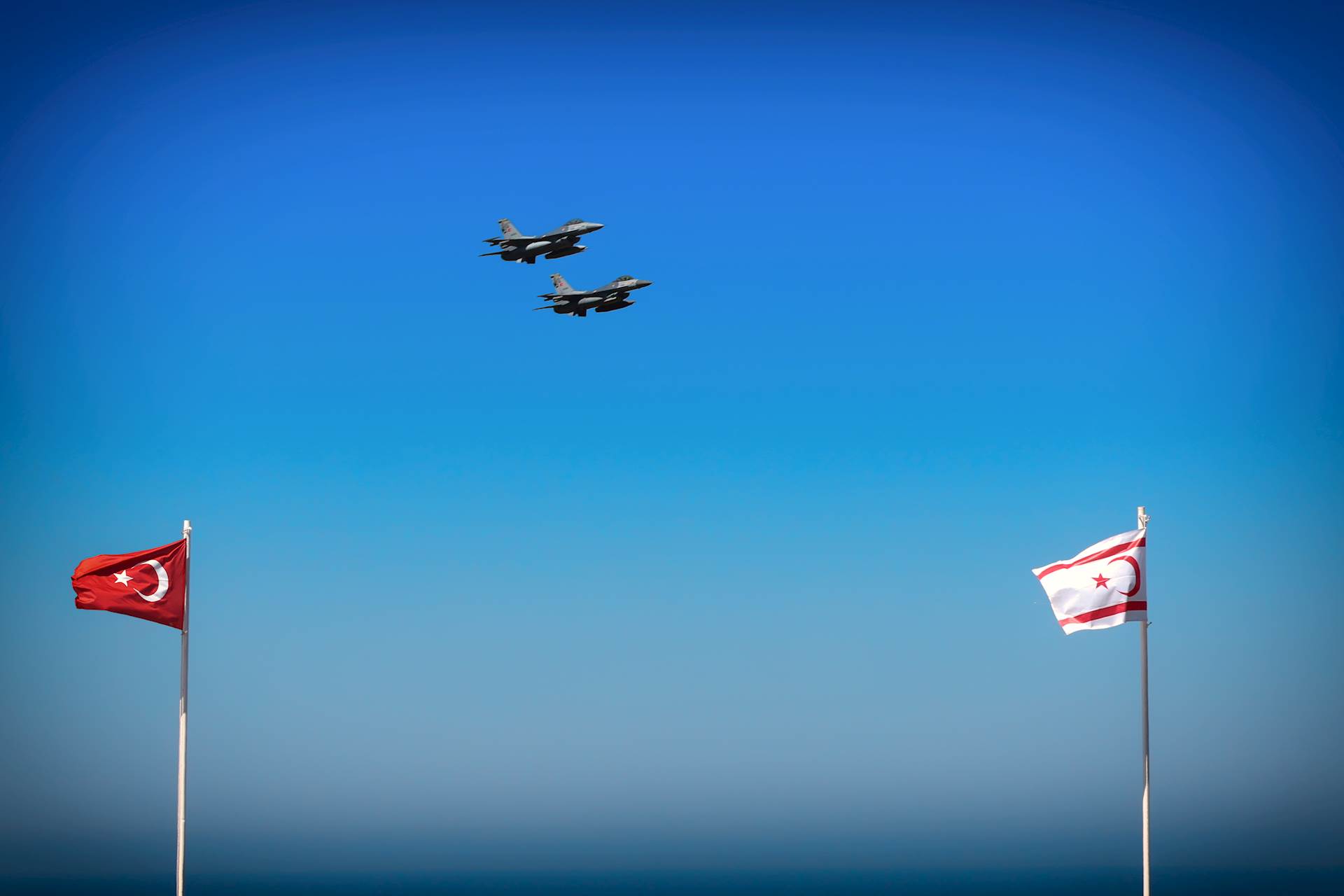
The government plans to report what it described as “interference” with communications between air traffic control and aircraft carrying ministers from Greece, France and the Netherlands by the Turkish Cypriot authorities as the three aircraft approached Cyprus, presidential press office director Victor Papadopoulos said on Monday.
“The Republic of Cyprus will report all of this competently where appropriate,” he said, before adding that Defence Minister Vasilis Palmas would also inform the European Union’s foreign affairs chief Kaja Kallas and his European counterparts of the alleged incident during Monday’s summit of EU defence ministers in Nicosia.
He said the government was informed by the governments of France, Greece and the Netherlands of “interference”, and that Turkish fighter jets were also “present … in the area” as the aircraft transporting Greek Defence Minister Nikos Dendias approached the island.
Asked whether the alleged incident could have been linked to the government’s signing of a status of forces agreement with France, which will allow for French troops to be stationed on the island, he remained coy, saying only that “it is an illegal action outside international law, which is condemnable”.
Turkish Cypriot air traffic controllers’ trade union leaderKursad Hudaverdioglu told the Cyprus Mail that the allegation constitutes “a completely politically motivated, misrepresentation of a news story”, and that “the matter has nothing to do with harassment”.
Regarding the accusation that fighter jets had also been present in the area as Dendias’ aircraft approached the island, he said that the jets “took off due to an emergency”, and that “they flew to the north of the island without violating any borders from the moment they took off”.
Later in the day, President Nikos Christodoulides confirmed that he believed there had been “interference” with the landing aircraft, saying that “such harassment is unacceptable” and that “there is absolutely no excuse”.
“The fact that this is happening to European Union member states – France, the Netherlands and Greece – also shows a revisionist approach,” he said, before adding that the matter will be discussed at Wednesday’s cabinet meeting, and that “from there, we will see what we will do with the European Union as well”.
Christodoulides’ comments were swiftly followed by a statement issued by the Turkish presidential communication’s office Nicosia branch, which described the claims of harassment of “completely false”.
Instead, it said, “four out of the six aircraft operating from Greece to southern Cyprus violated the airspace of the Turkish Republic of Northern Cyprus”, and as such, “two Turkish F-16 aircraft … were immediately scrambled as a precautionary measure”.
Like Hudaverdioglu, the office said that the F-16 fighter jets “did not violate Greek Cypriot airspace”, before adding that “no harassment was made unto the aforementioned aircraft”.
Shortly afterwards, Greece, too, weighed in on the matter, with the country’s government spokesman Pavlos Marinakis saying that “we unequivocally condemn this specific incident”.
“Any behaviour which deviates from international law cannot be tolerated,” he said.
A total of six F-16s have been stationed at Ercan (Tymbou) airport since March, being deployed after Cyprus was hit by an Iranian-made drone. Those fighter jets were then joined by Hisar-A surface-to-air missiles.
Shortly after their deployment, Greek government spokesman Pavlos Marinakis had questioned the legality of the move, saying that it is “prohibited” for Turkey to use the aircraft for “offensive actions outside the country”.
“The invasion and occupation of the northern part of Cyprus is illegal and does not legitimise any presence of a military force on the island. The F-16s, in fact, are prohibited from being used for offensive actions outside the country by the US supply contract,” he said at the time.
Greece had also deployed four F-16s of its own to Paphos in March, and the country’s foreign ministry spokeswoman Lana Zochiou had insisted that her country’s own deployment was “purely defensive in nature”.
Before this year, Turkey had once before stationed F-16 fighter jets in Cyprus, deploying them to Lefkoniko airport in 1998 in response to Greece’s positioning of four F-16s and two Lockheed C-130 Hercules military transport aircraft at Paphos airport amid rising tensions between the two countries.




Click here to change your cookie preferences