
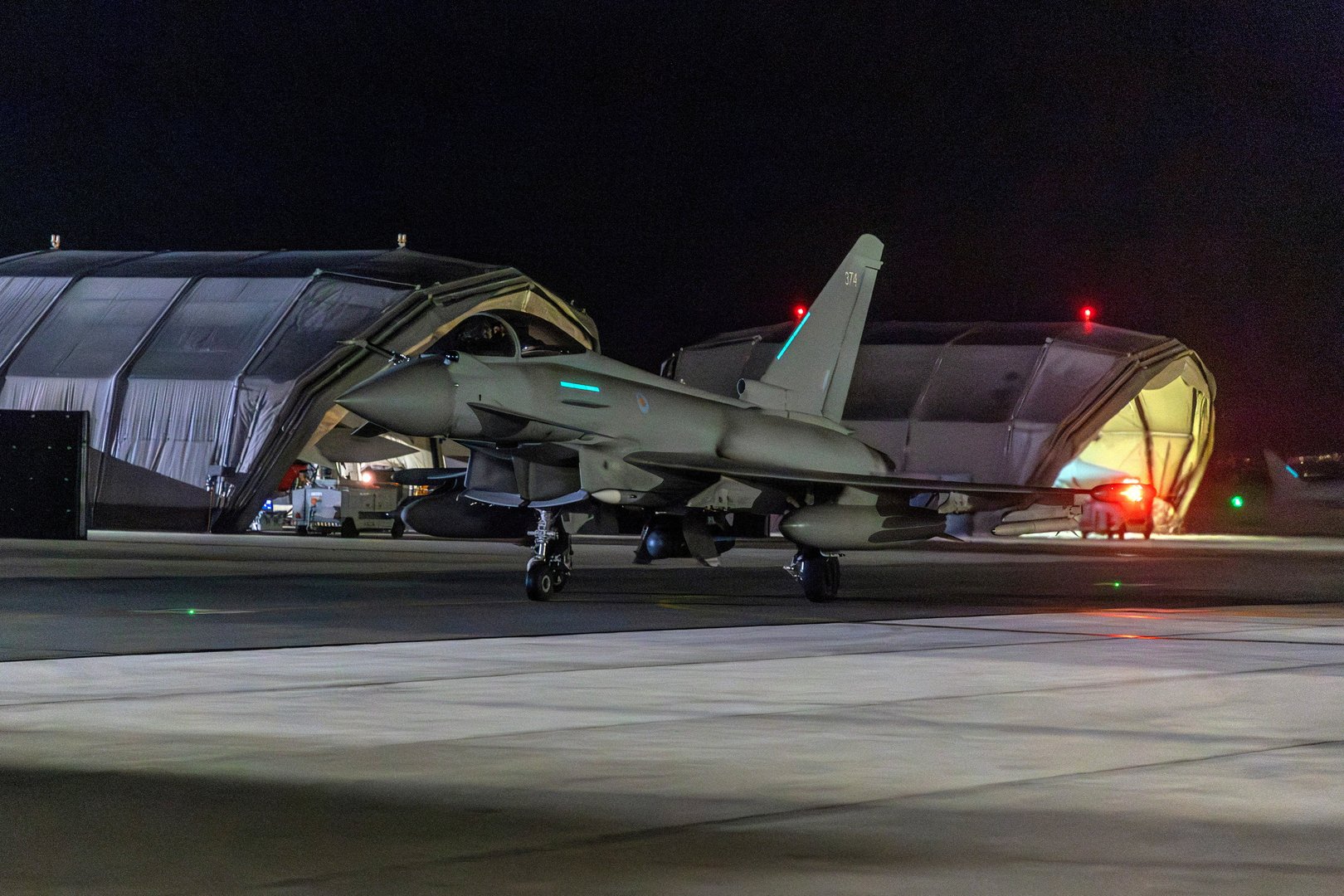
The United Kingdom’s Akrotiri air force base in Cyprus has been hit by a drone, the Cyprus Mail learned in the early hours of Monday morning.
Personnel on the bases were informed that a “small drone” had “impacted the airfield” and that the bases’ authorities were responding.
It was also confirmed that there were no casualties as a result of the strike, but that “minor damage” had been caused.
The bases’ authorities also instructed personnel to “remain in place and await further instruction”, warning that “there may be additional impact”, with the explosion and siren sounds having been heard in nearby Limassol.
Later, the UK’s government announced that British armed forces were “responding to a suspected drone strike” at the Akrotiri base.
“Our force protection in the region is at the highest level and the base has responded to defend our people. This is a live situation and further information will be provided in due course,” it said.
On this front, a British Royal Air Force Airbus KC2 Voyager aircraft spent three hours circling above the skies south of Cyprus in the early hours of Monday morning, and was still in the sky as of 3.30am.
Unconfirmed reports suggested that the drone which struck Cyprus may have been a Shahed 136 – a one-way attack drone which has been previously used both in Iranian strikes on Israel and by the Russian military during its war with Ukraine.
Earlier, the British bases had declared a “security threat” shortly before midnight.
Sources informed the Cyprus Mail that personnel at the base were told of the threat, and instructed to “return to your homes and stay inside until further notice”.
They were also told to “move away from windows and take cover behind or beneath substantial, solid furniture”, and to await further instruction.
The strike came a little over an hour after British Prime Minister Sir Keir Starmer had announced that he would allow the United States to use British military bases to “destroy [Iranian] missiles at source”, either in storage depots or in the “launchers which [are] used to fire the missiles”.
He had said that his government took this decision “to prevent Iran firing missiles across the region, killing innocent civilians, putting British lives at risk, and hitting countries that have not been involved”.
“The basis of our decision is the collective self-defence of longstanding friends and allies, and protecting British lives,” he said, before stressing that this decision had been taken “in accordance with international law”, and that the UK’s military itself is “not joining these strikes.
Earlier in the day, politicians in the United Kingdom and Cyprus had offered contradicting accounts regarding the question of whether or not Iranian missiles had been fired in the direction of Cyprus on Saturday night.
British Defence Secretary John Healey had on Sunday morning told television channel Sky News that “we had two missiles fired in the direction of Cyprus”.
“We don’t believe they were targeted at Cyprus, but nevertheless, it’s an example of how there is a very real and rising threat from a regime that is lashing out widely across the region, and that requires us to act,” he said.
However, later in the day, President Nikos Christodoulides, Turkish Cypriot leader Tufan Erhurman, Defence Minister Vasilis Palmas, and government spokesman Konstantinos Letymbiotis had all said this had not been the case.
Letymbiotis was the first to respond to Healey’s comments, saying that. “this is not the case and there is no indication whatsoever that the country was under threat”, while Palmas wrote on social media that he “categorically denies” that which Healey had asserted.
Christodoulides later said that he had held a telephone conversation with British Prime Minister Sir Keir Starmer, in which Starmer had “confirmed clearly and unequivocally that Cyprus was not a target”.
Meanwhile, Erhurman said that he had been informed that reports of missiles heading in the direction of Cyprus were false, and warned that “making statements without fully confirming any news at a time like this is extremely risky”.





Click here to change your cookie preferences